Carnegie Hero Saves Pilot: The Rescue of Lt. Andrew H. Doswell
They were not supposed to meet.
One man worked the land in southern Alabama—one of many children in a farming family, his name recorded only as R.C. Daniel on official forms, as if even the record-keepers never thought to ask for more.
The other came from Cleveland—Andrew Harrison Doswell, the son of a foundry worker, a young man, a track athlete, who could leap over a high bar with ease, his future stretching far beyond the city streets where he grew up.
Ten years apart and hundreds of miles between them. And yet—on one September day in 1943—their lives collided.
The Incident: Plane Crash at Tuskegee Army Airfield
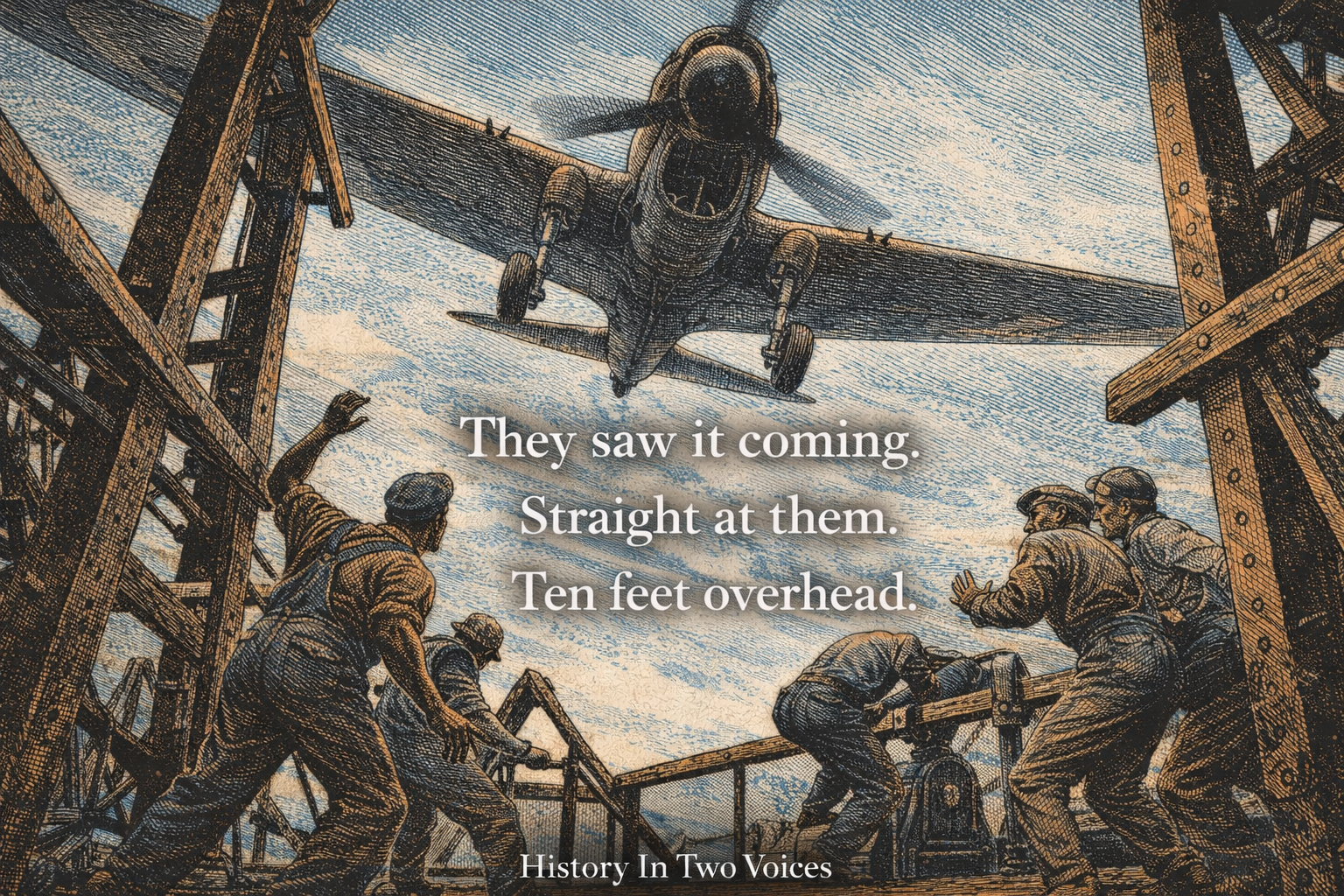
On September 22, 1943, Lt. Andrew H. Doswell, a fighter pilot trainee, was involved in a serious accident while coming in for a landing at the Tuskegee Army Airfield, Alabama. His P-40 fighter plane crashed into a steam-operated, pile-driver for a bridge under construction over the Unhapee Creek, adjacent to the training field. The impact caused the plane to fall “on the bank, with the nose three feet above the foot of a steeply sloping bank and the tail extending beyond the top.” Flames erupted from the motor, and the gasoline leaking from two tanks under the cockpit ignited, sending fire into the cockpit. Lt. Doswell was trapped inside as flames rose four feet from the fuselage.
Rescue Efforts by R.C. Daniel
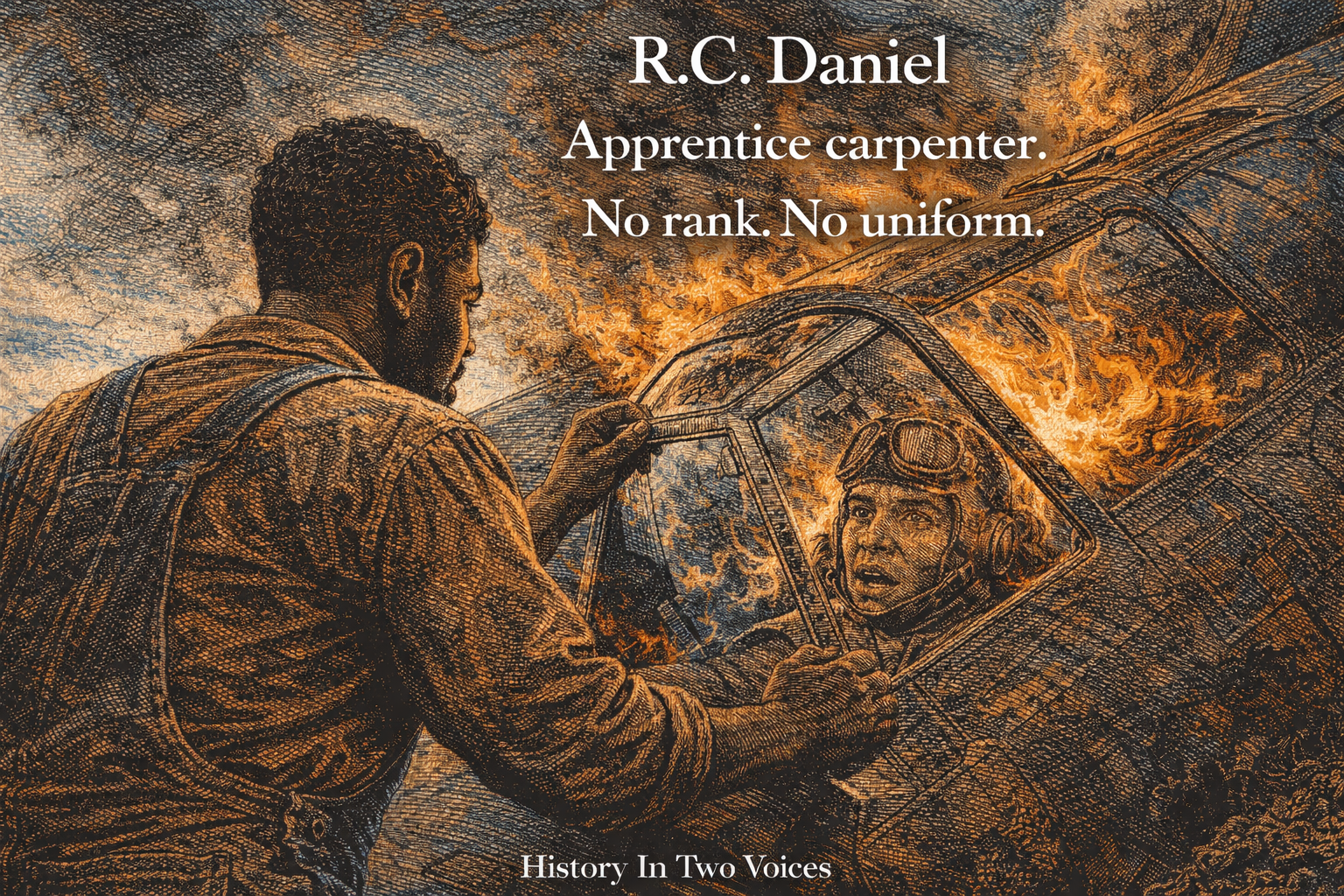
R.C. Daniel, an apprentice carpenter and civilian worker at the Tuskegee Army Airfield, witnessed the crash while working on the bridge construction site. Despite warnings from others that the plane could explode, Daniel acted decisively. He was the first on the scene and attempted to open the canopy of the burning plane. When his initial efforts failed, he grabbed a stick and then a six-foot piece of timber to pry at the jammed glass canopy. Persistent and courageous, Daniel managed to open the movable section and pull Lt. Doswell from the wreckage. As Doswell fell from the upended aircraft, a parachute strap snagged him inside the cockpit. Daniel quickly unfastened the harness chest strap, freed Doswell, and helped him away from the flames. “The fire was getting mighty hot and I could hardly breathe or see for the smoke, recalled Daniel” Although he was exposed to intense heat and smoke, Daniel escaped without burns, while Doswell suffered severe burns to his face and hands but was declared fully recovered at the base hospital later that week.
Recognition and Commendation
Maj. Gen. T.J. Hanley, Jr., commanding general of the Eastern Flying Training Command, officially commended R.C. Daniel for his heroic actions:
“On September 22, 1943, with complete disregard for your personal safety, you risked death to rescue a pilot trapped in a burning Army airplane which had crashed into a bridge under construction adjacent to the Tuskegee Army Airfield, where you are employed. Remaining at the plane, although your first efforts to extricate the trapped flier were unsuccessful, you continued to expose yourself until you had succeeded in freeing him and helping him to safety.
Your alertness and quick thinking in rescuing this pilot were in keeping with the best traditions of the American spirit of unselfish sacrifice. I therefore take pleasure in extending to you my official commendation for your display of courage. Sincerely yours, T.J. Hanley, Jr., Major General, U.S. Army.”
Colonel Neol F. Parrish, commanding officer of the Tuskegee Army Airfield, also praised Daniel for his heroic work saving Lt. Doswell’s life.
Carnegie Hero Fund Commission Award
On May 5, 1944, R.C. Daniel was awarded a Carnegie bronze medal for heroism, along with a financial reward of five hundred dollars. The award recognized Daniel’s bravery in saving Lt. Doswell from burning to death in the wrecked plane. Daniel revealed he planned to use the money to purchase the home he lived in and help educate his four minor children. The Carnegie Hero Fund Commission’s citation highlighted Daniel’s outstanding and heroic deed of bravery.
Personal Reflections
Asked about his reaction at the time of the crash, Daniel humbly admitted, “I was scared of course when the plane fell so near us, and at first, I thought of running to safety with all my fellow workers who cleared out fast.” He could hear the pilot crying for help, and he could not stand the thought of him burning to death. So, Daniel explained, “I just decided to help him, and you know the rest.” Daniel demonstrated remarkable courage and selflessness in the face of danger.
Significance
Lt. Doswell survived the ordeal and went on to recover from his injuries. The actions of R.C. Daniel stand as a testament to the bravery and heroism displayed by civilian workers during wartime emergencies.
If you’d like to learn more about or support the work of the Carnegie Hero Fund Commission, visit:
https://www.carnegiehero.org/about/mission/
Sources
Carnegie Hero Fund Commission https://www.carnegiehero.org/hero-search/r-c-daniel/
Alabama Journal, Montgomery, AL, October 4, 1943
Atlanta Daily World, November 5, 1943
Chicago Defender, May 20, 1944
Los Angeles Times, Aug 1, 1988
Cleveland Press, September 7, 1943
For R.C. Daniel, 1920 US Census, Shirley, Covington County, Alabama, Ancestry.com.
For R.C. Daniel, US WWII Draft Cards, 1940-47, Ancestry.com
For Andrew H. Doswell, 1920 US Census, Cleveland OH; 1950 US Census, Cleveland OH. Ancestry.com
For Andrew H. Doswell,US WWII Draft Cards, 1940-47. Ancestry.com
Image Citations
Slide 1 — Tuskegee Airmen (Inspiration)
Tuskegee Airmen group photograph, World War II.
Wikimedia Commons.
Leahy, Sharon. A plane came down over Tuskegee…and one man ran toward the fire.
Image concept and direction. AI-assisted illustration generated using digital tools, 2026.
Slide 2 — Andrew H. Doswell
“High Jumper Sprouts Wings,” Call and Post (Cleveland, OH), September 11, 1943.
Leahy, Sharon. Andrew H. Doswell: Ohio State high jumper turned Army pilot.
Image concept and direction. AI-assisted illustration generated using digital tools, 2026.
Slide 3 — Plane Approach (Scene Reconstruction)
Visual reconstruction based on contemporary newspaper accounts and Carnegie Hero Fund Commission report.
Leahy, Sharon. They saw it coming. Straight at them. Ten feet overhead.
Image concept and direction. AI-assisted illustration generated using digital tools, 2026.
Slide 4 — Crash and Fire
Visual reconstruction based on contemporary newspaper accounts and Carnegie Hero Fund Commission report.
Leahy, Sharon. It missed them—then struck the structure. Fuel ignited.
Image concept and direction. AI-assisted illustration generated using digital tools, 2026.
Slide 5 — The Decision
Visual reconstruction based on eyewitness account of R.C. Daniel.
Leahy, Sharon. The others ran. He heard the pilot cry out. He turned back.
Image concept and direction. AI-assisted illustration generated using digital tools, 2026.
Slide 6 — The Rescue
Visual reconstruction based on Carnegie Hero Fund Commission citation and newspaper accounts.
Leahy, Sharon. R.C. Daniel—Apprentice carpenter. No rank. No uniform.
Image concept and direction. AI-assisted illustration generated using digital tools, 2026.
Slide 7 — Outcome and Legacy
Carnegie Hero Fund Commission medal reference image.
Leahy, Sharon. Doswell lived. Daniel walked away. A Carnegie Medal followed.
Image concept and direction. AI-assisted illustration generated using digital tools, 2026.