Mother of Eight Risks Life in Brooklyn Subway Rescue, 1934
On a hot July afternoon in 1934, the Morgan Avenue subway platform in Brooklyn pulsed with ordinary city life—workers waiting, trains rumbling, no one expecting heroism.
Then a man collapsed.
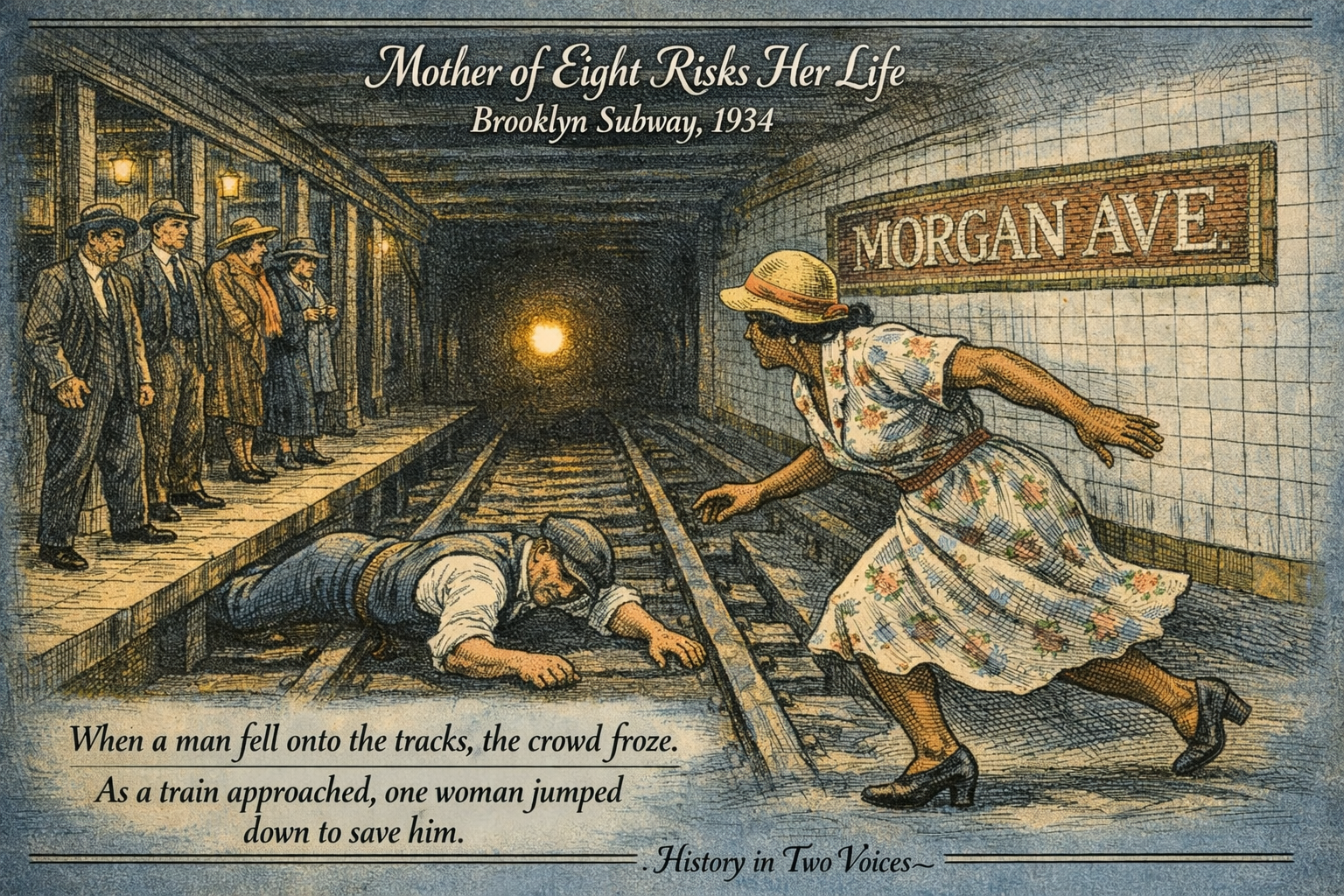
James McKeon, thirty-six years old, suddenly pitched forward from the platform and fell onto the tracks of the Brooklyn–Manhattan Transit line. The danger was immediate. A Canarsie-bound train was already approaching.
People froze.
One woman did not.
“Without a Moment’s Hesitation”
Rosena L. McKnight jumped down onto the tracks.
Newspapers across New York described the same scene: while others stood helplessly wondering what to do, McKnight acted. According to the Times Union of Brooklyn (July 19, 1934), she was the only person on the platform who instantly “jumped to the subway tracks” to try to save the unconscious man.
She attempted to lift McKeon, but he was too heavy. As the rumble of the oncoming train grew louder, Rosena made a split-second decision.
She ran.
Pulling a large white handkerchief from her purse, she raced down the tracks, waving it frantically toward the oncoming train. Motorman Harry Seidler saw her signal in time and brought his train to a sharp stop.
He leapt from the cab. Together, they lifted McKeon back onto the platform.
A life was saved.
A Hero Who Didn’t Linger
The Daily News (July 20, 1934) recorded what happened next with striking clarity.
Once it was determined that McKeon had suffered only cuts and bruises, Rosena “brushed the dirt from her dress, adjusted her hat, and wiped the perspiration from her brow with the same handkerchief she had used to stop the train.”
Then she boarded the subway.
She was headed to Canarsie.
“Being a hero didn’t ruffle her,” the paper observed.
Who Was Rosena McKnight?
Official records help us see the woman behind the headlines.
The 1930 U.S. Census places Rosena L. McKnight, age thirty-three, in Jamaica, Queens (District 1191), living with her husband, Warren McKnight, a forty-year-old building maintenance attendant, and their eight children. By their fourteenth-year of marriage, the couple had six sons—ranging in age from ten months to thirteen years old—and one daughter, age four.
Both Rosena and Warren were natives of Wilmington, North Carolina. The census recorded that they owned their home at 68 111th Street—and owned a radio.
Rosena McKnight died in January 1985.
A Note on the Record
Contemporary newspaper accounts consistently reported that Mrs. McKnight was the mother of ten children and spelled her name “Rosina.”
Census and federal records tell a slightly different story. The 1930 U.S. Census lists her as Rosena L. McKnight, mother of eight children, and the Social Security Death Index confirms the spelling Rosena. Such discrepancies were common in newspaper reporting of the era—particularly when working-class women briefly entered the public spotlight. Official records provide the more reliable account of Rosena McKnight’s life.
Why It Matters
Rosena McKnight did not wait for instructions, applause, or permission.
She had eight children at home, responsibilities that filled every corner of her life—and still, when a stranger’s life hung in the balance, she stepped forward while others hesitated.
Her story reminds us that heroism is often unadorned. It happens in work clothes. It uses whatever is at hand. And when it is finished, it boards the next train and disappears back into the city.
Sources
Times Union (Brooklyn, NY), July 19, 1934
Daily News (New York, NY), July 20, 1934
New York Age (New York, NY), July 28, 1934
U.S. Census, 1930, Queens District 1191 (Ancestry.com)
U.S. Social Security Death Index, 1935–2014 (Ancestry.com)
Images:
Slide 1–3 illustrations:
Images created by the author for History in Two Voices, inspired by contemporary newspaper accounts of the 1934 Brooklyn subway rescue involving Rosena McKnight. These images are interpretive reconstructions and do not depict an actual photograph of the event.
Morgan Avenue Station reference image:
Morgan Avenue subway station, Brooklyn, New York. Photograph, modern reference image used for historical context. Wikimedia Commons.
If you enjoyed this story, please stay connected. Complete the form below: