The Dress That Dressed the Nation: Mamie Eisenhower and Model #448
Inspired by Life Magazine, April 25, 1955.
In the spring of 1955, what should have been an ordinary Washington reception turned into a national fashion sensation.
At a Senate wives’ reception honoring First Lady Mamie Eisenhower, guests arrived in full mid-century elegance—gloves, pearls, mink capes. Among them was Mrs. Durries Crane.
She and the First Lady were wearing the same dress. Not merely similar - Identical.
The garment in question was Model #448, a full-skirted shirtwaist designed by New York designer Mollie Parnis, known for her high-end ready-to-wear collections sold in department stores nationwide. With its electric blue background and densely patterned emerald-green leaf motif, the dress featured a tightly fitted button-front bodice, shirt lapel, and sweeping skirt that fell fashionably well below the knee in the “New Look” silhouette that defined the decade.
What might have been an awkward social moment instead became front-page news.
Both women handled the coincidence with grace, complimenting one another. But newspapers delighted in the symmetry. Cameras captured the First Lady and Mrs. Crane standing side by side—two embodiments of postwar American polish, wrapped in identical silk taffeta.
And they were not alone.
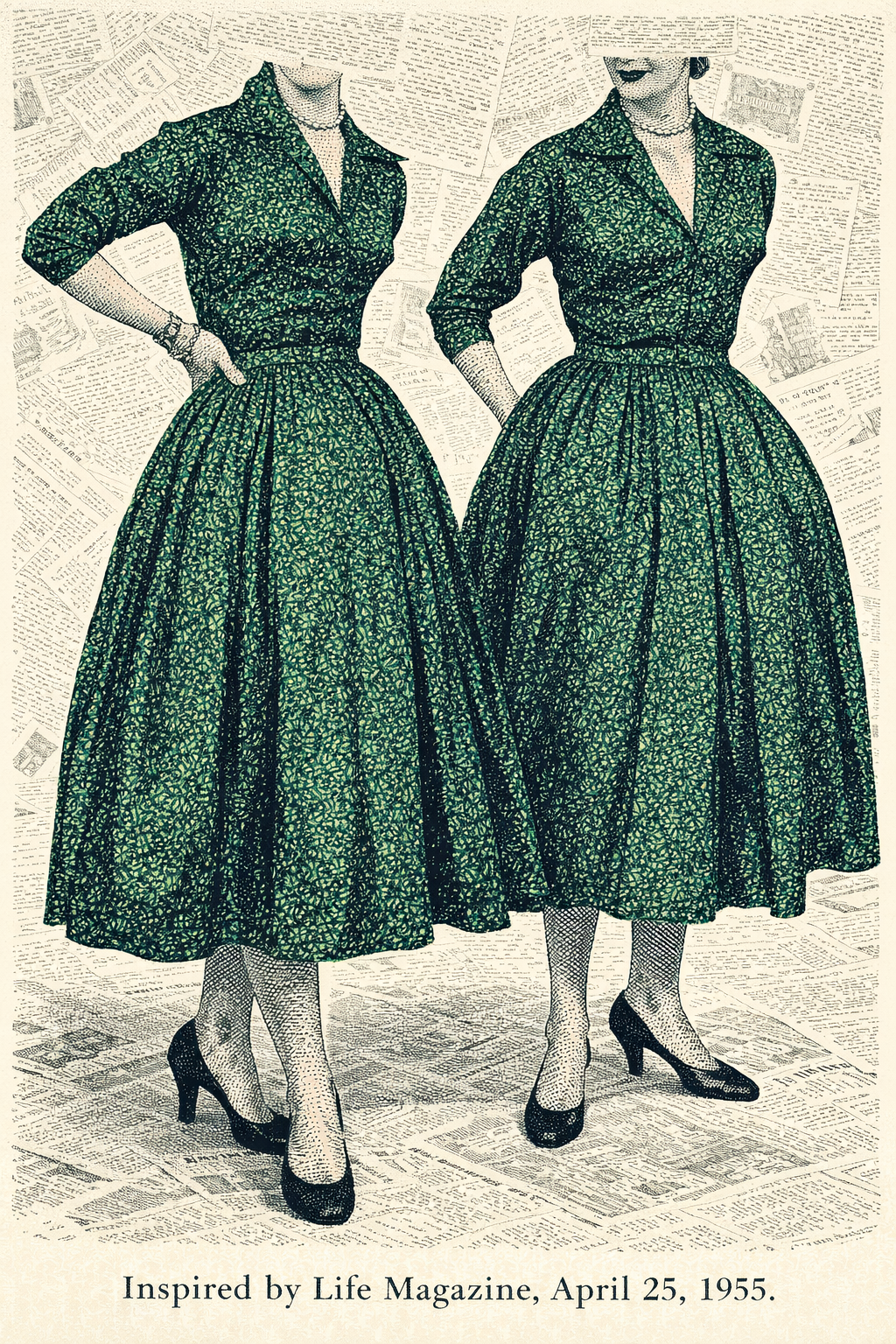
A Dress Goes National
Mollie Parnis had produced just 165 dresses from 1,000 yards of the distinctive fabric. Retailing for approximately $90—a significant investment in 1955—Model #448 was already “the most talked-of dress of the spring season,” according to Life Magazine.
Mrs. Eisenhower had ordered hers directly, requesting a small bow added at the neckline.
When Parnis learned of the double appearance at the reception, she reportedly exclaimed:
“I would like to drop dead.”
Yet the publicity only fueled demand.
Life documented women across the country proudly wearing their own versions of Model #448:
In Chicago, a young grandmother called it her “Mamie dress.”
In Seattle, a mother admired it as a rare splurge.
In Detroit, it debuted on Easter Sunday.
In New Orleans, several copies had already been sold locally.
In Los Angeles and Denver, women expressed pride that the First Lady wore American-made fashion.
Even a third guest at the reception, Mrs. Bulkley Griffin, owned the same dress. To everyone’s quiet relief, she selected something else for the occasion. Had she worn Model #448, the scene might have shifted from coincidence to spectacle.
Model #448 had done something remarkable.
It had democratized glamour.
The Media Moment
Life Magazine, April 25, 1955, devoted multiple pages to the phenomenon. Photographs showed women from suburbs to major cities modeling the same silhouette that graced the White House.
In an era before social media, this was viral.
A First Lady’s wardrobe choice—once a symbol of exclusivity—had been replicated across the nation. For many women, wearing Model #448 was not embarrassment. It was participation.
They were dressed like Mamie.
Our Perspective
The Model #448 episode reveals something larger than a fashion faux pas.
By the mid-1950s, American manufacturing, mass retail distribution, and glossy national media had reshaped the meaning of status. High fashion no longer belonged exclusively to elite salons or private dressmakers. A woman in Oregon or Louisiana could purchase the same design worn in Washington D.C.
Mamie Eisenhower’s popularity amplified the effect. Her approachable, polished image encouraged imitation. When women bought Model #448, they were not simply purchasing silk taffeta. They were buying into an ideal of mid-century American femininity—gracious, composed, patriotic, modern.
The “debacle” was not truly a scandal.
It was a signal.
It marked a moment when American glamour became national, not local.
And in that democratization, the First Lady became not distant—but relatable.
A Question for Our Readers
Did you—or your mother or grandmother—own a version of Model #448? Do any of these dresses survive in closets, trunks, or family photographs?
We would love to hear your story.
*** If you would like to hear more First Lady stories, pre-order our forthcoming biography: Presidentess: The Life of First Lady Julia Gardiner Tyler (Univ Press of Kansas, Sept 2026)
Image Citation:
Leahy, Sharon, using computer-assisted tools, inspired by Life Magazine, April 25, 1955, featuring Mamie Eisenhower in her iconic dress. Image courtesy of Wikimedia Commons (Black & White Photo of Mamie Eisenhower).