When an Actress Became First Lady
A White House Dinner, a Sudden Fainting Spell, and the Rise of Priscilla Cooper Tyler
One night in early May 1841, not long after he became president, John Tyler hosted a dinner party—the first of his administration—for the members of the cabinet. Washington had been in disarray since the untimely death of Tyler’s predecessor, William Henry Harrison, one month earlier, and the night’s festivities were meant to inaugurate the regular formal dinners expected of a president, as well as offer a return to the normal routine.
Ushered into the White House dining room, guests found a spectacular tableau. Candles set in front of mirrors brightened the room. Fine china combined with bouquets of fresh flowers created a beautiful table setting. As food and wine were served, pleasant and lighthearted conversation put everyone at ease, and laughter came easily. President Tyler had every reason to be pleased with the occasion.
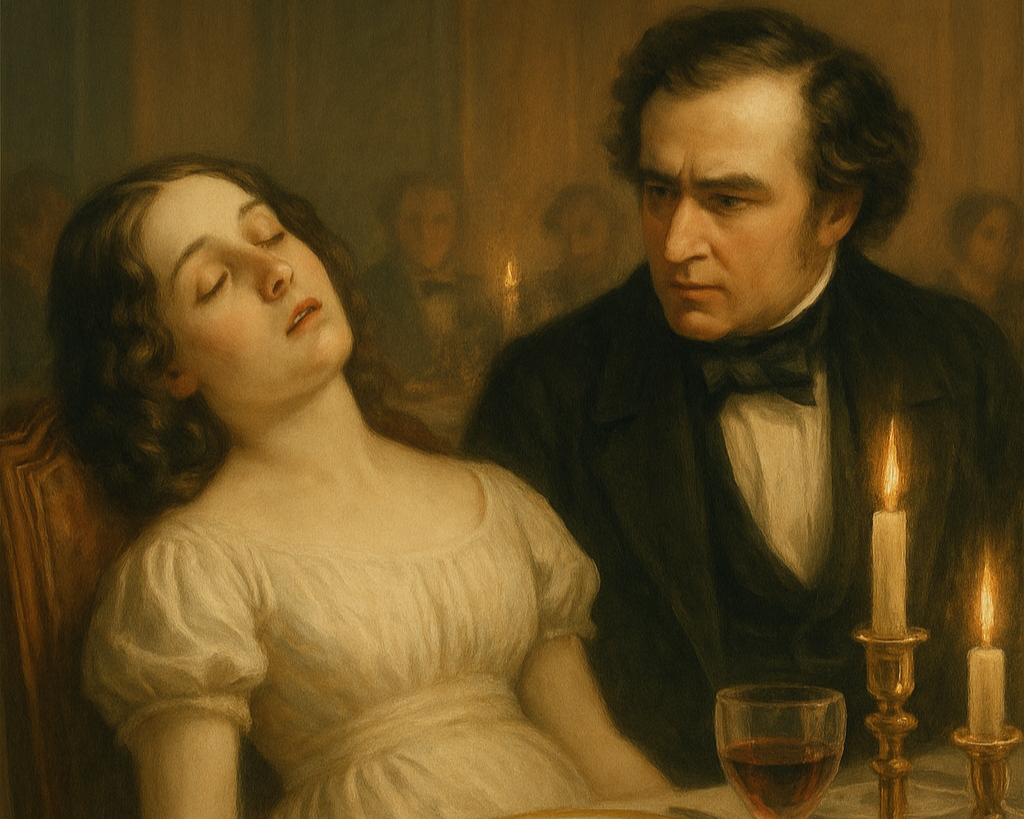
Everyone was enjoying the evening when, suddenly, Priscilla Cooper Tyler, the president’s daughter-in-law and the only woman present, felt lightheaded. “Just in the full tide of successful experiment,” she related later, “at the moment the ices were being put on the table, everybody in good humor, and all going ‘merry as a marriage bell,’ what should I do but grow deathly pale, and, for the first time in my life, fall back in a fainting fit.”
Luckily, Secretary of State Daniel Webster was sitting next to Priscilla. He caught her, gallantly picked her up in his arms, and quickly took her away from the table, heading for the door. Before he could exit the room, however, Robert Tyler, the president’s eldest son and Priscilla’s husband, rushed towards Webster and threw a pitcher of cold water at him, drenching his wife and the secretary. Horrified at her husband’s “impetuosity,” which may have been motivated more by jealousy than a desire to assist his stricken wife, Priscilla had to be taken dripping wet to her room, and “poor Mr. Webster had to be shaken off, dried and brushed, before he could resume his place at the table!” Priscilla feared she had “disgraced” herself with President Tyler “forever.”
She need not have worried. Happily for Priscilla, no other White House engagement during the Tyler administration had that kind of excitement. Not quite twenty-five years of age in the spring of 1841, Priscilla became official White House hostess, and in effect, acted as first lady (although that term was not yet in use), because President Tyler’s wife, Letitia, was too ill to fulfill the duties. The daughter of former stage star Thomas Cooper, and a Shakespearian actress herself, Priscilla played her greatest role as a surrogate White House hostess. She presided over numerous functions, including a widely acclaimed party honoring Charles Dickens and Washington Irving on March 15, 1842, as well as a levee one month later for Alexander Baring, Lord Ashburton, the British government’s emissary sent to the United States to negotiate what became the Webster-Ashburton Treaty.
Our Perspective
Years earlier, First Lady Dolley Madison had made social occasions an integral component of Washington politics, setting a standard that no president could afford to ignore. Priscilla Tyler’s willingness to take on the role of surrogate hostess attested to the importance of the White House social scene. Official Washington would not have accepted the excuse that Letitia Tyler was too ill to oversee White House social functions. The show had to go on, and Priscilla played her role to perfection, despite doing so while pregnant and raising a young family. She won over hypercritical Washington society and pleased many observers in an era when stage actresses did not enjoy social prestige. Most importantly, her efforts legitimized the embattled Tyler administration—and Tyler himself—both at home and abroad.
*** If you enjoy stories about the influence of First Ladies, explore more in our forthcoming biography Presidentess: The Life of First Lady Julia Gardiner Tyler, coming September 2026.
Source
Christopher J. Leahy, “Playing Her Greatest Role: Priscilla Cooper Tyler and the Politics of the White House Social Scene, 1841–1844.” Virginia Magazine of History and Biography 120, no. 3 (September 2012): 236–269.