Chief Justice Marshall’s Most Famous Supreme Court Decision
The Case: McCulloch v. Maryland
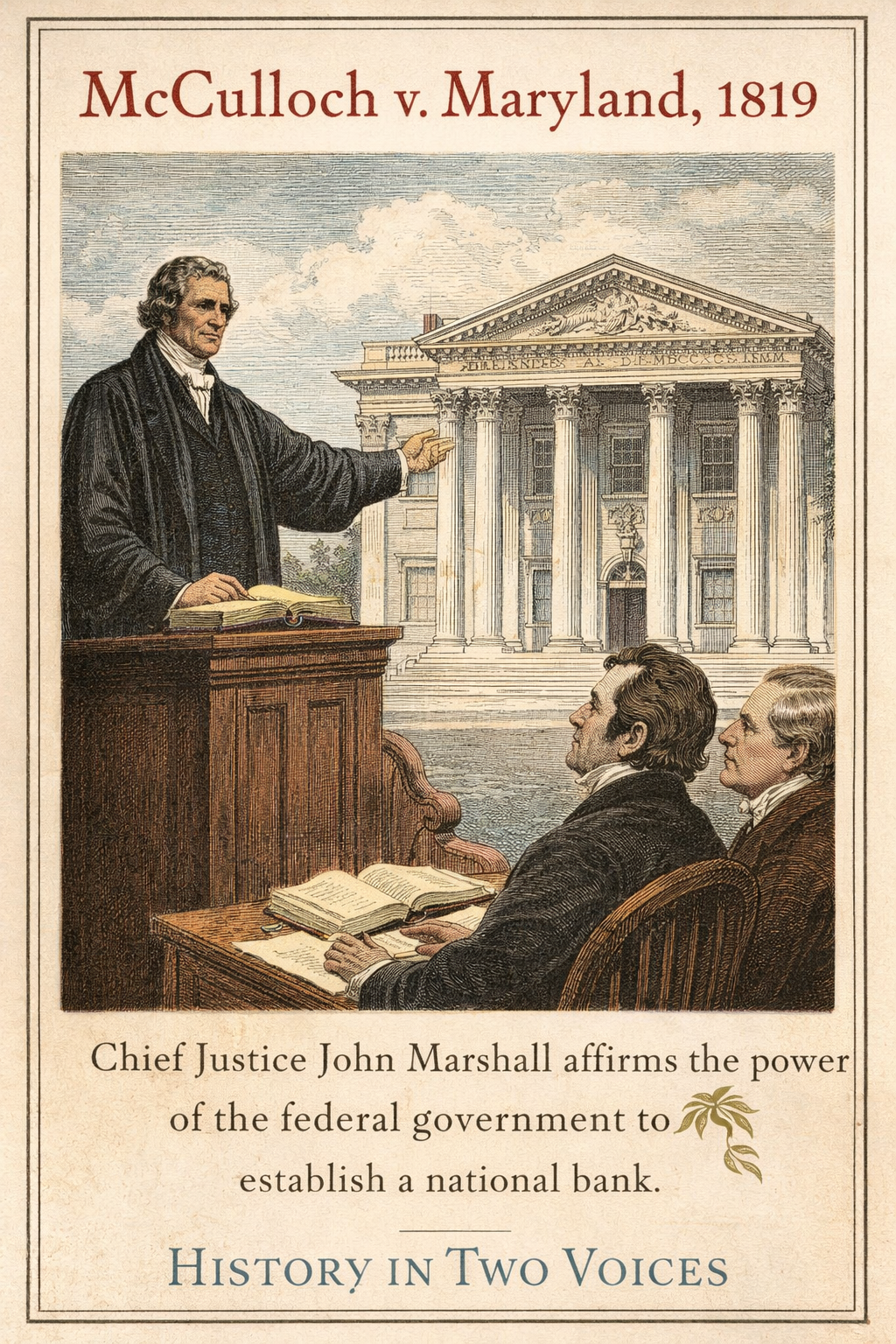
On March 6, 1819, U.S. Chief Justice John Marshall issued his ruling in the case McCulloch v. Maryland. The case arose from the creation of the Second Bank of the United States in 1816. While the first Bank had been denied re-charter in 1811, the nation’s fiscal struggles during the War of 1812 led Congress to recognize the value of a central banking system.
The Challenge to the Bank's Constitutionality
In 1818, the Maryland legislature passed a law imposing a substantial tax on the national bank, joining five other states in questioning both its constitutionality and its economic benefit. James McCulloch, the cashier of the Baltimore branch of the Bank of the United States, refused to pay the tax. The Baltimore County Court and the Maryland Court of Appeals ruled against McCulloch, upholding the law. The case was subsequently appealed to the U.S. Supreme Court.
Marshall's Unanimous Ruling
Writing for a unanimous (7-0) Court, Chief Justice Marshall affirmed the constitutionality of the national bank. He argued for a broad interpretation of the U.S. Constitution, focusing on the "necessary and proper" clause found in Article 1, Section 8. Marshall held that the clause "is placed among the powers of Congress, not among the limitations in those powers." In other words, it was an additional power granted to Congress, not a restriction on its authority.
Marshall further argued that the Supremacy Clause of Article VI meant that Maryland—or any state—did not have the power to tax an entity of the federal government. As he wrote, "The power to tax involves the power to destroy," and allowing Maryland to tax the national bank would, in effect, destroy it.
The Political Backlash
Marshall’s decision sparked fierce opposition from states’ rights proponents, who favored a strict interpretation of the Constitution. These critics, particularly in Virginia, argued that the ruling expanded federal power too far. The influential Richmond Enquirer newspaper published essays that attempted to dismantle Marshall’s argument. In response, Marshall anonymously defended the Court’s decision.
The Jacksonian Reaction
Opponents of the national bank ultimately gained traction during the presidency of Andrew Jackson. In the early 1830s, Jackson launched a "war" against the bank, successfully “killing” the institution he had long denounced as a "Monster" and a "tool of privilege."
Our Perspective
The McCulloch v. Maryland decision remains one of Chief Justice Marshall’s most significant contributions to the U.S. judicial system, solidifying the principle of federal supremacy. It justified an expansion of federal power that continues to influence constitutional law today. Some scholars, however, have questioned its legacy. David S. Schwartz, for example, argues that Marshall’s ruling has been interpreted differently over time, depending on political and legal contexts. While Marshall’s decision aimed to strengthen federal authority, it also reflected his balanced approach to constitutional interpretation, which his critics in 1819 failed to fully appreciate.
Sources:
Charles F. Hobson, ed., John Marshall: Writings. (New York: Library of America, 2010), pp. 412-436.
Richard E. Ellis, Aggressive Nationalism: McCulloch v. Maryland and the Foundation of Federal Authority in the Young Republic (New York: Oxford University Press, 2007).
David S. Schwartz, The Spirit of the Constitution: John Marshall and the 200-Year Odyssey of McCulloch v. Maryland (New York: Oxford University Press, 2019).
Image:
McCulloch v. Maryland, 1819.” Computer generated image, by History in Two Voices. Image derived from public domain sources of the First Bank of the United States and Chief Justice John Marshall.
Pre-order Presidentess: The Life of First Lady Julia Gardiner Tyler today and discover the remarkable story of America’s first presidential elopement!