The President Comes to Dinner: Thomas Jefferson Dines with the Tylers — Two Plum Puddings!
Jefferson’s Enduring Reputation
There was something about Thomas Jefferson that fascinated the presidents who succeeded him in the White House. John F. Kennedy once hosted a dinner for forty-nine former Nobel Prize winners, declaring in a toast that it was “the most extraordinary collection of talent, of human knowledge, that has ever been gathered together at the White House, with the possible exception of when Thomas Jefferson dined alone.” Ronald Reagan noted admiringly that “Thomas Jefferson remains one of the towering figures in American history; he was, first and foremost, a champion of individual liberty.” Bill Clinton, whose middle name honored Jefferson, once remarked that the nation’s third chief executive was “one of our greatest presidents and perhaps our most brilliant president.”
Clearly, all three of these men would have placed Thomas Jefferson at the top—or near the top—of a list of people with whom they would like to have dinner.
A Young John Tyler Meets Jefferson
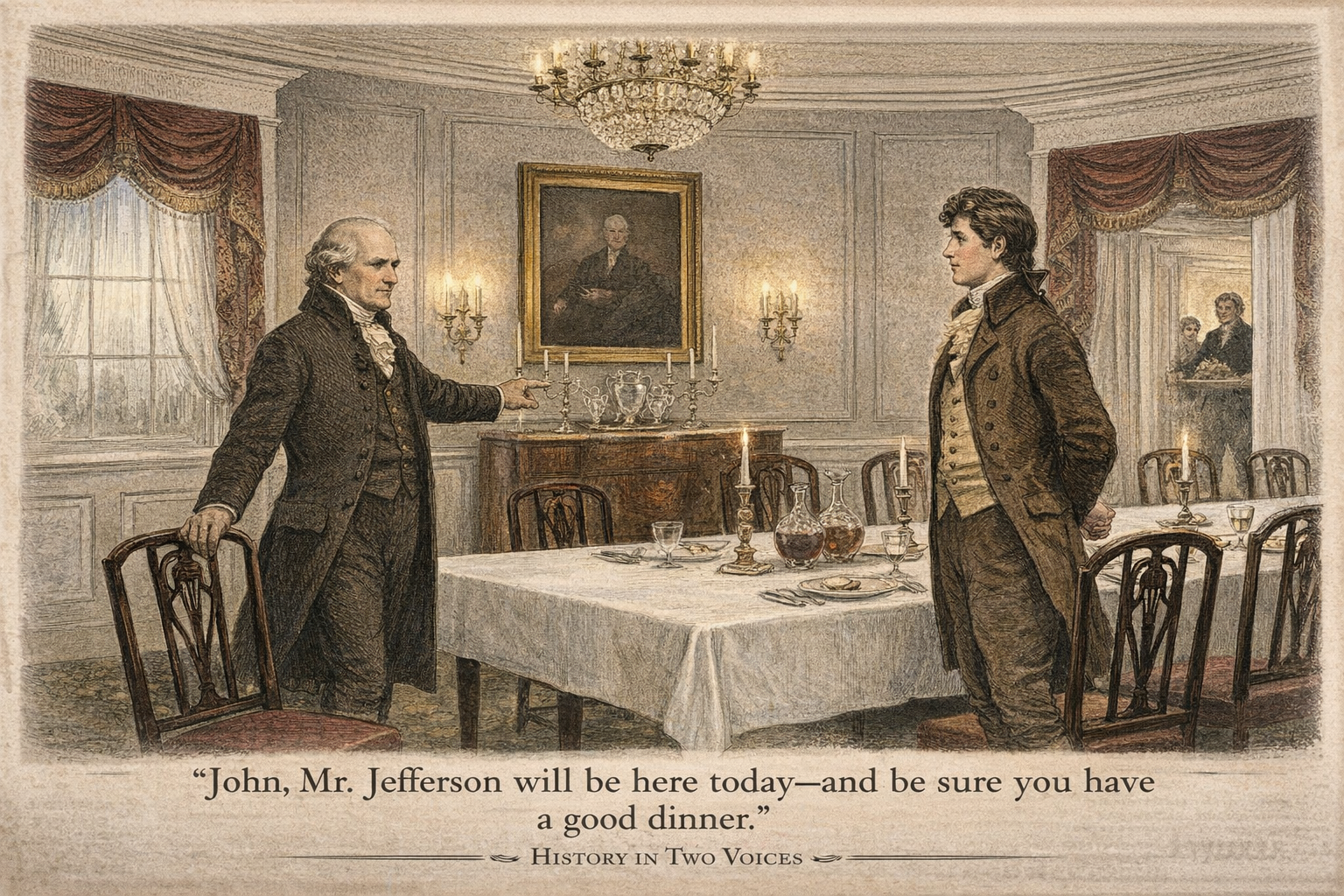
One of Jefferson’s successors actually did enjoy sharing dinner with him—and, in fact, planned the entire evening. Some thirty-two years before he himself took the oath of office, nineteen-year-old John Tyler spent an evening in Jefferson’s company.
The future tenth president’s father, Judge John Tyler, was elected governor of Virginia in 1808. One year into his term, he hosted Jefferson—now a private citizen living at Monticello—in Richmond. On Saturday, October 21, 1809, a group of the city’s most influential men feted Jefferson at the Eagle Tavern. The next night, Jefferson had dinner at the Governor’s Mansion. Governor Tyler placed his teenage son in charge of the meal.
“John, Mr. Jefferson will be here to-day, and be sure you have a good dinner,” he instructed on Sunday morning.
Dinner at the Governor’s Mansion
When Jefferson arrived at the mansion, young Tyler was awestruck. For most of the meal he sat with rapt attention as his father and Jefferson reminisced. The two men had been roommates for a time in Williamsburg as students at the College of William and Mary and seemed to have an endless supply of anecdotes about their younger days together. They became political allies as well, sharing the same reverence for the American Revolution and its republican principles.
Jefferson quizzed John Tyler—the future president—about his plans for a legal career. Having just been admitted to the Virginia bar (at nineteen!), the budding attorney was unsure how exactly he wanted to put his education to use. Judging from what transpired in the next few years, as Tyler won election to the Virginia legislature, Jefferson’s advice about how to parlay the practice of law into a political career hit its mark.
The Two Plum Puddings
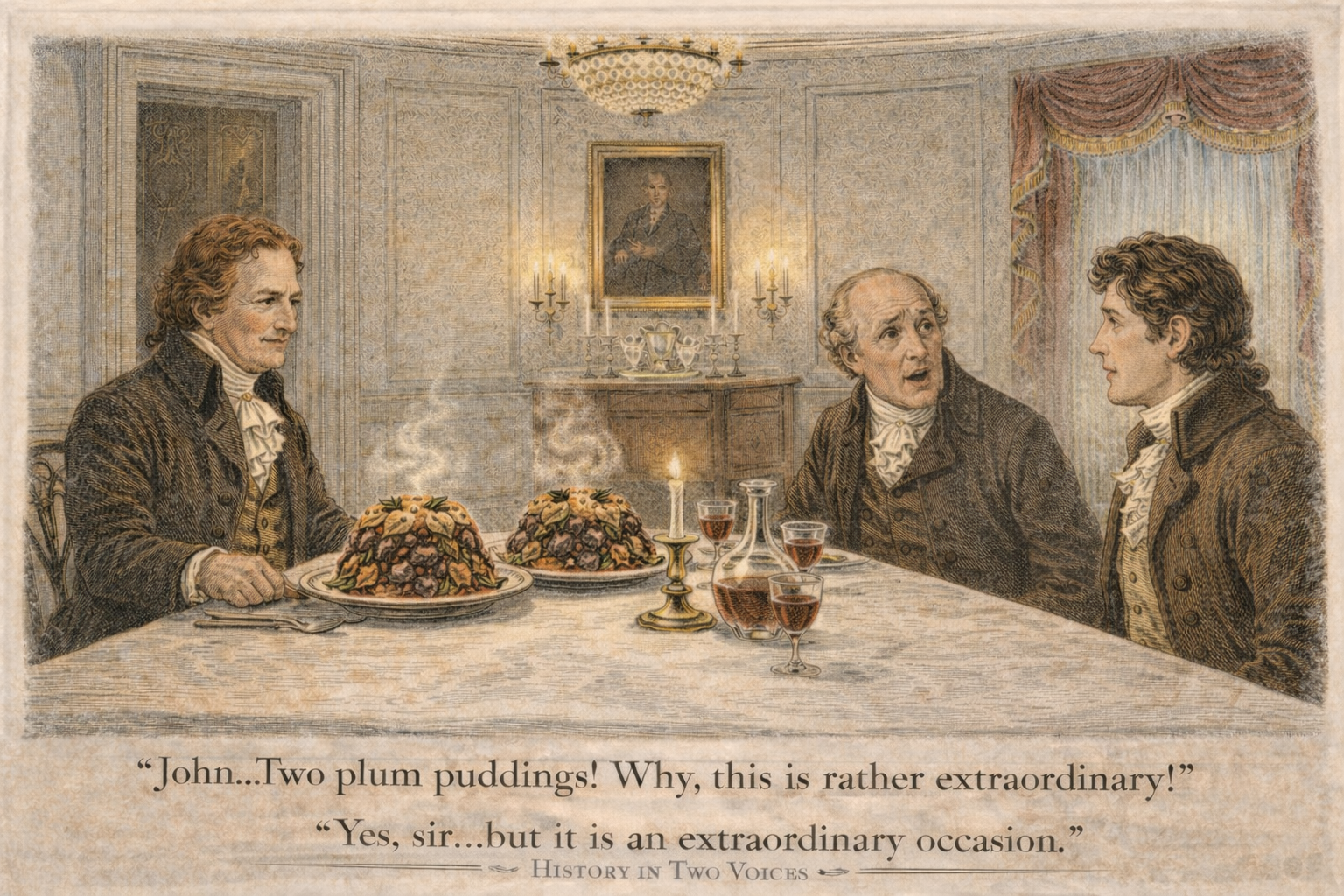
After the dishes from the main course had been cleared, Judge Tyler and Jefferson continued their discussion when suddenly the mansion’s butler threw open the doors and walked in with a piping hot dish of plum pudding. Right behind him was the cook, carrying another steaming bowl of plum pudding.
“Two plum puddings, John; two plum puddings!” the governor exclaimed. “Why, this is rather extraordinary!”
His son nodded and bowed toward Jefferson.
“Yes, sir,” he said, “it is extraordinary—but it is an extraordinary occasion.”
President Tyler’s son Lyon later summed up the significance of what had transpired that night in the Governor’s Mansion:
“In his old age, Mr. Tyler enjoyed telling this anecdote of his first meeting with Mr. Jefferson, and it is almost unnecessary to say that his love for plum-pudding continued as long as his admiration for the great statesman. Both were co-extensive with his life.”
Our Perspective
Moments like this remind us how closely connected the generations of the early American republic really were. Thomas Jefferson—the author of the Declaration of Independence—sat at dinner with a young man who would one day become the nation’s tenth president.
For John Tyler, the evening was more than a pleasant social memory. It represented a living link to the Revolutionary generation and the political ideals that shaped the young republic. Tyler would carry those influences with him throughout his own long public career.
The story also captures something personal and human about the world of early American politics. Great statesmen debated principles, but they also shared meals, traded stories from their youth, and occasionally celebrated a special guest with two plum puddings instead of one.
*** The story of John Tyler’s presidency - and the extraordinary First Lady who followed - continues in our forthcoming biography, Presidentess: The Life of First Lady Julia Gardiner Tyler
Sources
Lyon G. Tyler, Letters and Times of the Tylers, Vol. 1 (Richmond: Whittet and Shepperson, 1884), 228–230.
For context on later presidential reflections on Jefferson:
John F. Kennedy, remarks at a White House dinner honoring Nobel Prize winners, April 29, 1962.
Ronald Reagan, public remarks reflecting on the legacy of Thomas Jefferson, various addresses during his presidency.
Bill Clinton, remarks on Thomas Jefferson during public speeches and commemorations of Jefferson’s legacy.
Image Citations
Slide 1 – Governor John Tyler instructs his son before Jefferson’s arrival
Illustration inspired by the dining room of the Virginia Executive Mansion (Governor’s Mansion), Richmond, Virginia.
Architectural reference photograph courtesy of the Virginia Executive Mansion / Commonwealth of Virginia.
Slide 2 – Jefferson and Judge Tyler reminisce while young John Tyler listens
Illustration inspired by historical portraits of Thomas Jefferson and Judge John Tyler.
Jefferson portrait reference: Mather Brown, Thomas Jefferson, 1786. Smithsonian Institution, National Portrait Gallery.
Judge John Tyler portrait reference: Judge John Tyler, early nineteenth-century portrait reproduced in Lyon G. Tyler, Letters and Times of the Tylers, Vol. 1 (Richmond: Whittet and Shepperson, 1884).
Slide 3 – The extraordinary appearance of two plum puddings
Illustration inspired by early nineteenth-century depictions of Federal-era dining interiors and culinary service.
Architectural reference: Virginia Executive Mansion dining room, Richmond, Virginia.
Slide 4 – Jefferson and young John Tyler
Illustration inspired by period portraits of Thomas Jefferson and John Tyler.
Jefferson portrait reference: Mather Brown, Thomas Jefferson, 1786, National Portrait Gallery, Smithsonian Institution.