The Calamity Aboard the U.S.S. Princeton
Ice on the Potomac — and a Phantom Ship
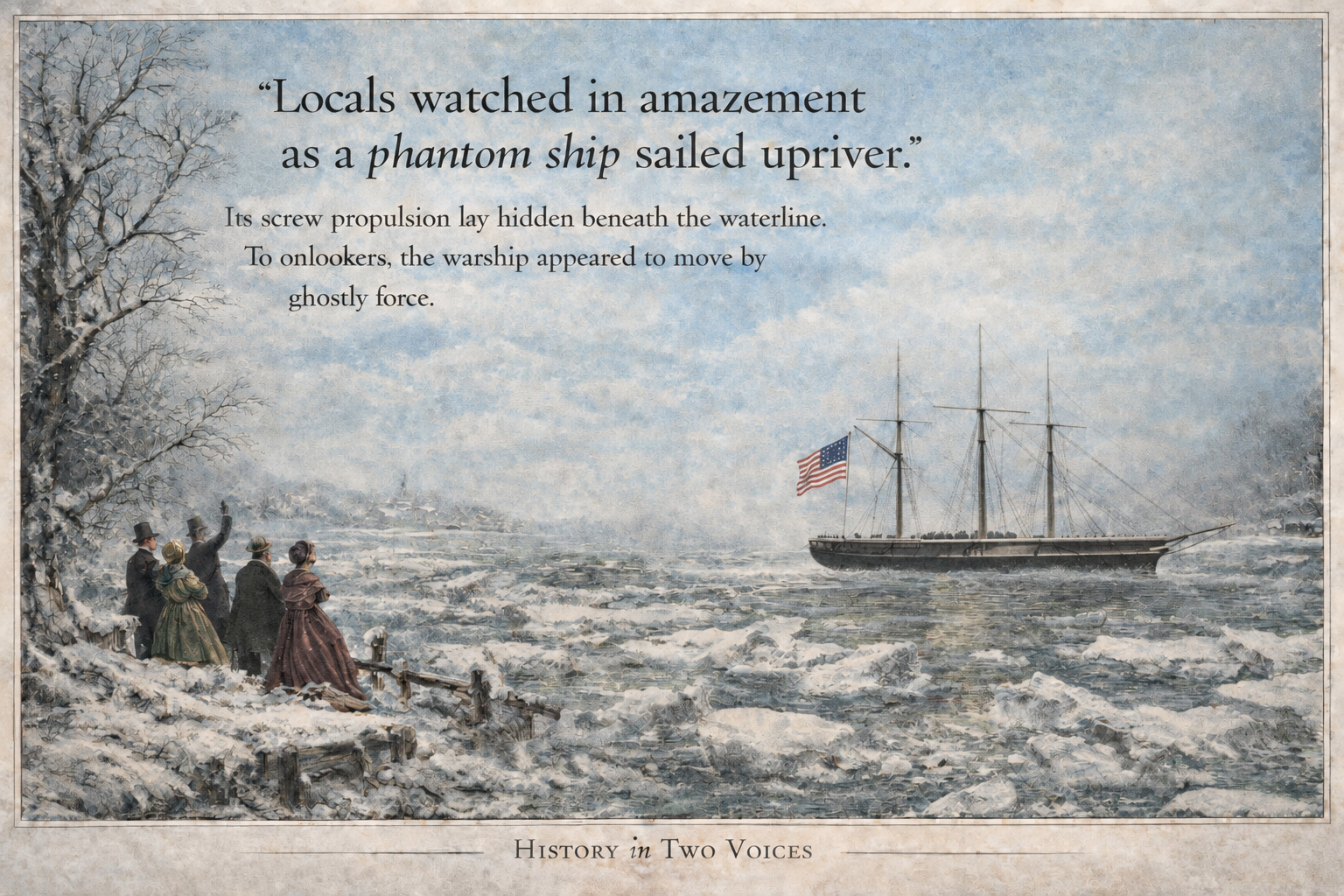
Ice reportedly nine inches thick on sections of the Potomac River near Washington brought watercraft to a standstill in early February 1844—except one vessel.
What appeared to be an unmanned U.S. Navy warship cruised through the river unimpeded, like a wind-powered, three-masted sailing vessel. Yet not a stitch of sail could be seen. No smoke billowed from the bowels of the ship. Onlookers along the riverbank wondered how the vessel navigated; some may have briefly speculated that they were witnessing a paranormal event.
What they heard, however, made them realize that what they were seeing was real. The “fairy phantom ship” plowed through the thick ice, “ripping, tearing, breaking, [and] crushing with irresistible power.”
Measuring 164 feet in length, the sloop of war’s propulsion demonstrated what one newspaper called a “new principle in steam machinery.” Instead of the paddlewheel typically mounted on the back of vessels of the day, this ship boasted:
a telescopic funnel
boilers burning anthracite coal to minimize smoke
a screw propeller positioned under the waterline, said to be “impervious” to enemy cannon fire
The star of President John Tyler’s navy and the brainchild of Captain Robert Stockton of the U.S. Navy and Swedish engineer John Ericsson, this brand-new instrument of war had been designed to announce America’s arrival as a power on the high seas. It was christened the U.S.S. Princeton.
Stockton skippered his pride and joy—named for his hometown in New Jersey—the distance from its berth in Philadelphia to Washington during the winter of 1844.
The “Peacemaker”
The Princeton’s two great cannons made her more than a match for any other ship in the world.
One of the great guns was called the Oregon. The other bore the name Peacemaker.
Weighing ten tons, the Peacemaker was described by one newspaper as a “glutton,” requiring thirty pounds of gunpowder to fire. It launched a 225-pound ball that could be hurled as far as two miles.
The Princeton sailed twice on the Potomac with members of Congress aboard. They were duly impressed. A third and final excursion was set for Wednesday, February 28, 1844.
A Day of Celebration
The night before, President Tyler entertained guests at a White House levee. Captain Stockton was feted. Former New York State Senator David Gardiner and his daughters, Julia and Margaret, were present. Spirits ran high.
Tyler wanted everything just right the next day for his latest attempt to impress the woman he hoped to marry—Julia Gardiner.
The weather cooperated. By mid-morning, bright sunshine, blue skies, and unseasonably mild temperatures beckoned guests to the water. At eleven o’clock, David Gardiner escorted his daughters to the wharf designated as the pick-up point. They boarded a chartered steamboat that would convey nearly four hundred invited guests—dressed in their “very best”—to the Princeton, anchored approximately six miles down the Potomac opposite Alexandria.
Among those present were former first lady Dolley Madison, Priscilla Tyler, John Tyler Jr., senators, members of Congress, and other prominent guests.
When all were aboard, the Princeton’s engines moved into motion. Soon the ship arrived at a spot across from George Washington’s Mount Vernon. While the band played “Washington’s March” and “Hail to the Chief,” the cannoneers readied the Peacemaker.
Partygoers were warned to keep their mouths open and place their hands over their ears to lessen the effect of the gun’s percussion.
Julia, Margaret, their father, and President Tyler crowded around the cannon. They were “exhilarated” at the deafening report and the sight of the cannonball skipping across the river.
With the demonstration complete, Stockton invited the guests to luncheon in the main cabin below decks.
The Final Firing
Some guests finished quickly and returned topside to witness a second firing of the Peacemaker.
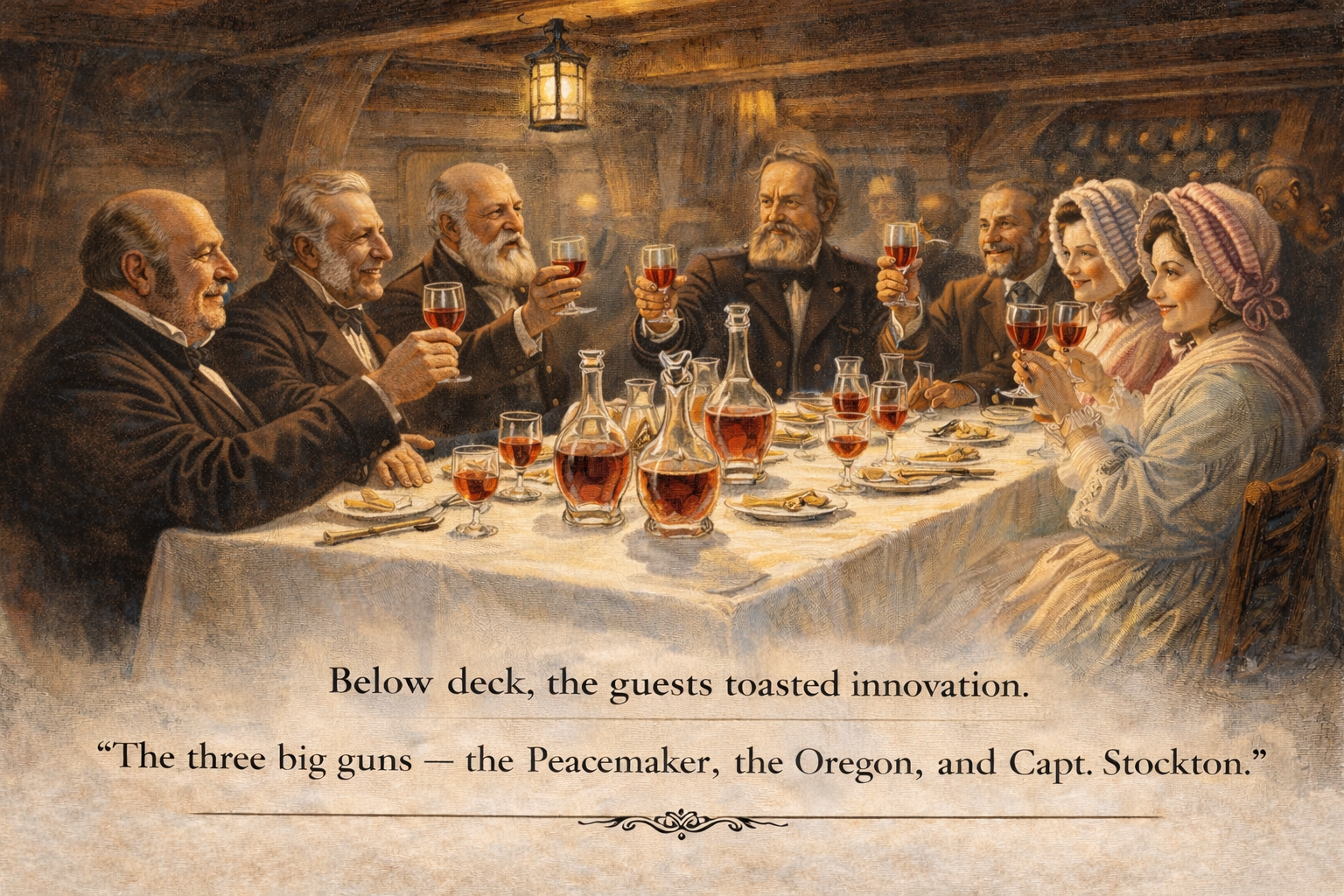
Below deck, the president was encouraged to toast the occasion. He proclaimed:
“The three big guns – the Peacemaker, the Oregon, and Capt. Stockton.”
Three cheers followed. Several additional toasts were given.
Amid the revelry, a midshipman informed Stockton that the cannon was loaded and ready for a third firing. President Tyler wished to witness it. He excused himself and rose from the table, leaving Julia and Margaret conversing with Mrs. Madison and Stockton’s son.
David Gardiner rose with the president, and the two men began ascending the stairs.
Tyler reached the middle of the staircase just as he heard his son-in-law, William Waller, begin singing an old Virginia tune. The melody prompted the president to stop and return to the cabin to hear Waller finish his impromptu performance.
Fortunately, most guests followed Tyler’s example and remained below deck.
Roughly one hundred guests stayed above to view the final firing.
David Gardiner, Treasury Secretary Thomas W. Gilmer, Secretary of State Abel Upshur, Commodore Beverly Kennon, and Virgil Maxcy stood about fifteen paces from the left side of the great gun. The Peacemaker was aimed toward the Virginia shore. Stockton stood directly behind it.
Below deck, the guests heard the boom.
Seconds later, a midshipman emerged, “blackened” with gunpowder, calling loudly for a surgeon.
The great gun had burst.
Carnage on the Deck
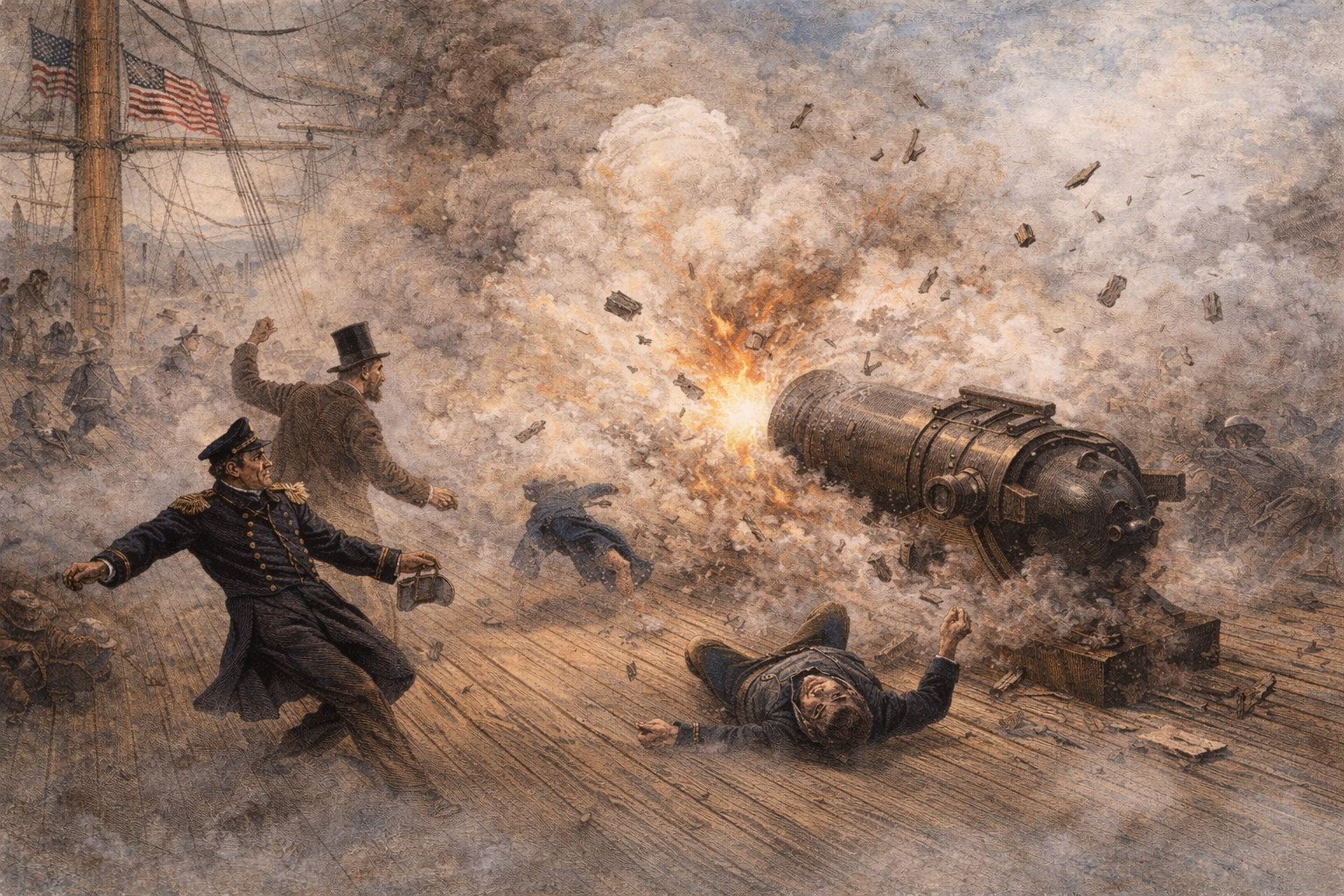
The scene on the deck of the Princeton was devastation.
Black smoke enveloped the area. Every person in proximity to the gun lay “prostrate” on the deck. Some thirty to forty men lay in heaps—wounded or dead.
Gilmer lay on his back, a fragment of the gun having crushed his legs. He was turned slightly to his right side, his “mouth open” as if gasping for breath.
Secretary Upshur lay dead across Gilmer’s left arm, his right hand touching David Gardiner’s chest.
Minutes later, Gardiner and Gilmer were dead.
Commodore Kennon was killed, “mangled in the most dreadful manner—his breast was completely mashed in; both legs and both arms were broken in several places.”
Virgil Maxcy was killed instantly, as was President Tyler’s twenty-three-year-old manservant.
The wounded were taken below deck as the Princeton continued to Alexandria. There, the chartered steamboat came alongside, and the remaining passengers and most of the wounded were ferried back to Washington.
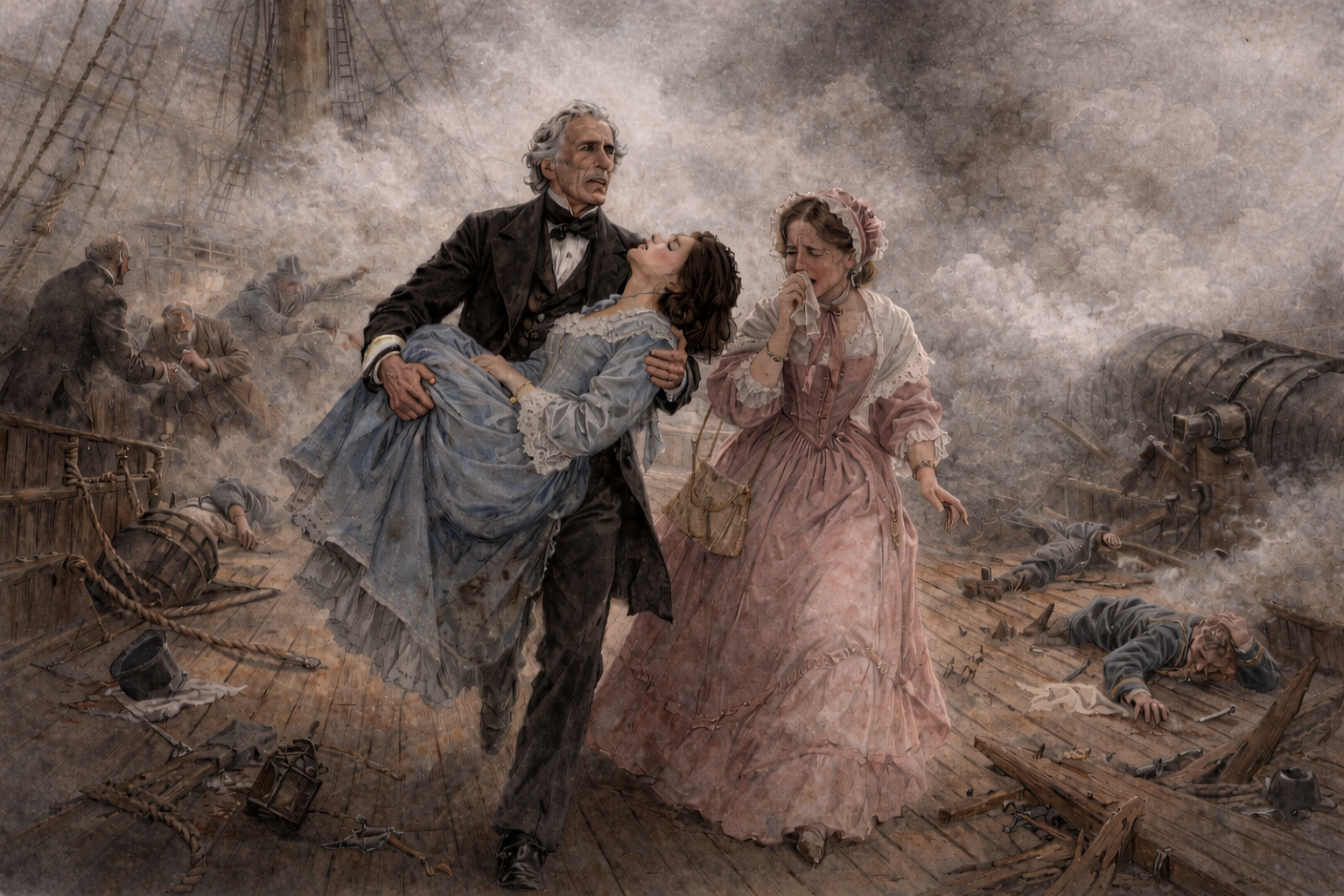
President Tyler carried Julia, who had fainted, away from the carnage. At the president’s insistence, the Gardiner sisters were taken to the White House.
All aboard knew they had witnessed a tragedy they would never forget. The next day, six coffins lined the deck of the Princeton waiting to be taken to lie in state in the East Room of the White House.
Our Perspective
The Princeton explosion changed the course of history.
President Tyler replaced Secretary of State Abel Upshur with John C. Calhoun. Calhoun’s handling of Texas annexation hardened sectional tensions and tied the issue more directly to slavery. Ultimately, Tyler employed a joint resolution of Congress to annex Texas—an act that pushed the nation further down the road toward the Civil War.
On a more personal level, the tragedy altered Julia Gardiner’s life. Her father’s death, and Tyler’s steadfast care for her in the aftermath, prompted her to accept his proposal of marriage.
In June 1844, Julia became first lady—the first wife of a president to serve as White House hostess since Louisa Catherine Adams in 1829.
** This event is covered in our forthcoming biography, Presidentess: The Life of First Lady Julia Gardiner Tyler, (Univ Press of Kansas, Sept 29) Use 24LADYJULIA at checkout for 30% off.
Sources
New York Herald, February 16, 1844
“The Steamer Princeton,” New York Evening Post, January 19, 1844
“Progress of Steam Navigation,” New York Herald, October 19, 1843
Lee M. Pearson, “The ‘Princeton’ and the ‘Peacemaker’: A Study in Nineteenth-Century Naval Research and Development Procedures,” Technology and Culture 7 (Spring 1966): 163-183
Washington Whig Standard, February 24, 29, 1844
New York Tribune, February 13, 1844
Baltimore Sun, February 23, 1844
New York Herald, February 19, 1844
“Captain Stockton’s Piece of Ordnance,” New York Herald, August 1, 1843
“Further Particulars of the Deplorable Accident,” Philadelphia Public Ledger, March 2, 1844
Alexandra Gazette, October 30, 1888
New York Evening Post, March 1, 1844
Baltimore Sun, March 2, 1844
“The Accident on Board the U.S. Steamer “Princeton";” The Accident on Board the U.S. Steamer "Princeton" | Pennsylvania History: A Journal of Mid-Atlantic Studies (psu.edu)
Images
Slide 1 — USS Princeton
Leahy, Sharon. USS Princeton on the Potomac in Winter. Image concept and direction. AI-assisted illustration generated using digital tools, 2026.
Source inspiration: USS Princeton, 1843. Engraving. Wikimedia Commons.
Slide 2 — Robert F. Stockton
Leahy, Sharon. Robert F. Stockton (Profile Portrait). Image concept and direction. AI-assisted illustration generated using digital tools, 2026.
Source inspiration: Portrait of Robert F. Stockton. Engraving. Wikimedia Commons.
Slide 2 — John Ericsson
Leahy, Sharon. John Ericsson (Profile Portrait). Image concept and direction. AI-assisted illustration generated using digital tools, 2026.
Source inspiration: Portrait of John Ericsson. Wikimedia Commons.
Engineering description drawn from:
Lee M. Pearson, “The ‘Princeton’ and the ‘Peacemaker’: A Study in Nineteenth-Century Naval Research and Development Procedures,” Technology and Culture 7 (Spring 1966): 163–183.
Slides 3–5, 7, and 8 — Narrative Scene Reconstructions
Leahy, Sharon. Scenes from the USS Princeton Excursion and Aftermath. Image concept and direction. AI-assisted illustration generated using digital tools, 2026.
Historical framing informed by:
“The Accident on Board the U.S. Steamer ‘Princeton,’” Pennsylvania History: A Journal of Mid-Atlantic Studies (Penn State University Press).
Slide 6 — Explosion of the Peacemaker
Leahy, Sharon. Explosion of the “Peacemaker” Gun. Image concept and direction. AI-assisted illustration generated using digital tools, 2026.
Source inspiration: Currier & Ives, Awful Explosion of the “Peace-Maker” on Board the U.S. Steam Frigate Princeton, 1844. Library of Congress / Wikimedia Commons.
Peacemaker / Great Gun Identification
Identification of the surviving Great Gun supported by:
“The Princeton and the Peacemaker,” U.S. Naval Institute Proceedings, June 2013.
https://www.usni.org/magazines/proceedings/2013/june/princeton-and-peacemaker