Mamie’s Gift to a Queen: How a First Lady Elevated American Porcelain
In 1957, the White House prepared for a visit that would showcase not only American diplomacy but also American artistry. Queen Elizabeth II and Prince Philip were coming to the United States, and First Lady Mamie Eisenhower wanted a state gift that would stand out—a mark of both elegance and innovation [Leahy, 2026].
Choosing a Truly American Gift
Mamie Eisenhower had experience with thoughtful, personalized gifts. In 1954, she presented Queen Elizabeth’s mother with a custom “Crown Cup” crafted by Steuben Glass of Corning, New York [London Daily Telegraph, 1954]. For the young Queen’s inaugural visit, Mamie turned to a rising talent in American porcelain: Edward and Helen Boehm (pronounced “Beam”) of New Jersey.
By selecting the Boehms, Mamie highlighted an American studio whose work could rival the finest European and Asian porcelain manufacturers. It was a deliberate choice to place the United States on the international stage as a producer of exceptional fine art [Leahy, 2026; Boehm & Dunn, 1985].
The Boehms: Talent Meets Opportunity
Edward Boehm, a devoted artist who preferred sculpting animals to people, had recently begun working in hard-paste porcelain—a medium almost exclusively dominated by European makers[Palley, 1988]. His wife, Helen, combined business savvy with a sharp eye for opportunity. She had previously secured recognition for Edward’s work at the Metropolitan Museum of Art, and her determination ensured that Ed’s porcelain artistry gained national attention [Leahy, 2026].
Their partnership mirrored Mamie Eisenhower’s own skillful balance of social grace and strategic foresight. Helen handled the business side, while Ed focused on perfecting his craft—just as Mamie had guided Ike early in their marriage. This dynamic would be critical in meeting the high expectations of a state commission[Boehm & Dunn, 1985].
Crafting the Polo Player Sculpture
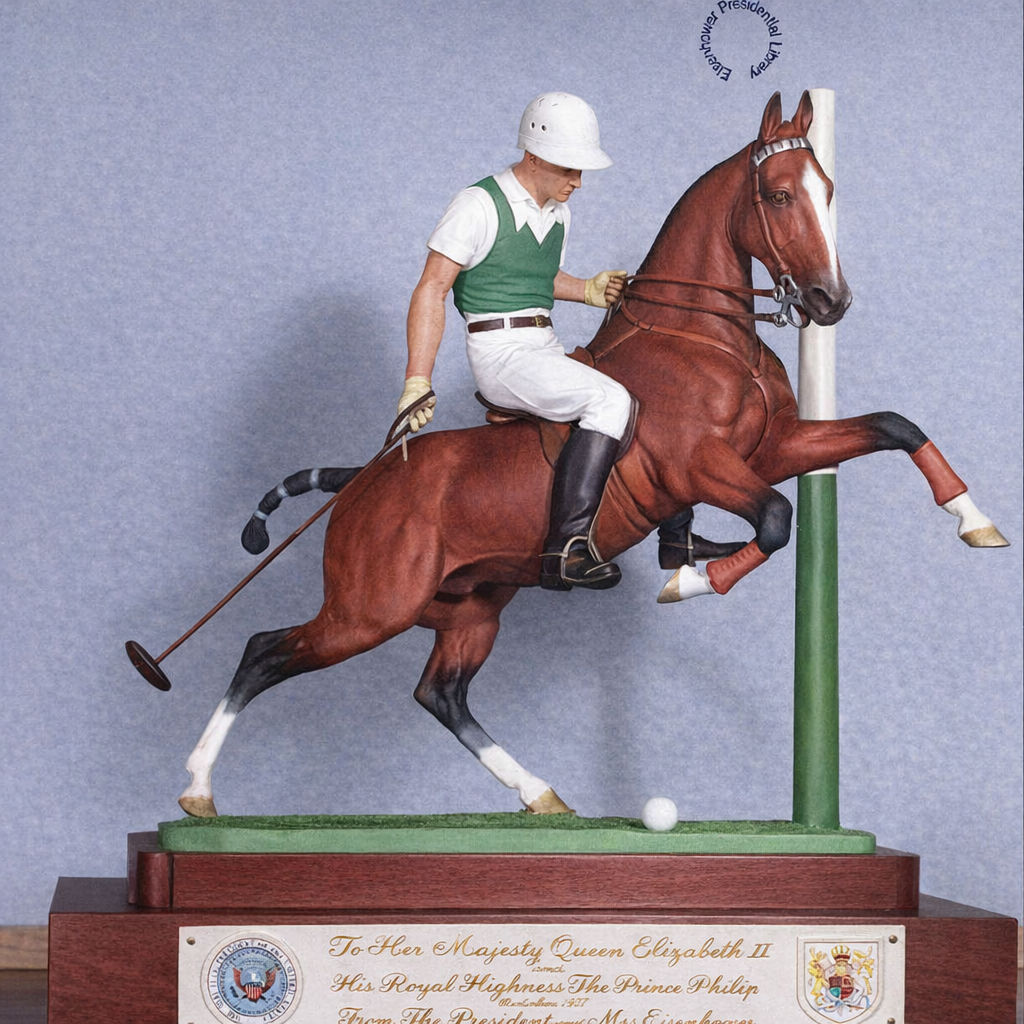
For the royal visit, the Boehms suggested creating a sculpture capturing Prince Philip’s love of polo. The piece was an ambitious undertaking:
268 interlocking porcelain parts were reduced to twenty-five principal molds.
Fired at 2,500°F, carefully cooled, and painted to achieve lifelike realism.
Mounted on a double-tiered polished wood base with plaques bearing the Royal Coat of Arms and the U.S. Presidential Seal.
An inscription read: “To Her Majesty Queen Elizabeth II and His Royal Highness the Prince Philip, October 1957, from President and Mrs. Eisenhower.”
For the First Lady, the ambitious sculpture was a gamble. Mamie approved the details, ensuring the final gift was both beautiful and meaningful [Hackensack Record, 1957].
A Presidential Endorsement and a Global Impact
When Edward Boehm’s “Polo Player” was presented on October 18, 1957, it immediately made headlines. The sculpture’s image appeared above the fold in the New York Daily News, and Helen showcased a studio replica on NBC’s Today Show [New York Daily News, 1989]. The gift propelled Boehm porcelain into the international spotlight, establishing the United States as a leader in fine porcelain art.
Mamie’s discerning eye and personal touch didn’t just result in a memorable gift; it also created opportunities for future presidential commissions. The Boehms would go on to create sculptures for John F. Kennedy, Richard Nixon, and other heads of state, leaving a lasting legacy in American art [Leahy, 2026; Palley, 1988].
Why It Matters
Mamie Eisenhower’s commission illustrates the subtle power of a First Lady in promoting American culture. By recognizing talent, supporting a small but ambitious studio, and carefully selecting a gift that reflected both elegance and innovation, Mamie elevated American craftsmanship on the world stage.
Her actions demonstrate that diplomacy is not only about policy—it can also be about cultural leadership, fostering creativity, and shining a light on emerging American talent. Through her choice, Mamie quietly put the United States on the global porcelain map and created a legacy of artistic patronage that endures to this day[Leahy, 2026].
For more in-depth research on this topic, read Sharon’s full article, “Housepower: Mamie Eisenhower’s Hidden Hand Partnerships,” published in the Journal of First Ladies Studies. Click below:
Image Citations:
Edward Marshall Boehm, Polo Porcelain Sculpture, gift from President and Mrs. Dwight D. Eisenhower to Queen Elizabeth II and Prince Philip, October 1957. Courtesy of Dwight D. Eisenhower Presidential Library【Leahy, 2026】.
Leahy, Sharon. Image concept and direction. AI-assisted illustration generated using digital tools, 2026. Inspired by photograph of Edward Marshall Boehm sketching a polo player, Dwight D. Eisenhower Presidential Library.
Leahy, Sharon. Image concept and direction. AI-assisted illustration generated using digital tools, 2026. Inspired by photograph of Edward Marshall Boehm examining the completed polo sculpture, Dwight D. Eisenhower Presidential Library.
Leahy, Sharon. Image concept and direction. AI-assisted illustration generated using digital tools, 2026. Inspired by White House state dinner presentation of the Boehm sculpture to Queen Elizabeth II and Prince Philip, 1957.
Leahy, Sharon. Image concept and direction. AI-assisted illustration generated using digital tools, 2026. Inspired by photograph of Edward and Helen Boehm reading a 1957 newspaper featuring the polo player sculpture, Dwight D. Eisenhower Presidential Library.
Leahy, Sharon. Image concept and direction. AI-assisted illustration generated using digital tools, 2026. Inspired by photograph of Helen Boehm presenting the replica sculpture on NBC’s Today Show, 1957.