Mapping the Memories of First Ladies: Lucretia Garfield
Lucretia Garfield: A Life in Mentor, Ohio
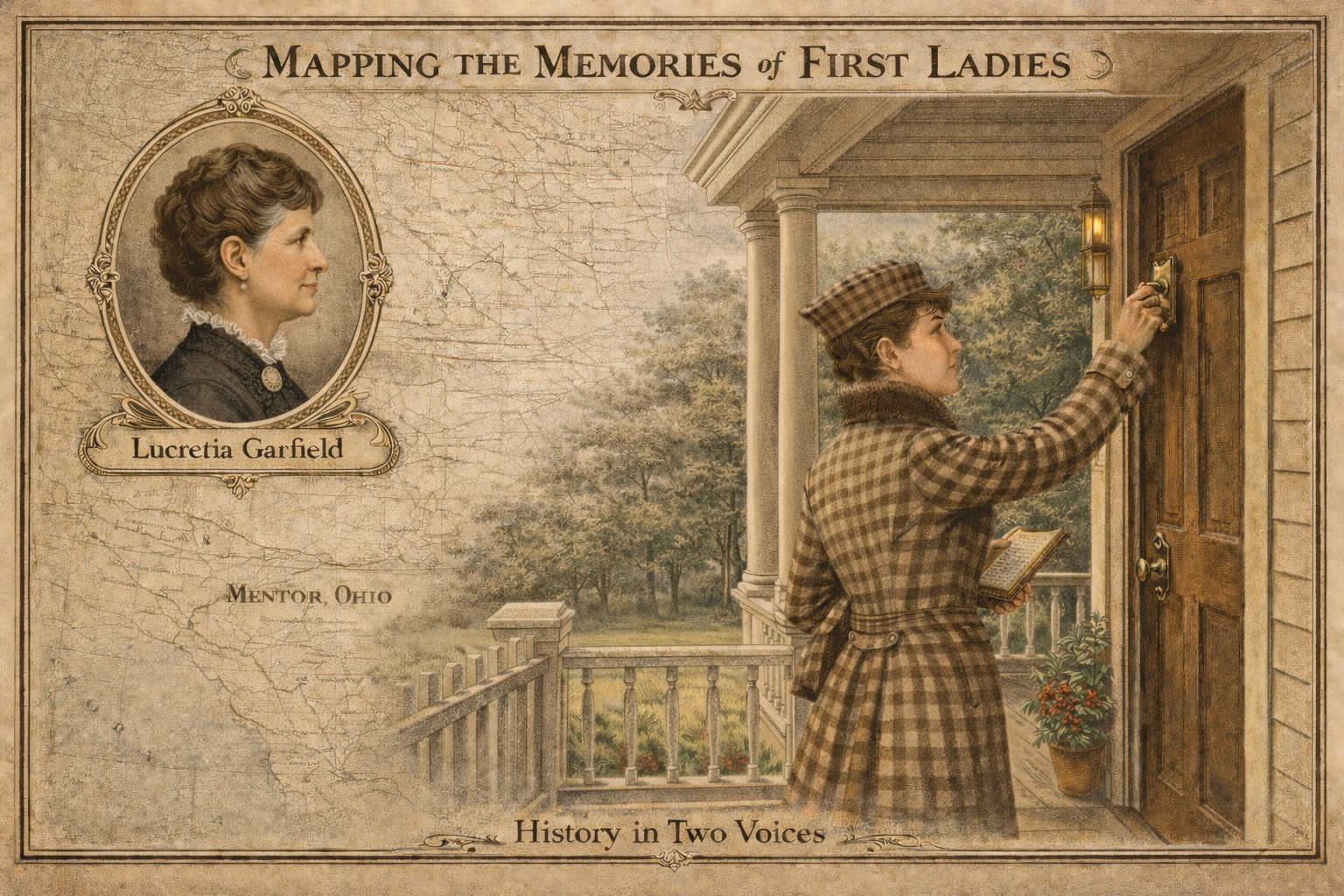
Nellie Bly's Visit and Impressions
In 1888, the renowned journalist Nellie Bly visited Lucretia Garfield, former First Lady of the United States, in Mentor, Ohio. Bly was immediately struck by the isolation and simplicity of the small town, which had fewer than fifty houses—most of them modest white homes with green shutters. Amid these humble dwellings stood the Garfield residence: a large Victorian farmhouse with a spacious front porch. Bly described the house as “pretentious,” having expected a “little country home” but finding instead a home that was both elegant and surprising.
Lucretia Garfield's Education and Marriage
Bly noted that Lucretia Garfield was well-educated, having attended Geauga Seminary and later, what is now Hiram College in 1850. Despite her origins in a farming family, Lucretia pursued higher education, where she met James A. Garfield. Their friendship blossomed, and they married in 1858.
Family Life and Public Service
Lucretia and James Garfield had five children—four sons and one daughter. Tragically, their eldest daughter and youngest son passed away, as Bly observed. After the Civil War, James Garfield entered politics, serving as a Congressman from Ohio. Lucretia chose to remain at home, raising their children rather than participating in the social scene of Washington, D.C.
Widowhood and Appearance
By 1888, Lucretia Garfield retained much of her youthful beauty. Her slender figure, elegant black dresses, and streaks of gray in her brown hair reflected both her widowhood and the passage of time.
Life After President Garfield’s Death
While President Garfield was alive, the family lived modestly. After his death, Lucretia and her children benefited from public sympathy. Generous donations and a government pension awarded to the wives of deceased presidents enabled them to live comfortably.
Relations with the Community and Nellie Bly
Lucretia Garfield’s reserved demeanor was consistent with her behavior in Washington. Her neighbors in Mentor regarded her as “distant,” noting she was “not the least inclined to be neighborly.” Bly concluded her report by stating that Mrs. Garfield was unique among former First Ladies in refusing to meet with her.
Our Perspective
Nellie Bly’s attempted visit to Lucretia Garfield in 1888 reminds us how unusual the lives of presidential widows could be in the nineteenth century. After President James A. Garfield’s assassination in 1881, public sympathy for his family was widespread. In response, Congress passed legislation in 1882 granting the widows of deceased presidents an annual pension of $5,000—a significant sum at the time.
Lucretia Garfield was not the only woman to benefit from this new recognition of presidential service. The same pension applied equally to the surviving widows of John Tyler and James K. Polk, placing all three women—Julia Gardiner Tyler, Sarah Childress Polk, and Lucretia Garfield—on the federal rolls at the same annual rate.
The law quietly acknowledged something the early republic had rarely considered: that the presidency could leave families financially vulnerable after a president’s death. By extending federal support to these widows, Congress recognized the lasting impact of presidential service—not only on the men who held the office, but on the families who shared the burdens of public life.
At the same time, Bly’s account reveals another dimension of widowhood. Even with financial security, Lucretia Garfield chose privacy over public attention. Her refusal to meet the famous journalist suggests that some presidential widows preferred quiet independence to continued life in the national spotlight.
To explore another presidential widow who appears on the same 1882 pension roll as Lucretia Garfield, see our forthcoming book Presidentess: The Life of First Lady Julia Gardiner Tyler. Use Code 24LADYJULIA to save 30%.
Sources
Chicago Tribune, November 4, 1888.
Green Bay Advocate, February 23, 1882.
Images
Map Background
Map of Land-Grant and Bond-Aided Railroads of the United States, c. late 19th century. Public domain. Library of Congress Geography and Map Division.
Nellie Bly Portrait (reference for computer assisted illustration)
Nellie Bly (Elizabeth Cochran), journalist and world traveler, photographed in traveling attire, c. 1890s. Bain News Service photograph. Library of Congress Prints and Photographs Division.
Lucretia Garfield Portrait (reference for computer assisted illustration)
Lucretia Rudolph Garfield, First Lady of the United States (1881). Photograph by Mathew Brady Studio, c. 1870s–1880s. Library of Congress Prints and Photographs Division.
Garfield Residence (computer assisted Illustration_ (architectural reference)
Home of James A. Garfield, Mentor, Ohio. Lithograph by Chas. F. Schmidt Lith. Co., Cleveland, Ohio, late 19th century. Public domain.
Composite Illustration
Computer-assisted historical illustration created for History in Two Voices using public-domain reference materials.