Bicentennial Coins & Currency: The Money That Marked 200 Years
Introduction
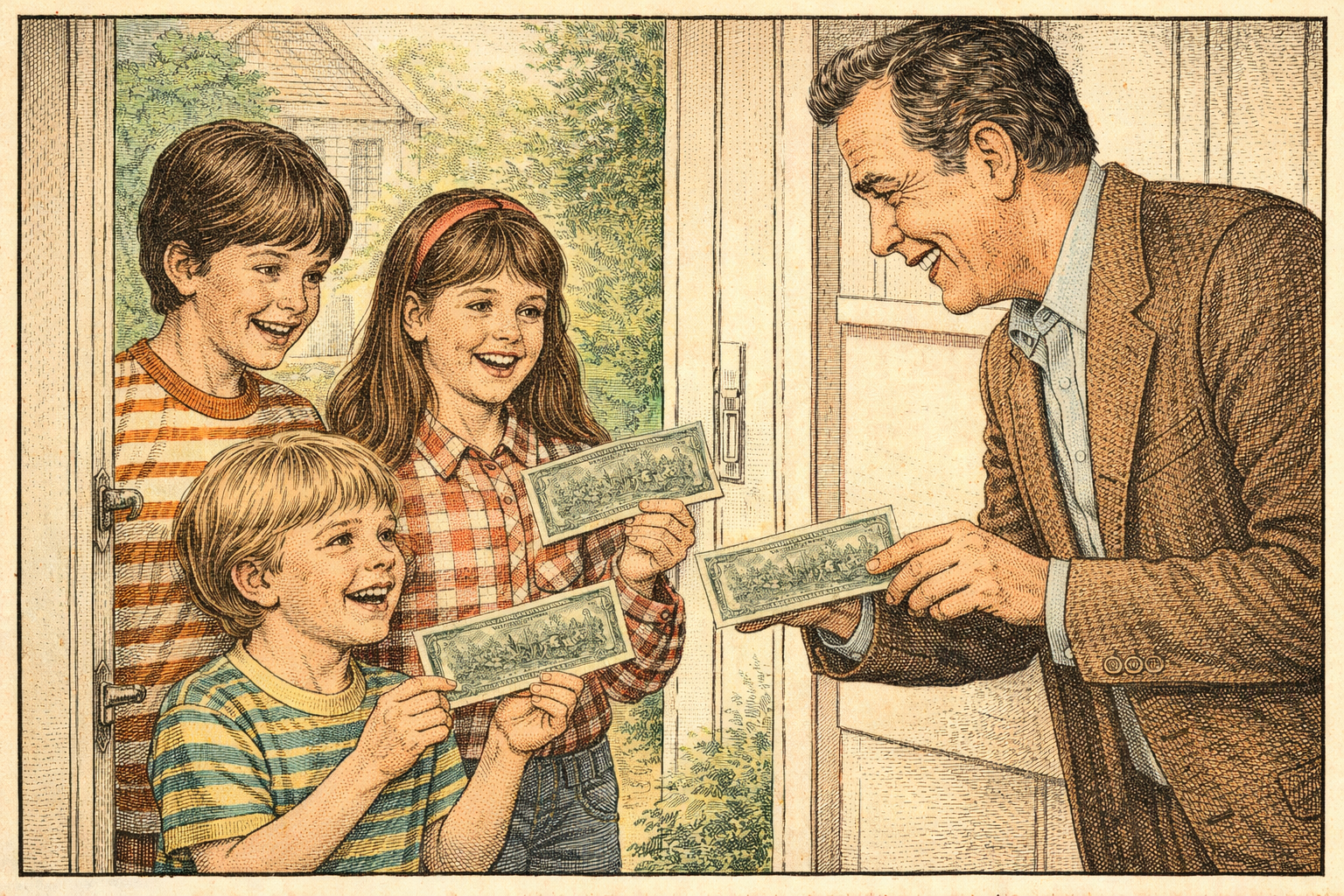
I remember the day my uncle came to visit.
As a special treat, he handed each of us—my brothers, my sister, and me—a crisp two-dollar bill. It felt different from any money I had ever held. The money felt… important.
I didn’t spend mine.
I kept it tucked away for years, taking it out every so often just to look at it. The engraving on the back—so detailed, so alive—felt less like currency and more like a piece of history you were somehow allowed to keep.
At the time, I didn’t fully understand why it felt so special.
But I do now.
To commemorate the 200th anniversary of the United States, special coins and currency were developed and released to the public during 1975 and 1976. These Bicentennial issues not only celebrated the nation’s founding but also reflected its ongoing achievements and heritage.
Bicentennial Coins
Designs and Significance
The unveiling of three commemorative coins took place in 1975. Each design honored key figures and symbols in American history, while also reflecting both the nation’s founding and its modern achievements.
Silver Dollar: The obverse features President Dwight D. Eisenhower, designed by U.S. Mint Chief Sculptor-Engraver Frank Gasparro. The reverse, created by Dennis R. Williams of Columbus, Ohio, pairs the Liberty Bell with the moon—symbolizing both the Revolution and America’s “spectacular space accomplishments.”
Half-Dollar: The obverse displays President John F. Kennedy, executed by Gilroy Roberts. The reverse, designed by Seth G. Huntington of Minneapolis, depicts Independence Hall in Philadelphia. Beneath it, thirteen stars represent the original colonies.
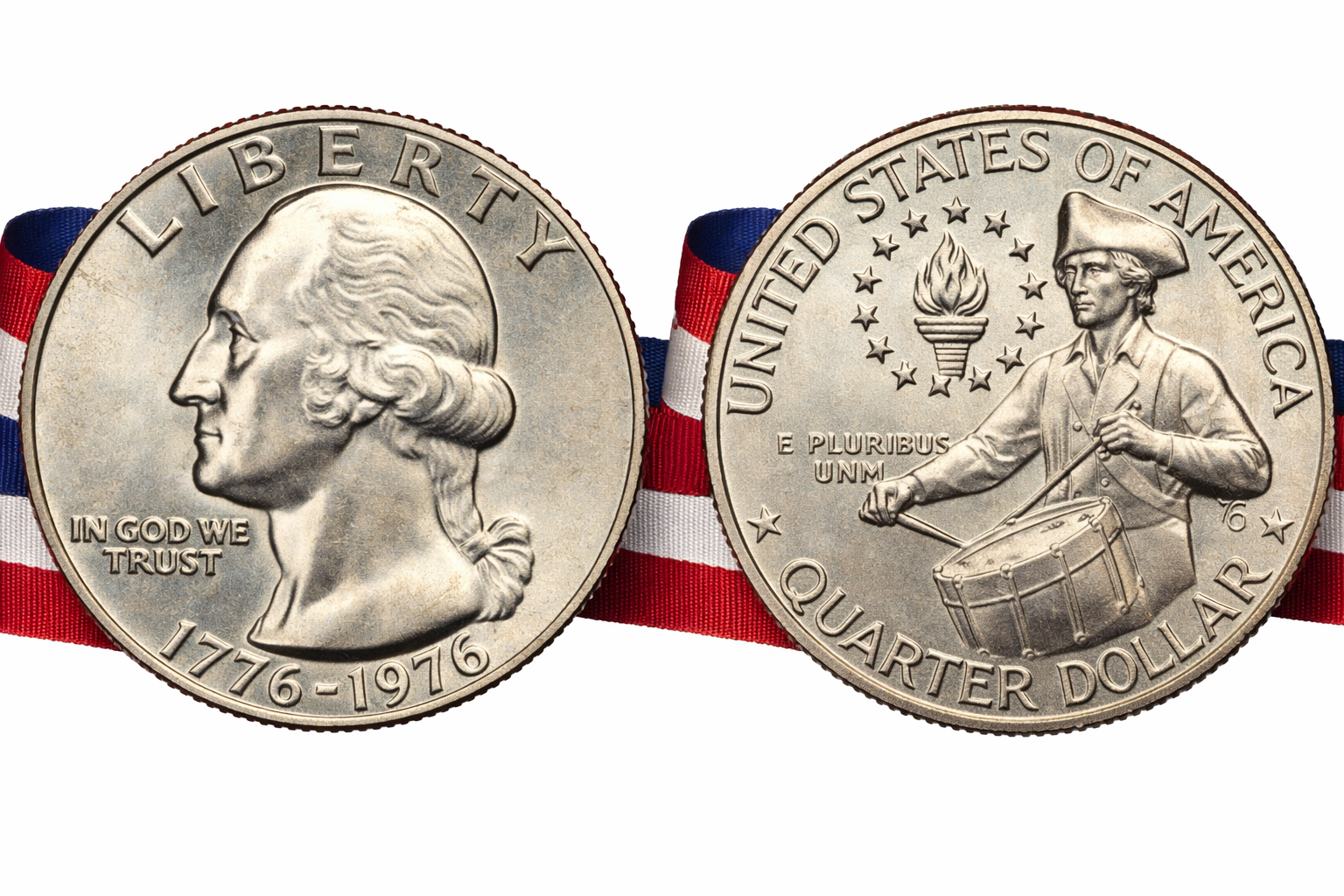
Quarter: The obverse presents George Washington. The reverse, designed by Jack L. Ahr of Arlington Heights, Illinois, features a colonial drummer with a torch of victory and thirteen surrounding stars—an image of citizen-soldiers and the spirit of 1776.
Design Competition and the Double Date
The designs for the Bicentennial coins were selected through a national competition launched in October 1973.
Unlike traditional coinage, these issues do not carry a single year. Instead, they are marked with the dual date:
1776–1976
This simple but powerful change transformed everyday coins into visible reminders of the nation’s 200-year journey.
Release and Circulation
The Bicentennial coins entered circulation in phases through local banks.
Half-dollars were first distributed to commercial banks by the Federal Reserve on July 7, 1975. The redesigned quarter followed in August, with the dollar coin appearing later that fall.
By the end of 1976, production was expected to reach:
$550 million in half-dollars
$1.6 billion in quarters
$300 million in dollar coins
Americans began requesting the new designs as early as June 1975—eager to see and save these commemorative pieces.
The Bicentennial Two-Dollar Bill
Reintroduction and Design
On April 13, 1976—Thomas Jefferson’s birthday—the U.S. Treasury reintroduced the two-dollar bill.
The front retained Jefferson’s portrait, continuing a tradition dating back to 1928. But the reverse introduced something entirely new: a detailed engraving based on John Trumbull’s painting of the signing of the Declaration of Independence.
For many Americans, it was the first time currency had so clearly resembled a historical scene.
Purpose and Circulation
The government hoped the revived two-dollar bill would replace a significant portion of one-dollar notes, potentially saving an estimated $35 million in printing and handling costs over five years.
The denomination itself had a long history, first issued by the Continental Congress on June 25, 1776, as “bills of credit for the defense of America.”
After its last printing in 1963–1963A ended in May 1965, the 1976 issue marked its return—now tied directly to the Bicentennial.
By April 13, 1976, approximately 225 million notes were expected to be available, with projections of 400 million printed annually.
Our Persective
The Bicentennial coins and currency were not rare objects reserved for collectors. They were placed directly into everyday circulation—into cash registers, wallets, piggy banks, and small hands receiving something special from a visiting relative.
For a brief moment in the mid-1970s, Americans did not just commemorate their history—they handled it.
A quarter with a drummer.
A dollar with the Liberty Bell and moon.
A two-dollar bill that felt too beautiful to spend.
These became quiet keepsakes of a national milestone.
And many were saved—not for their value, but because they felt different.
That feeling still lingers.
Decades later, people rediscover these pieces in drawers and jars, often with the same realization:
“Wait… I have that.”
In that moment, the Bicentennial is no longer a distant celebration.
It becomes personal again—something once held, saved, and remembered.
To pre-order our forthcoming biography, Presidentess: The Life of First Lady Julia Gardiner Tyler, (Sept 8, Univ Press of Kansas). Use code 24LADYJULIA at checkout:
Sources
Central New Jersey Home News (New Brunswick, NJ), May 4, 1975.
Cincinnati Enquirer (Cincinnati, OH), August 3, 1975.
Potomac News (Woodbridge, VA), July 14, 1975.
Berea Citizen (Berea, KY), April 1976.
Images
Carousel Image 1 (Opening Scene – Uncle & Two-Dollar Bills)
Computer-assisted illustration created for History in Two Voices, inspired by 1970s family life and the reintroduction of the Bicentennial two-dollar bill in 1976.
Carousel Image 2 (Bicentennial Quarter – Obverse & Reverse)
United States Bicentennial Quarter (1776–1976), obverse featuring George Washington and reverse with colonial drummer design by Jack L. Ahr. U.S. Mint, 1975–1976.
Carousel Image 3 (Bicentennial Half-Dollar – Obverse & Reverse)
United States Bicentennial Half Dollar (1776–1976), obverse featuring John F. Kennedy and reverse depicting Independence Hall by Seth G. Huntington. U.S. Mint, 1975–1976.
Carousel Image 4 (Bicentennial Dollar – Obverse & Reverse)
United States Bicentennial Eisenhower Dollar (1776–1976), obverse featuring Dwight D. Eisenhower and reverse with Liberty Bell and moon design by Dennis R. Williams. U.S. Mint, 1975–1976.