When 3,000 Guests Filled the White House: Charles Dickens Comes to Washington, 1842
A Night Washington Lost Its Composure
Before the Civil War, before the word “celebrity” even existed, 3,000 people packed into the White House to catch a glimpse of a very unimpressed Charles Dickens.
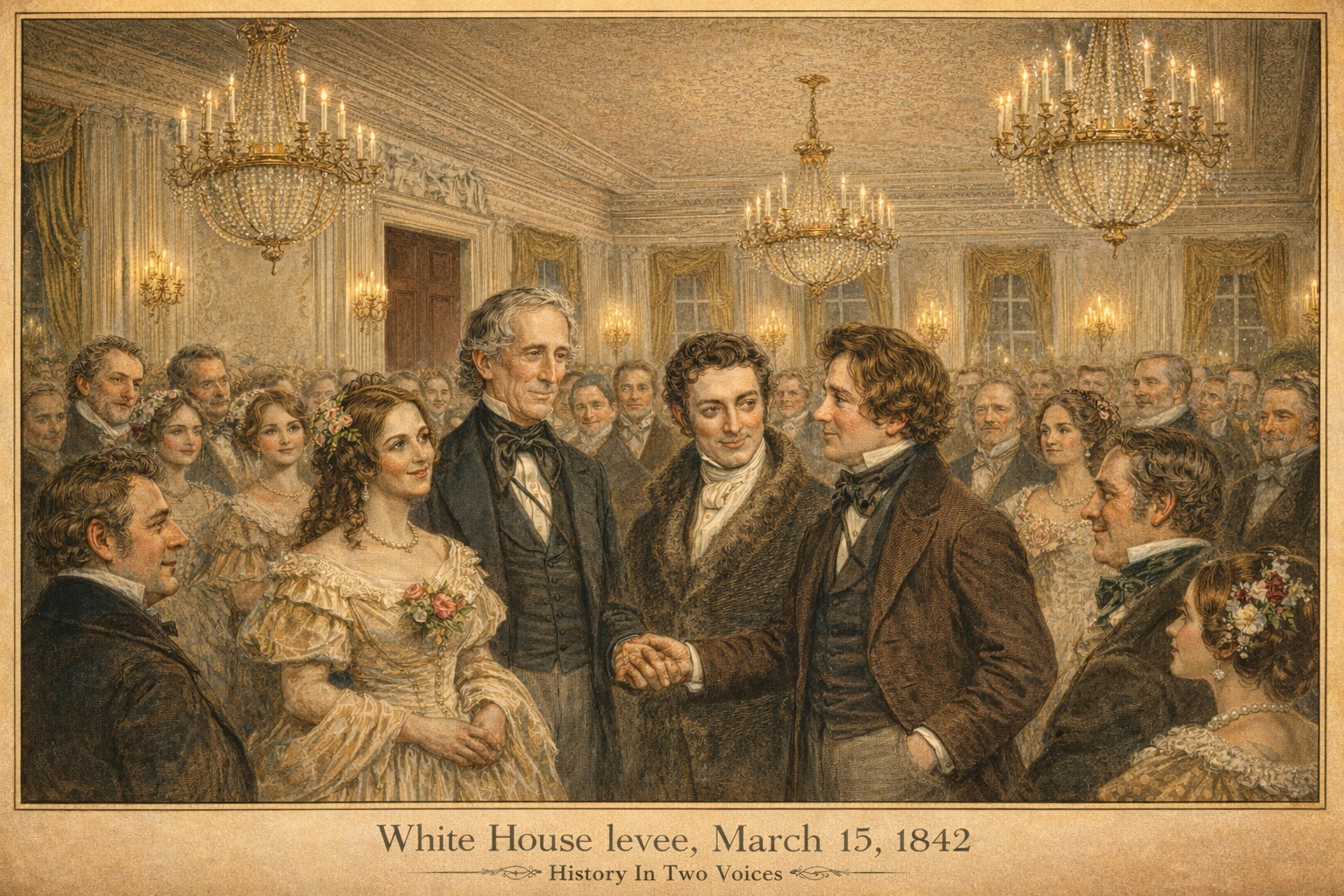
On the night of March 15, 1842, a reported 3,000 revelers thronged the White House for a levee to honor two famous guests: Washington Irving, the celebrated American author whom President John Tyler had just named Minister to Spain, and Dickens. The rooms of the mansion were “filled to overflowing,” and the East Room was, in the words of one attendee, a “complete jam.”
“Boz” Arrives in America
The great Dickens—or “Boz,” as he was called, in reference to Sketches by Boz, which launched his career in 1836—was in the midst of a five-month tour of the United States with his wife, Catherine, that began in Boston on January 22, 1842.
Americans had not seen such a celebrity since the Marquis de Lafayette made his triumphant return to the United States in 1824–1825, and the crowds in New England and New York reacted to the Englishman with a frenzy that even he found unsettling.
The attention paid to the famous writer, however, was understandable. By 1842, Dickens had published five serialized novels and was just as popular on the western side of the Atlantic as he was in Britain. Remarkably, too, he was only thirty years of age.
A Capital Visit—and a First Impression
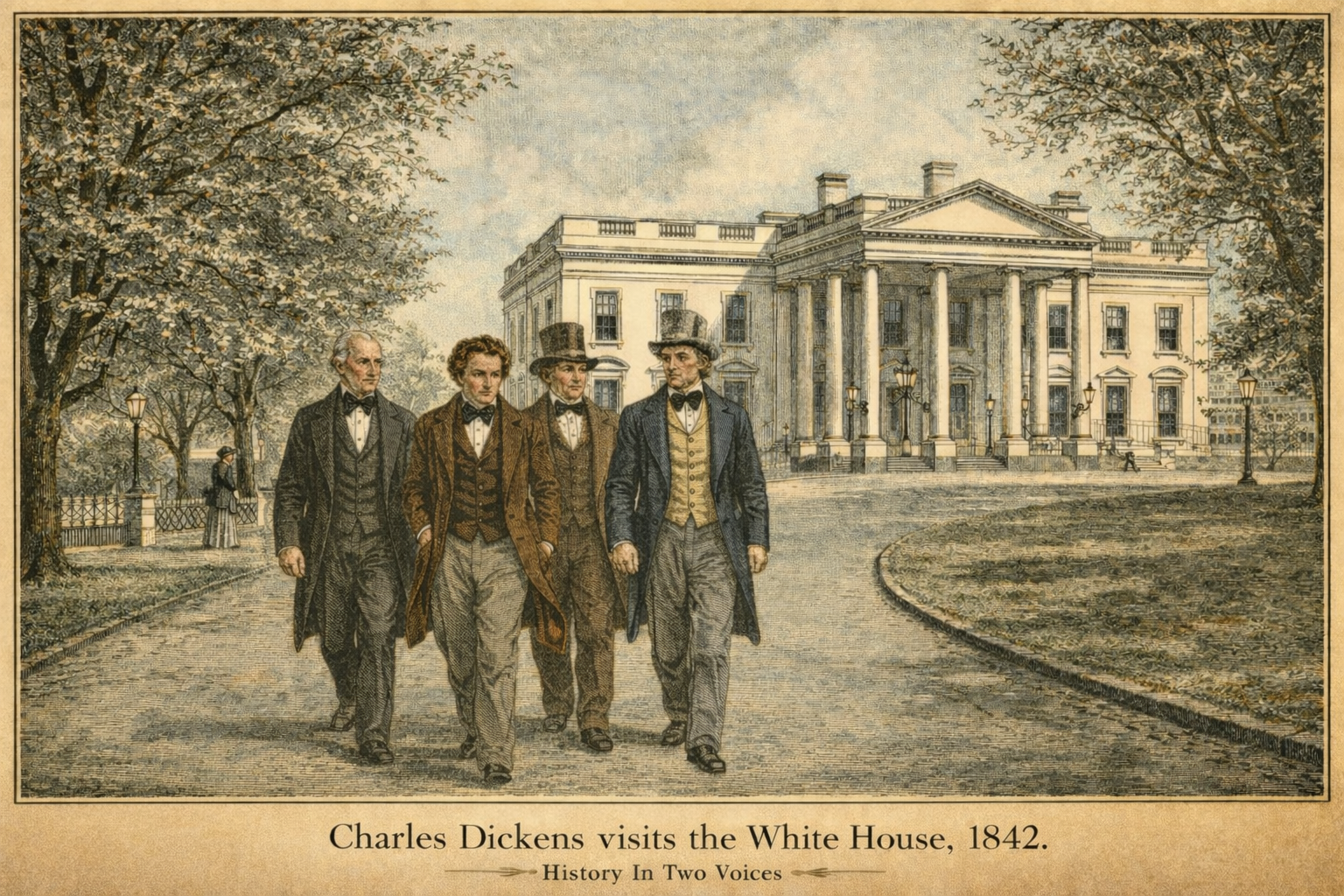
Dickens and his wife arrived in Washington by steamboat and rail from Philadelphia on the night of March 9. They checked into Fuller's Hotel on 14th Street and Pennsylvania Avenue, not far from the Capitol (Fuller’s would become the famous Willard’s Hotel in 1847), where they lodged for the week.
The next day, Dickens toured both houses of Congress. He later reported that he had “seen many of the Lions [politicians], both living and stuffed.”
That same morning, Dickens met President John Tyler. Tyler had asked the fortuitously named Secretary of the Senate, Asbury Dickens, to accompany the writer to the White House for a private audience.
When the two men arrived at the mansion, they entered and rang the bell—but received no answer. The doorkeeper, Martin Renehan, was nowhere to be found.
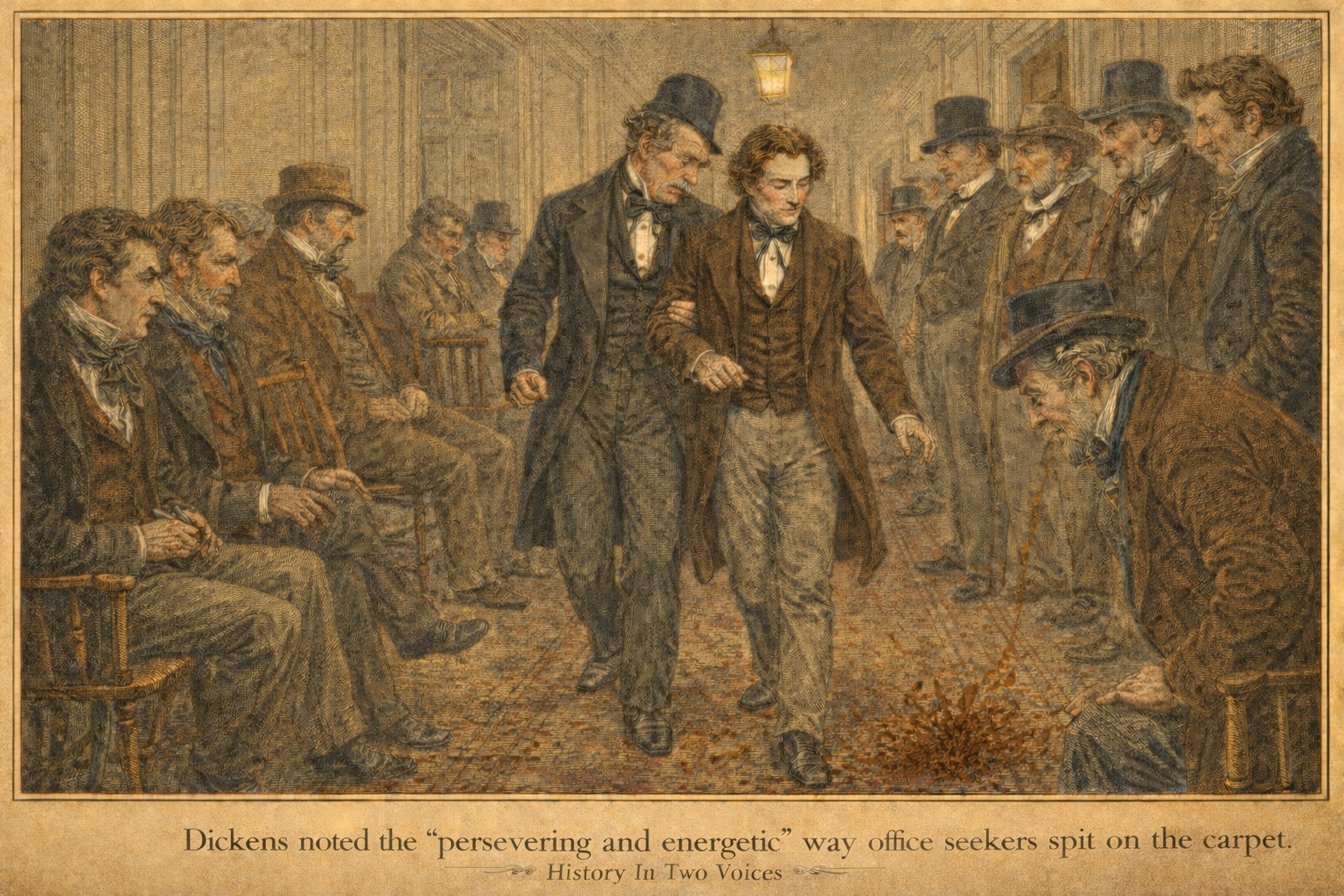
Undeterred, Dickens and his escort climbed the stairs to the second floor and wove their way through a gaggle of office seekers hoping for a few minutes with the president.
What struck the author most was the “very persevering and energetic” way these men spit streams of tobacco juice and “bestowed their favors so abundantly upon the carpet.”
Dickens made numerous comments during his visit to the United States expressing his disgust—“I can bear anything but filth”—with the American habit of spitting. One American entrepreneur saw opportunity in the novelist’s displeasure: Britannia spittoons went on sale in the fall of 1842.
An Audience with the President
Dickens found the president seated at a table covered with stacks of papers and official documents.
“Is this Mr. Dickens?” Tyler exclaimed as he rose to greet his visitor.
“Sir, it is,” Dickens replied, bowing slightly.
“I am astonished to see so young a man, Sir,” the president said.
Dickens smiled broadly.
“I am happy to join with my fellow citizens in welcoming you, warmly, to this country,” Tyler continued.
Dickens thanked him, and the two men shook hands.
As Tyler showed the Dickenses out of his office, Priscilla Cooper Tyler—his daughter-in-law and official White House hostess, filling in for the ailing Letitia Tyler—emerged and walked toward them. The president introduced her, and Priscilla told Dickens she looked forward to seeing him again at the levee.
The Levee: A Crush of Curiosity
At 10:00 PM on March 15, Dickens and his wife left Fuller’s and rode to the White House.
Taking his wife gently by the arm, Dickens pushed inside the mansion. Guests stopped in their tracks as the pair walked by, taken with the sense that they were in the presence of the greatest novelist of the age.
Dickens strode toward the president and Priscilla, Catherine in tow. The author greeted them and introduced his wife. Priscilla—seven months pregnant and disobeying her doctor’s orders to remain in her room until the baby was born—smiled warmly and welcomed the couple.
Dickens found her “a very interesting, graceful, and accomplished lady.”
She, in turn, sized up her famous guest. She liked him well enough, Priscilla reported to her sisters, but he was “not at all romantic looking,” was “rather thick set,” and wore “entirely too much jewelry.” Moreover, he “seemed horribly bored by the crowd pressing around.”
Irving Steals the Evening
Washington Irving impressed Priscilla more.
The witty and urbane fifty-eight-year-old man of letters had long been in the public eye. Nearly everyone had heard of Rip Van Winkle or knew of Sleepy Hollow. Irving had known and admired Priscilla’s mother, Mary Fairlie Cooper, and spent much of the evening monopolizing Priscilla’s attention.
“He took me into the dinner,” she later wrote, “and he talked to me of Mama all the time, telling me a great many anecdotes of Grandmama’s home and surroundings in the old times.”
A Respectable Crowd—With a Touch of Satire
New York socialite Philip Hone, who also attended the levee, perhaps best summarized the evening.
“I witnessed no gaucheries, no vulgarity,” he wrote in his diary, “and I doubt if any society in the country so organized could have turned out so decorous and respectable an assemblage.”
Still, Hone could not resist a snide comment.
“As for the host and his immediate satellites,” he chortled, “they seemed to be in the situation of King George’s apple in the dumpling, wondering how the devil they got there.”
A Social Triumph for the Tyler White House
No matter. The president and his daughter-in-law had succeeded yet again in conquering the Washington social scene.
Our Perspective
As a surrogate White House hostess, Priscilla Cooper Tyler operated under enormous pressure. The “president without a party” relied on her to offset his political unpopularity and bring credit to his administration.
Aided by her training as a stage actress, she remained unruffled when things did not always go according to plan and won over even her father-in-law’s harshest critics.
Later supplanted by the president’s second wife, Julia Gardiner Tyler, she nevertheless deserves tremendous credit for ensuring that—at least in the social realm—the Tyler White House exceeded expectations. In our view, she served as an effective bridge between earlier first ladies and those who followed, helping to shape the evolving role of the first lady.
If you are interested in hearing more about Tyler’s White House, pre-order our forthcoming biography, Presidentess: The Life of First Lady Julia Gardiner Tyler, (Sept 8, Univ Press of Kansas. Use code 24LADYJULIA at checkout.
Sources
Priscilla Cooper Tyler to her sisters, March 1842, Elizabeth Tyler Coleman Papers, University of Alabama.
Elizabeth Tyler Coleman, Priscilla Cooper Tyler and the American Scene, 1816–1889 (Tuscaloosa: University of Alabama Press, 1955).
American Notes for General Circulation, by Charles Dickens (1842; reprint, New York: Fromm International Publishing Corp., 1985).
Charles Dickens, by Michael Slater (New Haven: Yale University Press, 2011).
The Letters of Charles Dickens Volume 3 Pilgrim Edition, edited by Madeline House, Graham Storey, and Kathleen Tillotson (Oxford: Clarendon Press, 1974).
The Diary of Philip Hone 1828–1851, edited by Allan Nevins (New York: Dodd, Mead & Company, 1936).
The Experiment (Norwalk, OH), March 9, 1842.
New York Evening Post, March 18, 1842.
Images
Exterior Approach to White House
Citation:
Leahy, Sharon. Charles Dickens Visits the White House, 1842. Image concept and direction. AI-assisted illustration generated using digital tools, 2026. Source image: Charles Dickens portrait, via Wikimedia Commons.
Tobacco Commentary Scene
Citation:
Leahy, Sharon. Dickens Noted the “Persevering and Energetic” Way Office Seekers Spit on the Carpet. Image concept and direction. AI-assisted illustration generated using digital tools, 2026. Source image: Charles Dickens portrait, via Wikimedia Commons.
Tyler’s Office Meeting
Citation:
Leahy, Sharon. “Is This Mr. Dickens?” Image concept and direction. AI-assisted illustration generated using digital tools, 2026. Sources images: John Tyler portrait, via Wikimedia Commons. Charles Dickens portrait, via Wikimedia Commons.
East Room Gathering
Citation:
Leahy, Sharon. Dickens Visits the White House, 1840. Image concept and direction. AI-assisted illustration generated using digital tools, 2026. East Room, White House (historic photograph), via Wikimedia Commons. Source images: John Tyler portrait, Charles Dickens portrait, Washington Irving portrait, Priscilla Cooper Tyler portrait, via Wikimedia Commons.
Dinner Scene with Priscilla
Citation:
Leahy, Sharon. “He Seemed Horribly Bored by the Crowd…” Image concept and direction. AI-assisted illustration generated using digital tools, 2026. Source images: Charles Dickens portrait, and Priscilla Cooper Tyler, via Wikimedia Commons.