Mapping the Memories of First Ladies: Mary Arthur McElroy, President Arthur’s Sister
Chicago Tribune, November 4, 1888
Introduction
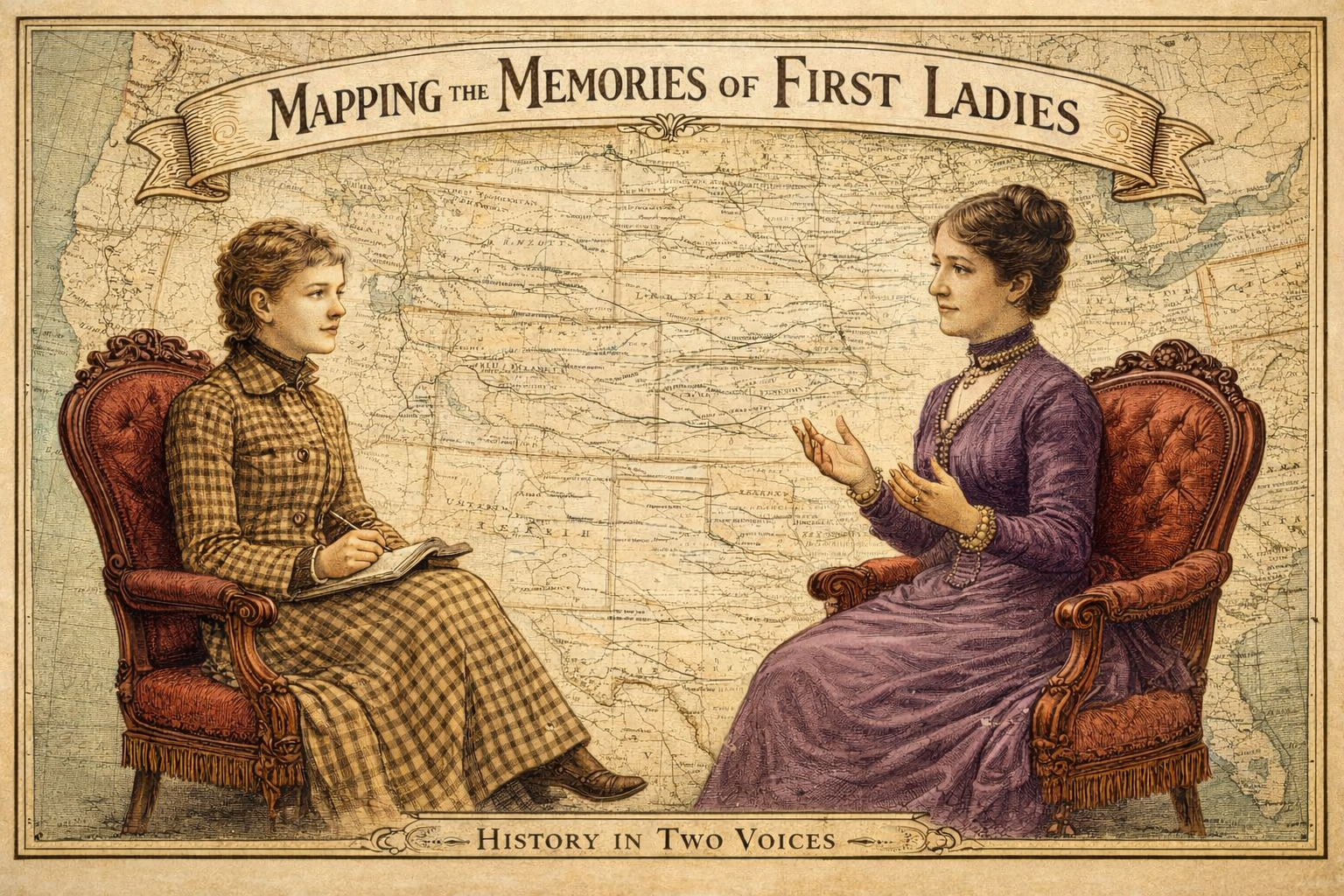
Nellie Bly, the journalist known for her sharp observations and fearless reporting, traveled to Albany, New York, to meet Mary Arthur McElroy—the woman who had served as “First Lady” for her widower brother, Chester A. Arthur.
Bly described her first impression of McElroy as “lovely,” noting her height of five foot five, striking dark eyes, and graceful figure. It was a portrait not of political ambition, but of quiet poise—an early indication of the steady presence McElroy brought to one of the most visible roles in the nation.
Experiences as White House Hostess
During their conversation, McElroy spoke candidly about her time in Washington, expressing genuine affection for her role. She told Bly that she had “loved” serving as the “Mistress of the White House,” calling it the most “charming position in the world.”
Yet her view was not romanticized. McElroy approached the role with a practical mindset, remarking that the position was not especially difficult—provided a woman “does not lose her head.”
She credited her success to maintaining a wide circle of acquaintances. By accepting invitations and forming connections, she strengthened ties with her brother’s supporters and helped extend what she called the “hospitality of the White House.”
Daily Rituals and Hospitality
McElroy’s days followed a disciplined rhythm. For four months out of each year, every morning, between eleven o’clock and one, she received visitors—often numbering between two and three hundred guests at a time.
Tea was the centerpiece of these gatherings, a simple but powerful gesture that defined her approach to hospitality. Rather than feeling overwhelmed by the volume of callers, McElroy embraced the responsibility, explaining that her duty was “to do the best I could” and ensure that each guest felt welcome.
In these daily rituals, the White House became more than a residence—it became a place of connection, access, and national visibility.
Appearance and Personal Choices
Even while in mourning, McElroy maintained a carefully composed appearance. Her wardrobe remained within the subdued tones of gray, violet, black, and white, reflecting both personal loss and social expectation.
Her choices were deliberate. She declined to wear low-necked dresses, simply because she did not care for them, and kept her jewelry minimal—only a few rings. With quiet emphasis, she noted to Bly that her ears had “never been pierced.”
These details, small as they may seem, reveal a woman who balanced public expectation with personal preference—choosing dignity over display.
Family Responsibilities and Media Accuracy
Following her brother’s death, McElroy assumed responsibility for his daughter, Ellen Herndon Arthur, becoming her guardian.
She was also quick to address a recurring error in newspaper accounts. Ellen, she explained, was often referred to in print as “Nellie Arthur”—a name she had never used.
The correction was subtle but telling. Even in the 1880s, public figures navigated a media landscape prone to inaccuracies. McElroy’s insistence on getting the name right reflects an enduring truth: history depends on careful attention to detail.
Our Perspective
Mary Arthur McElroy’s story reminds us that the role of “First Lady” has never been fixed—it has always adapted to circumstance.
When Chester A. Arthur entered the White House as a widower, it was his sister—not a spouse—who stepped into one of the most visible social roles in the nation. McElroy approached the position not with ambition or spectacle, but with composure, discipline, and an instinct for hospitality that helped stabilize the Arthur administration during a sensitive period.
Her reflections to Nellie Bly reveal something deeper: the White House was not simply a political center, but a social stage where perception, connection, and personal grace mattered immensely. Receiving hundreds of visitors daily was not just etiquette—it was a form of soft diplomacy.
To learn more about early White House first ladies, pre-order our forthcoming biography, Presidentess: The Life of First Lady Julia Gardiner Tyler (Univ Press of Kansas, Sept 8).
Sources
Chicago Tribune, “Nellie Bly’s Interview with Mary Arthur McElroy,” November 4, 1888.
Nellie Bly, published interviews and reporting, late 19th century.
White House Historical Association, biographies and records of presidential hostesses.
Images
Leahy, Sharon. Mapping the Memories of First Ladies: Mary Arthur McElroy and Nellie Bly. Image concept and direction. AI-assisted illustration generated using digital tools, 2026.
Mary Arthur McElroy portrait, after period engraving, late 19th century, via Wikimedia Commons.
Nellie Bly photograph, late 19th century, via Library of Congress.
Map of U.S. railroads, 19th century, via Wikimedia Commons.