Racing the Continent: The Married Journalists Who Drove America Into the Automobile Age (1899)
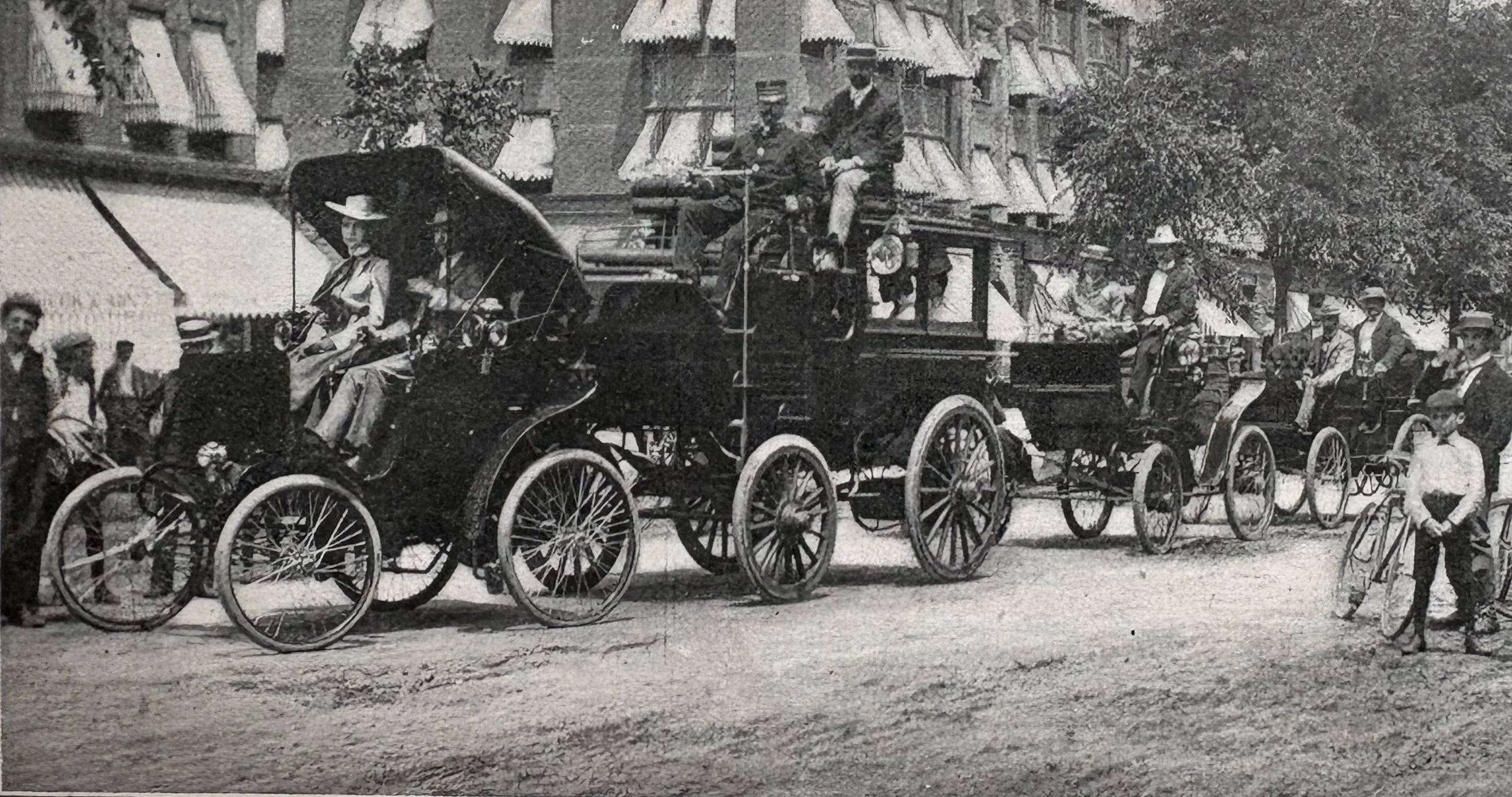
On a warm July morning in 1899, the sidewalk outside the New York Herald building overflowed with men, women, and children, all straining for a glimpse of an extraordinary sight. A married pair of journalists, John D. Davis and Louise Hitchcock Davis, were preparing to attempt what no American had yet dared: a drive from New York City to San Francisco in a brand-new “horseless carriage.”
Their plan was simple in theory, impossible in practice: travel 3,700 miles across a country with virtually no paved roads, and file telegraphed dispatches to the newspapers they worked for. Each day, readers across the nation would follow their struggles, repairs, hopes, and setbacks. Within hours they became national celebrities; symbols of American pluck at a time when “automobilism,” as it was then called, was still a novelty that most citizens had never seen, let alone ridden in.
The challenge had been partly inspired by a boast across the Atlantic. As the Daily Journal (Freeport, IL) reported on July 26, 1899:
“The French…have traveled 621 miles in a horseless carriage. American pluck and enterprise is to show them their mistake. Mr. and Mrs. John D. Davis will travel 3700 miles.”
If the French claimed supremacy in early automobile endurance, the Davises would show what American ingenuity — and determination — could do.
The Continental Touring Car
Their vehicle was called the “Continental Touring Car,” built in Stamford, Connecticut by the National Motor Company. The Watertown Herald (July 29, 1899) described it in loving detail: a “handsome contrivance” resembling a road phaeton, with steel bicycle-type wheels, pneumatic tires, and a buggy-style collapsible top. A big trunk and “well-stuffed valise” strapped to the back hinted at the journey ahead.
Its technical specifications were bold for 1899:
Three speeds: 10, 20, and 35 miles per hour
Climbed a 25% grade at 5 mph
Engine rated at 6 horsepower
Top speed theoretically 35 mph — in practice, far less
Louise, ever the realist, cautioned readers not to believe every claim made by automobile enthusiasts. Writing for the Evansville Journal on August 27, 1899, she noted:
“It is next to impossible for the owner of an automobile to see the vehicle as it is… If the gasoline tank holds five gallons, it expands to ten… Either he will not or cannot see its faults.”
Her clear-eyed perspective balanced her husband’s optimism; a dynamic that charmed readers.
A National Spectacle
When the Davises rolled out of Manhattan, a long row of automobiles followed them to Harlem, creating one of the earliest recorded automobile parades in American history. The Watertown Herald captured the scene: crowds lined the streets to cheer, and children ran alongside as the couple made their way north.
Across the country the reception was the same. In the Buffalo News (Aug 6, 1899), Louise described how the appearance of the automobile electrified towns:
“The first one to catch a glimpse of its approach is the hero of the day… From house to house he runs, calling lustily that ‘the carriage is coming.’”
Newspapers from coast to coast tracked the Davises’ progress. The Los Angeles Evening Post-Record (July 1, 1899) declared:
“Nothing to compare with the trip has ever been attempted in this country, where the sport ‘automobilism’ is yet in its infancy.”
And the Tehama County Daily Republican (Red Bluff, CA) emphasized the scale of the challenge:
“It will be the longest trip taken.”
This wasn’t just a stunt. It was a test of courage, technology, and public imagination.
Breakdowns, Setbacks, and the End of the Road
The Davises battled constant breakdowns — broken springs, balky gears, sputtering engines — yet John remained unfailingly upbeat in his telegraphed dispatches. Louise, more cautious, kept their readers grounded in reality. Their contrasting voices made their reports irresistible.
By the time they reached Chicago, the Continental Touring Car had suffered one breakdown too many. With regret, they ended their journey, still having achieved a staggering milestone: the longest distance traveled by an automobile at that point in American history.
In 1899, simply reaching Chicago by automobile was itself historic.
Our Perspective
The Los Angeles Evening Post-Record articulated why the Davises’ trip mattered:
The couple believed their journey would “demonstrate the possibilities of long-distance touring, even in the absence of good roads,” and serve as a powerful argument for improving America’s highways.
They were correct. Long-distance automobile touring became a national pastime. Within fifty years, Americans would cross the continent in days, not months. And in 1956, the Federal Highway Act would transform the nation with a network of safe, paved, modern roads.
The Davises’ 1899 experiment was one of the first public proofs that such a future was possible. Their journey was difficult, and unfinished, yet it helped drive America into the automobile age.
Image Captions
Header Image: Mr. and Mrs. John D. Davis at the start of their transcontinental attempt. Harper’s Weekly, July 22, 1899.
Image Credits:
San Francisco Call Bulletin (July 14, 1899);
Muncie Evening Press (July 20, 1899);
Los Angeles Express (July 15, 1899);
Harper's Weekly (July 22, 1899);
Florida Times-Union (July 17, 1899);
Journal & Tribune, Knoxville (Aug. 6, 1899).
If you enjoyed this story, you’re please stay connected. Please complete the form below.
We share occasional stories from America’s past - no spam, just history. Thanks, HiTV