The Bicentennial Freedom Train, 1975–1976
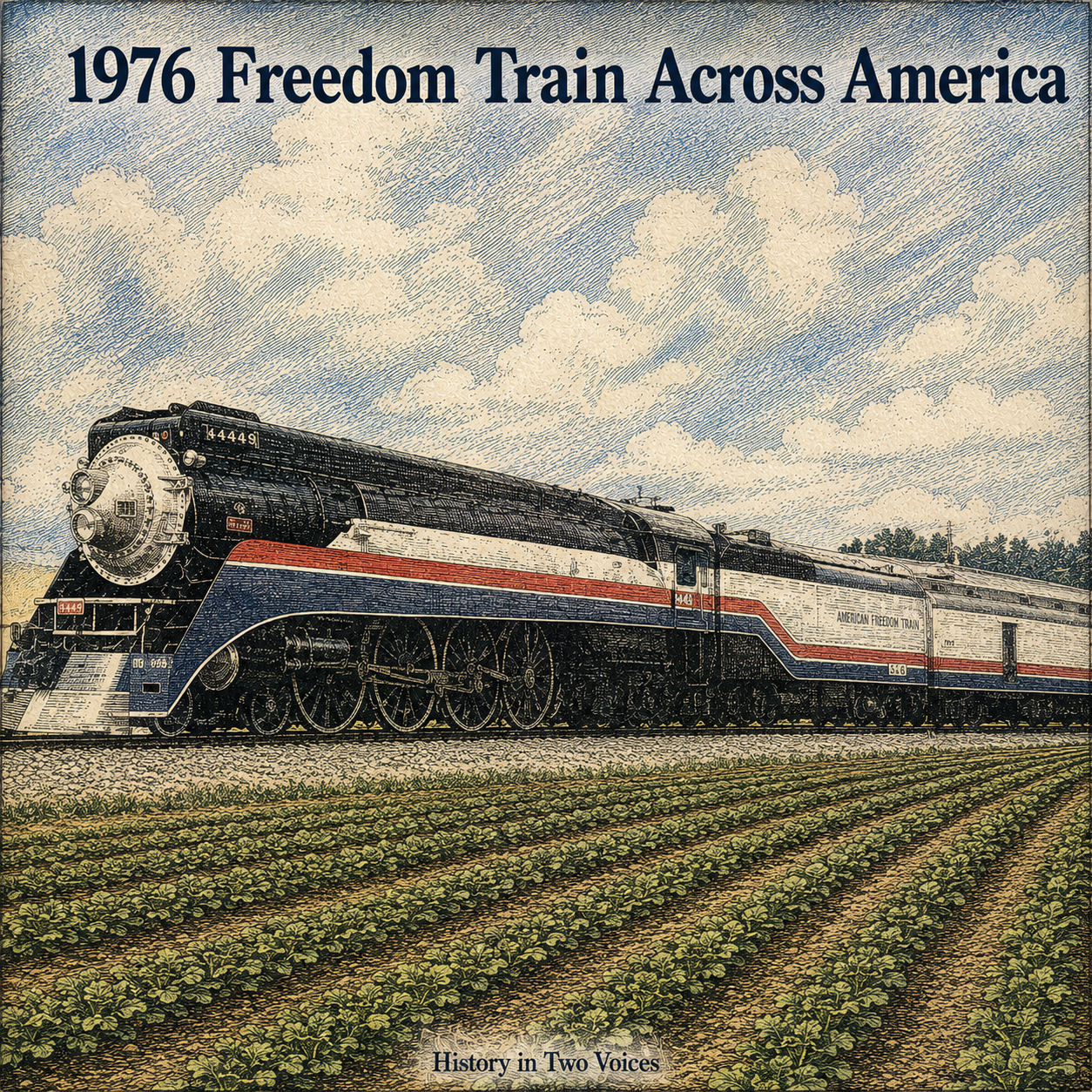
A Nation’s History on Rails
In the spring of 1975, a freshly painted 26-car red, white, and blue train pulled out of Wilmington, Delaware, carrying with it nothing less than the story of the United States.
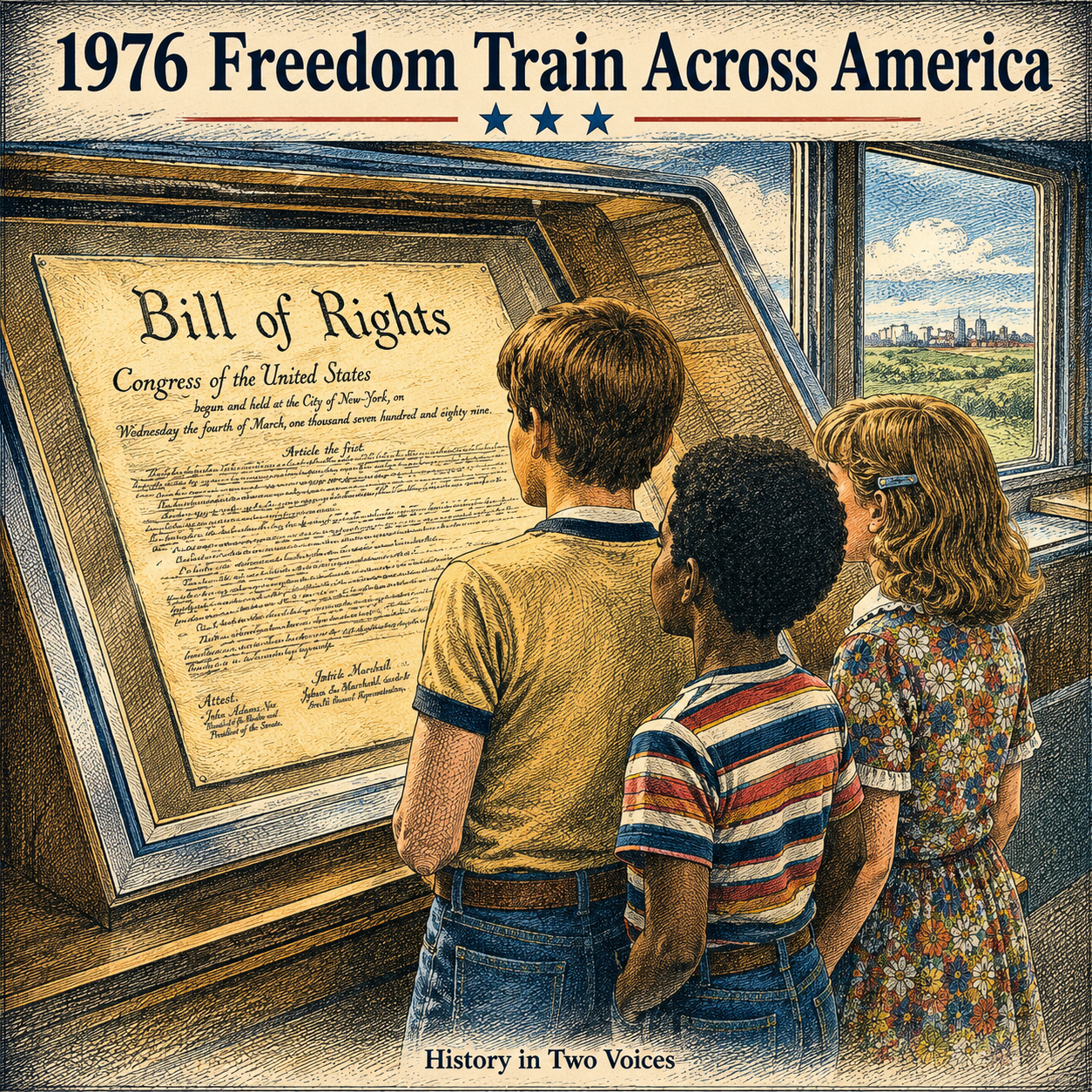
This was the American Freedom Train—a rolling museum created to mark the nation’s upcoming Bicentennial. Over the next two years, the train would travel across the country, stopping in more than 70 major cities and countless towns and villages, offering Americans a chance to encounter their shared past face to face.
Its first major stop was Boston, timed to coincide with the April 18th anniversary of the Battle of Lexington, anchoring the Bicentennial not just in celebration, but in remembrance.
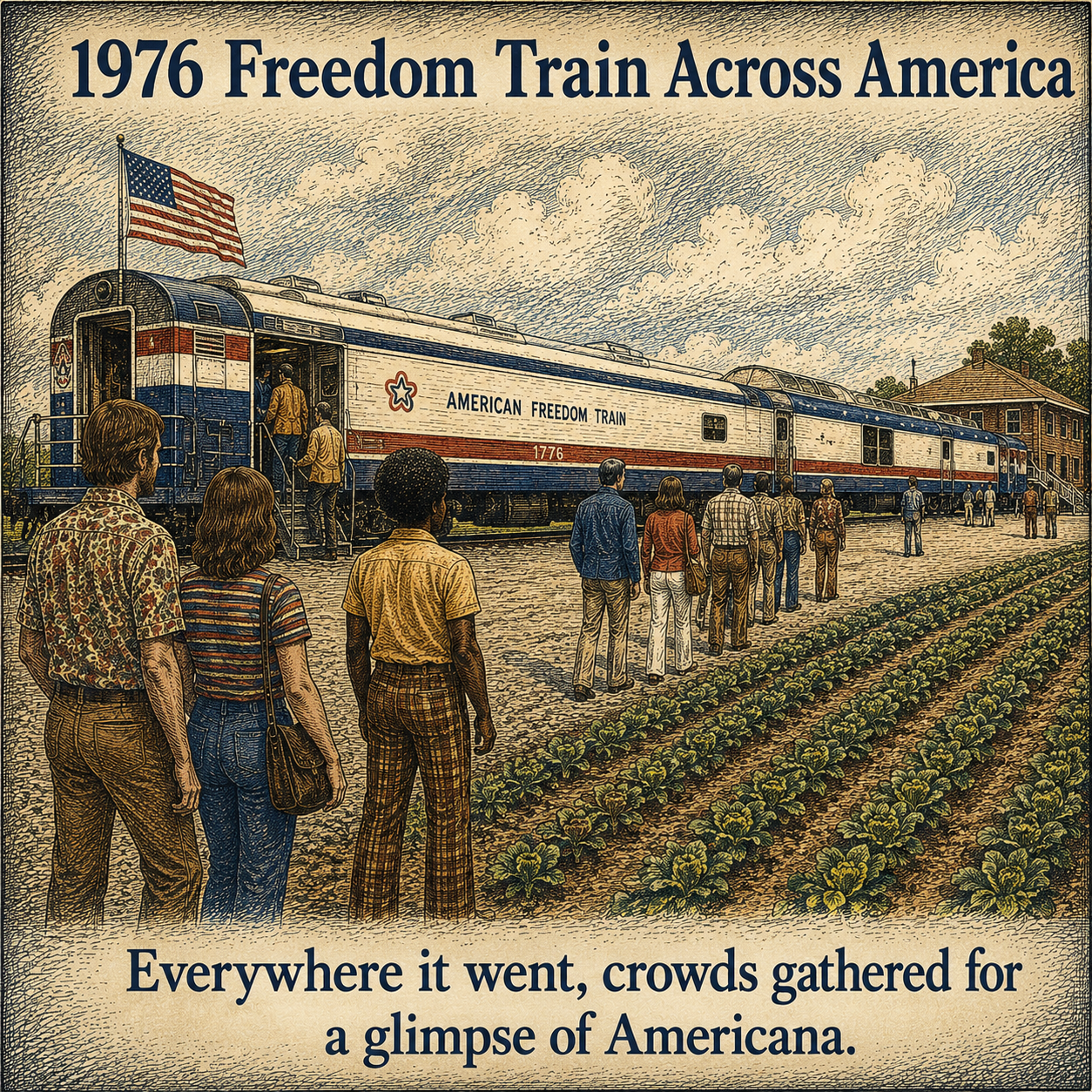
A Moving Museum of the American Experience
Inside the train, visitors stepped onto a moving walkway that carried them through 12 exhibit cars at a steady pace—nearly 2,000 people per hour, for up to 14 hours a day. A transistorized audio system narrated the journey as history quite literally unfolded beside them.
The exhibits traced the American story from its earliest moments to the modern age:
The opening car presented independence through the eyes of an 18th-century New Englander
Later cars followed westward expansion, industrial growth, cultural achievement, and finally, the moon landing
The artifacts were extraordinary:
The Articles of Confederation
Gold miners’ tools from 1849
Moon rocks
George Washington’s personal copy of the U.S. Constitution, complete with his marginal notes
Hank Aaron’s baseball bat
Judy Garland’s dress from The Wizard of Oz
It was history not behind glass in a distant capital—but passing through hometowns across America.
The Engine That Pulled a Nation Together
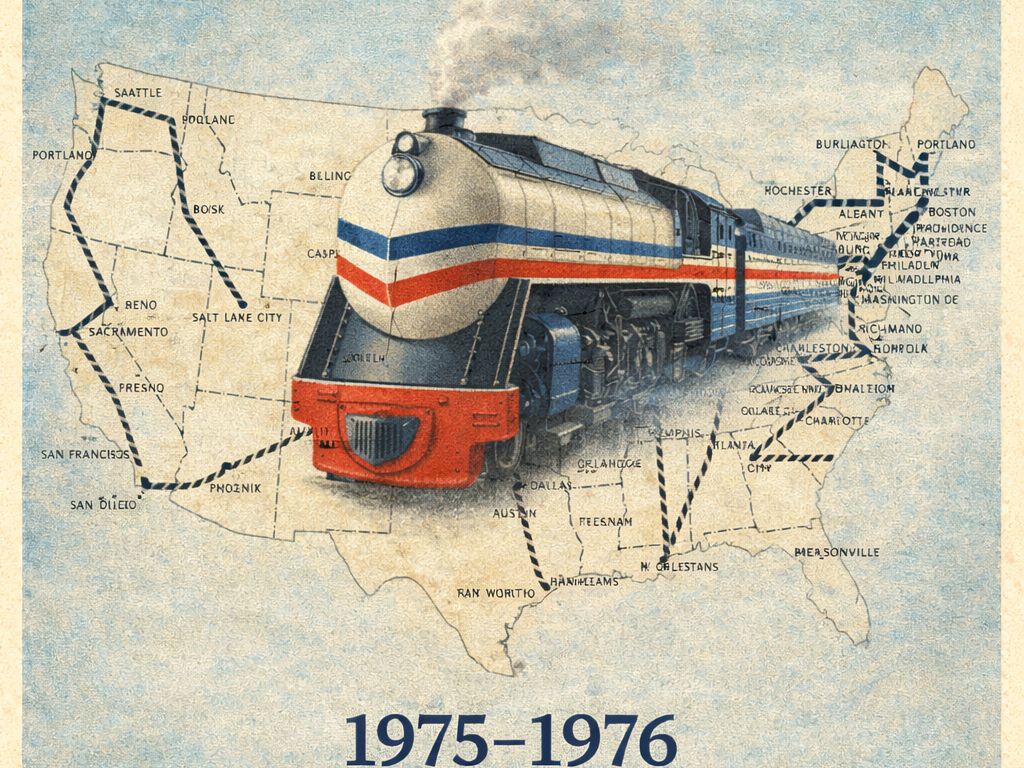
One of the engines powering the train was a legend in its own right: Southern Pacific 4449, a former Southern Pacific Daylight Class steam locomotive. Overhauled and refurbished for the occasion, it was donated by the city of Portland, Oregon, and became one of the most recognizable symbols of the Bicentennial era.
A Private Effort, A Public Purpose
The American Freedom Train was conceived and managed by the American Freedom Train Foundation, funded through private donations—including major contributions from Pepsi-Cola, General Motors, Prudential Insurance, and Kraft Foods.
It followed an earlier predecessor: a 1947 Freedom Train, sponsored by the American Heritage Foundation, which had toured the nation in the aftermath of World War II with a similar mission—using history to strengthen civic unity.
Presidential Reflections
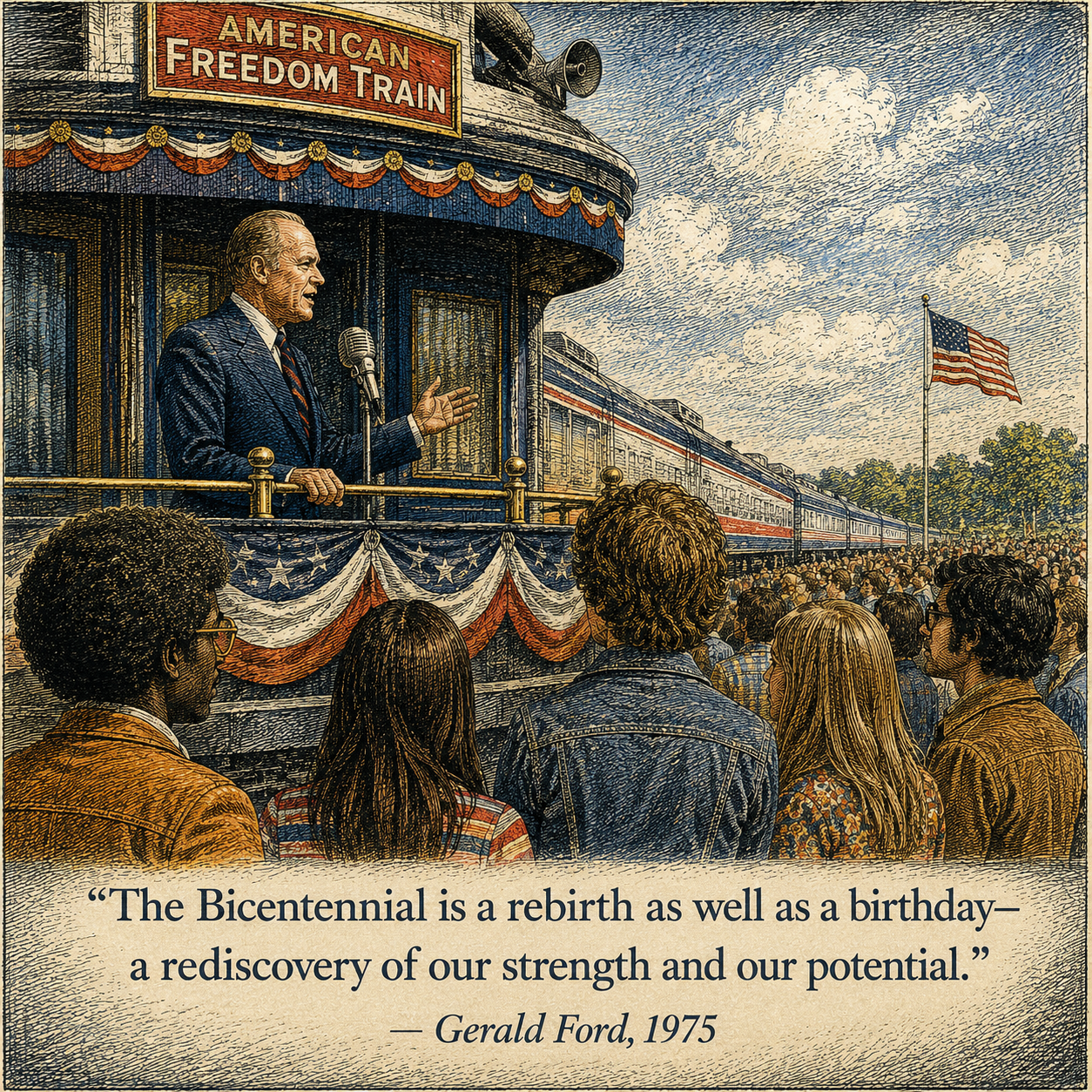
At a March 1975 appearance, Gerald Ford captured the train’s deeper meaning:
“I see the Bicentennial of 1976 as a rebirth as well as a birthday—a rediscovery of our strength and of our potential. This American Freedom Train will be a fitting symbol for what the Bicentennial really represents.”
Crowds, Curiosity, and Civic Memory
At one of its stops, more than 40,000 people crowded into Delaware Park Raceway to tour the train. Nationwide, projections estimated that over 40 million Americans would eventually walk through its cars.
For many, it was their first close encounter with original founding documents or iconic cultural artifacts. For others, it was a reminder that American history is not static—it moves, evolves, and belongs to everyone.
Why It Matters
The Bicentennial Freedom Train reminds us of a moment when the nation chose to teach history by bringing it directly to the people—not digitally, not abstractly, but physically and collectively.
In an era of uncertainty and change, the train offered something rare: a shared civic experience grounded in curiosity, memory, and possibility. It didn’t argue politics. It told stories. And sometimes, that’s how unity begins.
Sources & Contemporary Coverage
Fresno Bee, January 5, 1975
The Independent (Richmond, CA), January 7, 1975
Daily News (Lebanon, PA), January 21, 1975
Columbus Telegram (Columbus, NE), March 20, 1975
York Dispatch (York, PA), April 2, 1975
freedomtrain.org
History in Two Voices shares stories from America’s past for educational and historical purposes. This post is not intended as a political statement.
If you enjoyed this story, please stay connected. We share occasional stories from America’s past - no spam, just history. Complete the form below: