Theodore Henderson and the Rescue of a Young Nursing Student
Reunion and Rescue: Theodore Henderson and Carol Baisden
In September 1962, Redbook magazine reunited two people whose lives had been permanently altered by a single moment of courage eight years earlier: Carol Baisden, now a 28-year-old mother of three, and Theodore Henderson, a middle-aged Florida truck driver.
They had not seen one another since the day Henderson pulled Carol from a submerged automobile along a rural Florida highway. Time had passed. Life had unfolded. Yet the bond formed in water, pain, and breath remained unbroken.
The Accident
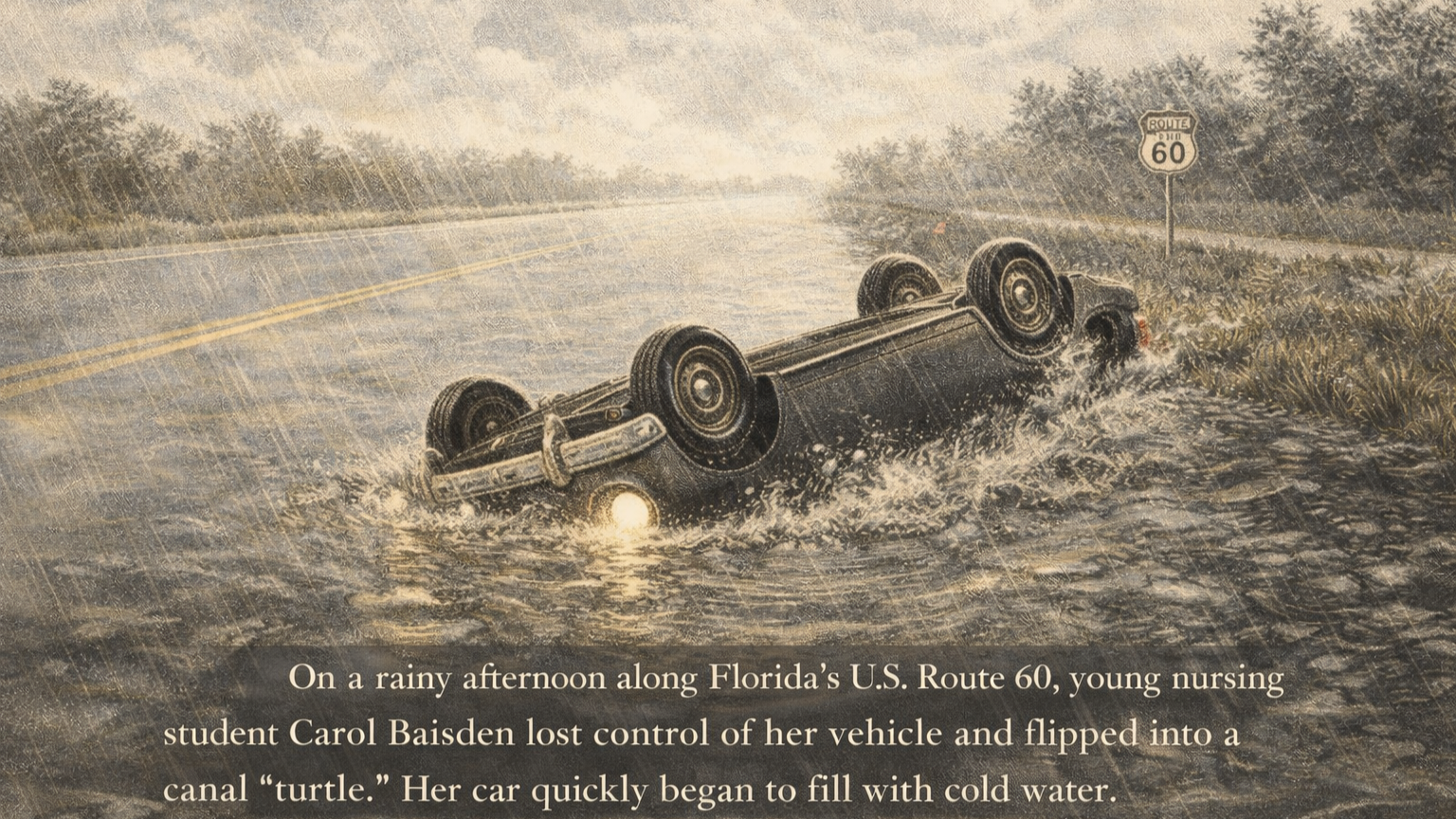
The afternoon was warm and heavy with humidity on August 17, 1953, a sudden rainstorm slicking the pavement along Florida Highway 60. Carol, then a young nursing student, was driving a friend’s 1946 two-door sedan back to her dormitory after spending two weeks with family.
The road was narrow and unforgiving, bordered by deep irrigation canals with no guardrails. When a flashing red light ahead caused her to brake, her tires struck a wet patch. The car skidded, crossed into the oncoming lane, then veered sharply off the shoulder.
In seconds, the vehicle rolled into the canal and flipped upside down.
Carol found herself hanging inside the car, sitting against the roof as water rushed in. The automobile was sinking fast. She later recalled the sound of the water, the pressure, and then the sensation of slipping into unconsciousness—briefly wondering if she was about to discover what came after life.
Henderson’s Heroism
Seventeen miles from Vero Beach, Theodore Henderson had pulled his produce truck to the side of the road to repair a flat tire. His ten-year-old son, Theodore Jr., stood nearby.
It was the boy who first saw the car plunge into the canal.
Henderson ran to the bank and saw the vehicle already disappearing beneath the surface. Three men stood nearby. He called out urgently for help.
They refused. One said he could not swim. Another warned of alligators and snakes.
Henderson did not hesitate.
He dove into the canal and reached the car, struggling to open the door as it sank. He managed to crack it open before it slammed shut on his hand, tearing off a the tip of his finger. He surfaced for air and again pleaded for help. The men only pointed to an alligator in the water.
Undeterred, Henderson dove again—and again.
On one descent, he smashed the window with his tire iron. With the help of his son, he pulled Carol free and dragged her to the bank. She was not breathing.
Henderson immediately began artificial respiration. After agonizing moments, Carol gasped for air.
She was alive.
Aftermath and Gratitude
When Carol regained consciousness, she struggled to breathe and told Henderson that a $100 bill was inside her green pocketbook still in the car. Despite his injured hand, Henderson dove back into the canal and retrieved it.
Passing cars sped by. Few stopped. Eventually, one driver did, and Carol was taken first to a nearby restaurant and then to the hospital.
Henderson bandaged his hand, finished fixing his tire, and drove home.
The next day, he visited the hospital. He had lost the tip of his fourth finger and required splints on two others.
When Carol’s mother contacted the press, the story spread nationwide.
Recognition and Reflection
Public donations poured in. Henderson used the funds to purchase his own delivery truck. He was awarded the Carnegie Silver Medal and a $700 grant for his bravery.
One gift, however, stayed with him.
Carol’s younger brother, Edward, presented Theodore Jr. with his bicycle.
Henderson tried to refuse.
The boy insisted.
“I got to give you something that’s mine,” Edward said.
“You gave me back my sister—and I like her a lot.”
A Rescue That Lasted
Carol returned to work at the hospital but found herself deeply changed. She became more sensitive to life and death, suffered from claustrophobia, and described having premonitions about patients.
When she later spoke with Henderson, she told him she felt permanently indebted—that he was a finer person than she could ever be.
Henderson gently corrected her.
“Looks like you ain’t done enough smiling lately, Miss Carol.
You don’t need to carry such a heavy load…When I go down in that water to pull you out, I don’t know if you is good or bad, or useful or useless. It don’t matter.
The gift of life He give equally to all of us—without conditions—except that we should try to take care of each other.”
Carol listened quietly before replying:
“I’ll try to remember that, Theodore.
Maybe in a way—you’ve rescued me again.”
Why It Matters
Theodore Henderson did not act for recognition. He acted because someone needed help—and because he believed every life carried equal worth.
His story reminds us that heroism is often quiet, unpolished, and deeply human. It does not announce itself. It simply steps forward when others step back.
Honoring Quiet Bravery: The Carnegie Hero Fund Commission
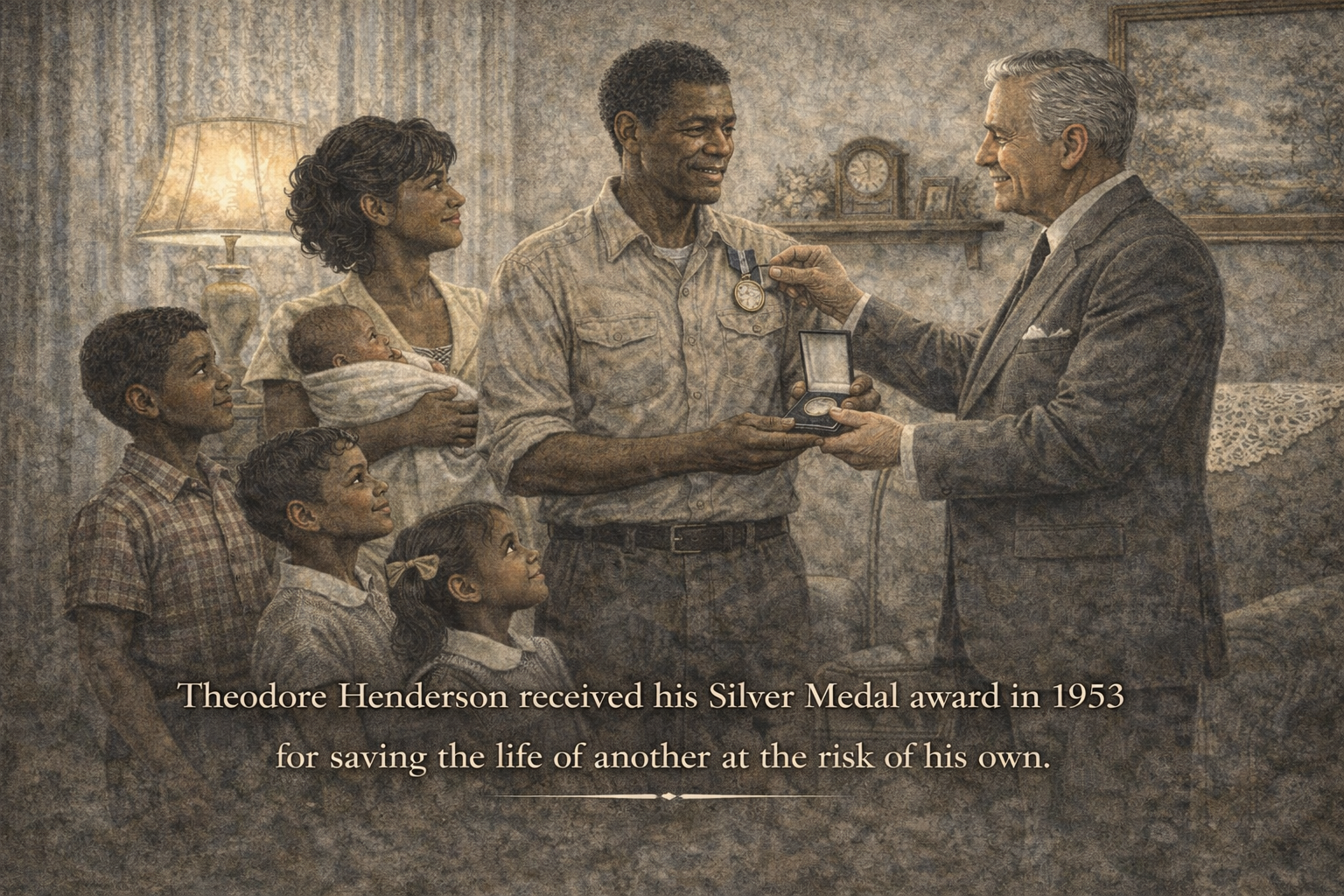
Theodore Henderson’s courage was formally recognized by the Carnegie Hero Fund Commission, an organization founded in 1904 by Andrew Carnegie to honor civilians who risk their lives to save others.
The Commission is still active today—quietly identifying acts of extraordinary bravery and supporting the heroes behind them.
If this story moved you, consider visiting carnegiehero.org and liking or following the Carnegie Hero Fund Commission on Facebook to help preserve and elevate stories of everyday heroism.
In a world that often celebrates noise, they honor courage.
Sources
Orlando Sentinel, November 22, 1962 (reprint of Redbook magazine article)
Miami Herald, November 27, 1962
Indian River Press Journal (Vero Beach, FL):
August 20, 1953
September 3, 1953
September 17, 1953
Tampa Times, August 18, 1953