The Color That Sold America: Mamie Eisenhower, Margaret Hayden Rorke, and the Rise of “First Lady Pink”
On a chilly February morning in 1953, listeners tuning into a popular New York radio show heard something unusual. Dorothy Kilgallen, the sharp-witted columnist and broadcaster, held in her hand a small swatch of silk—sent directly from the Textile Color Card Association.
It was, she said, “the most beautiful shade of pink” she had ever seen. The color had a name: “First Lady Pink.” And behind the color name stood not just Mamie Eisenhower—but a formidable partner most Americans have never heard of: Margaret Hayden Rorke.
A Partnership Begins
In November 1952, just weeks after the election, Margaret Hayden Rorke—managing director of the Textile Color Card Association (T.C.C.A.)—sent a request to the incoming First Lady: Would Mrs. Eisenhower allow a color to be created in her honor?
This was no small gesture. The T.C.C.A. was the central authority on color standardization in American industry, coordinating thousands of manufacturers across textiles, fashion, and consumer goods. When a color was named and distributed through their system, it didn’t remain a suggestion—it became a national directive for production.
Mamie Eisenhower said yes.
From Gown to National Standard
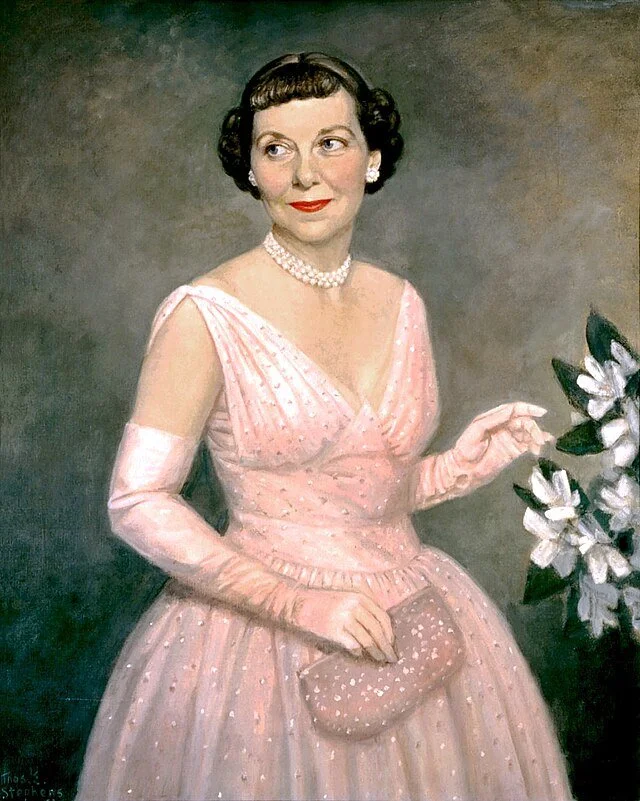
The timing could not have been better. Mamie’s inaugural ball gown—designed in a soft, luminous pink—had already captured public attention. But black-and-white photography left Americans guessing. Rorke sought the opportunity to collaborate with the incoming First Lady.
Working quickly, she secured an exact fabric match. At first it was going to be named “Mamie Pink;” however it was Mrs. Eisenhower who insisted the shade be named, “First Lady Pink.” What followed was a masterclass in coordination and timing—without the benefit of modern technology.
Within days silk swatches were produced, announcements were distributed, and manufacturers were alerted. Across the country, instructions went out with urgency: dye, display and sell products in “First Lady Pink.”
The Retail Chain Reaction
The response was immediate. Retailers flooded their shelves with: hats, gloves, scarves, and dresses. Fabrics, accessories, and home décor soon were branded “First Lady Pink.” Soon, the color expanded far beyond fashion: kitchen appliances, bathroom fixtures, furniture and plastics all came in a version of soft pink.
What began as a ballgown became a nationwide consumer phenomenon—touching nearly every corner of American domestic life.
The Woman Behind the Color
Margaret Hayden Rorke was no passive facilitator. She was one of the most influential figures in American design and manufacturing. A former actress turned business leader, Rorke built the T.C.C.A. into an international authority with offices across Europe and Asia. She standardized colors for: the U.S. military, national manufacturing systems, and even the American flag. She understood something essential:
Color was not just aesthetic—it was economic.
And with Mamie Eisenhower, she found the perfect partner to bring that insight to life.
Importance
The story of “First Lady Pink” is not simply about fashion. Mamie Eisenhower did not deliver speeches or campaign for legislation. Instead, she made a decision—quietly, deliberately—that activated an entire network of industry leaders, manufacturers, and retailers. Margaret Hayden Rorke supplied the infrastructure, and Mamie Eisenhower supplied the cultural force.
Together, they demonstrate a form of leadership that often goes unrecognized: the power to shape behavior, markets, and taste—without ever issuing a command.
This was not coincidence, rather it was coordination through partnership.
It was, in every sense, housepower.
For more in-depth research on this topic, read my full article, “Housepower: Mamie Eisenhower’s Hidden Hand Partnerships,” published in the Journal of First Ladies Studies. Click below:
Source
Leahy, Sharon, “Housepower: Mamie Eisenhower’s Hidden Hand Partnerships,” Journal of First Ladies Studies, Vol. 1, No. 1, (Spring/Summer) 1-34.
Image
Portrait of Mamie Eisenhower, Oil on Canvas, Thomas Edgar Stephens, 1959, Open Source: Wikimedia Commons.