The Dinner That Served Up a Capital
Jefferson, Hamilton, and Madison at the Table Where a New City Was Set in Motion
A Desperate Appeal at Washington’s Door
In June 1790, Secretary of State Thomas Jefferson approached the door to President George Washington’s residence in New York City (New York was the first capital of the United States).
Just as he was about to go inside, Alexander Hamilton appeared, materializing almost out of thin air. Jefferson was startled to see the Treasury Secretary looking “sombre, haggard, and dejected beyond description. Even his dress uncouth and neglected.” Hamilton asked for a moment of Jefferson’s time.
Hamilton quickly got to the point. He was seeking Jefferson’s support for a crucial component of his financial program, which had stalled in Congress. Hamilton had drafted a proposal for the national government to assume the debts the states had incurred during the American Revolution, part of a plan to establish what he called the “public credit” of the United States. Without passage of the assumption plan, Hamilton informed Jefferson, he would be forced to resign from Washington’s cabinet.
Jefferson Suggests a Private Dinner
As Secretary of State, Jefferson concerned himself chiefly with foreign affairs. But he was fully aware that his fellow Virginian James Madison had used his influence as a member of Congress to construct a voting bloc that stymied Hamilton’s plan for assumption. Madison argued that since Virginia had already extinguished most of her debts and northern states like Massachusetts had not, what Hamilton proposed would reward irresponsible behavior. Jefferson suggested that perhaps he, Madison, and Hamilton should dine together and hash out an agreement that would allow Hamilton to get what he wanted. Hamilton readily agreed, and on June 20, the three men met for dinner at Jefferson’s residence.
What Happened Around the Table
In a memorandum composed two years later, Jefferson maintained that the dinner prompted the salutary effect Hamilton had hoped for. Madison agreed to tone down his opposition to assumption and allow the members of his bloc to vote as they saw fit, though he himself would not support the measure.
“It was observed,” Jefferson wrote, “I forget by which of them, that as the pill would be a bitter one for the Southern states, something should be done to soothe them; that the removal of the seat of government to the Patowmac [sic] was a just measure, and would probably be a popular one with them, and would be a proper one to follow the assumption.”
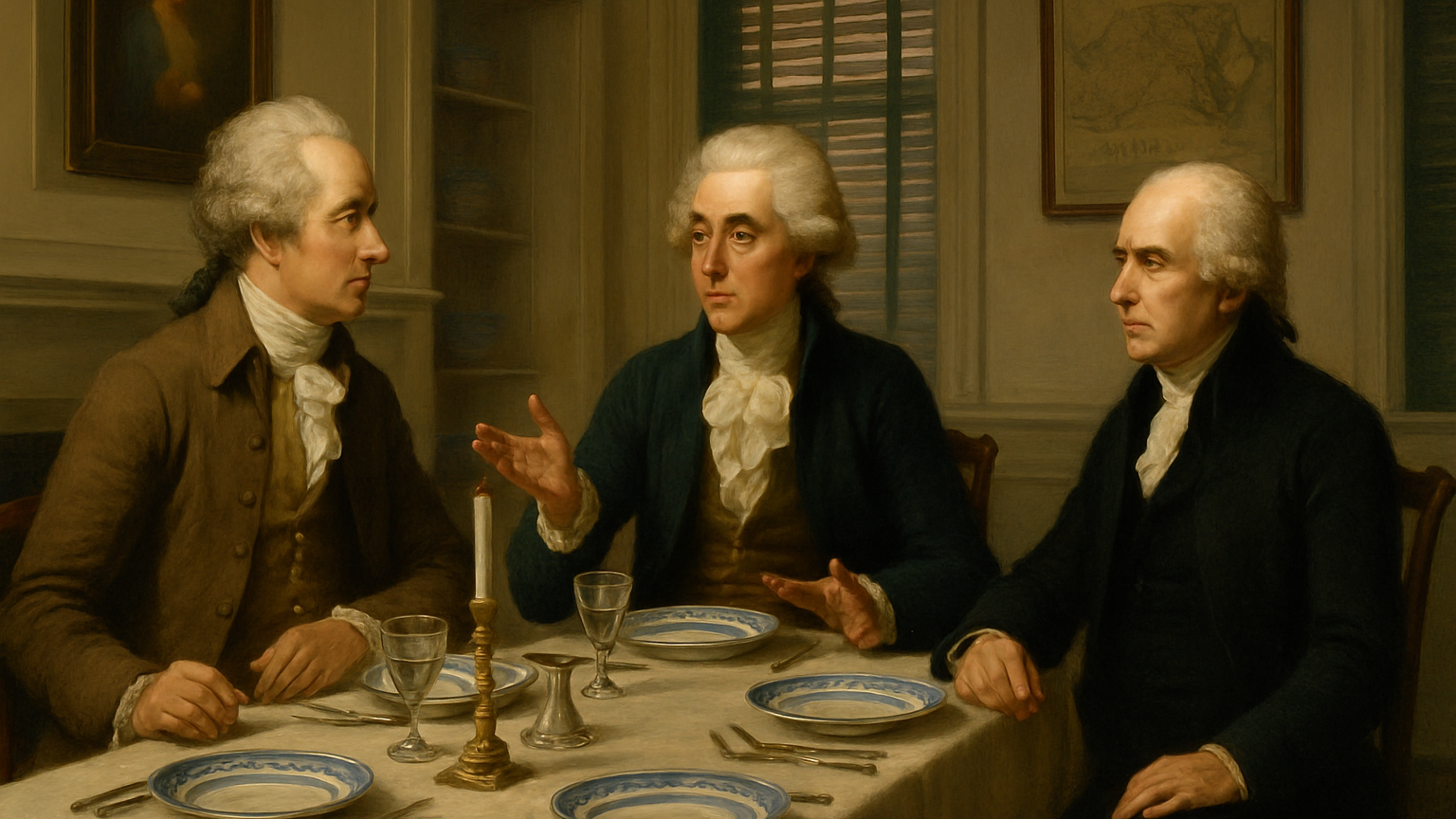
The Capital for the Nation
Thus, the more significant outcome of this now famous dinner was the agreement of the three men to work towards moving the nation’s capital permanently to a site on the Potomac River, which, of course, became Washington, DC. Historians have quibbled with some of the granular details of the agreement, have rightly argued that much of the groundwork for both assumption and the removal of the capital had already been developed before the dinner on June 20, 1790, and correctly maintained that Jefferson, Madison, and Hamilton could not finalize the deal all by themselves.
Debates Among Historians
As Stanley Elkins and Eric McKitrik point out, however, “considering the circumstances…no settlement not acquiesced in by them was likely to occur. One might assume that what they agreed upon at that quiet dinner provided the moral cement needed to make the arrangement cohere until passage and—since there would still be ten or fifteen years in which anything might happen to it—to guarantee that it would continue to hold afterward. And if the occasion achieved nothing else, it secured an asset of crucial value to the assumptionists, the silence of James Madison.”
Why It Matters
In the aftermath of the dinner, Congress got to work solidifying plans for the permanent nation’s capital. The capital would move from New York to Philadelphia for a period of ten years, to allow for the development of Washington, DC. In 1800, the United States would enjoy a new seat of government. While it took many years for Washington to shed its somewhat provincial status (when compared to London or Paris) and earn the respect of its own citizens and foreign visitors, the new capital’s location owed a great deal to the meeting of the minds that occurred at Thomas Jefferson’s house on June 20, 1790.
IMAGE CAPTIONS
Main Composite Image:
An imagined reconstruction of the June 20, 1790 dinner at Thomas Jefferson’s New York residence, where Alexander Hamilton, James Madison, and Jefferson forged a political understanding that helped pave the way for the assumption deal and the location of the permanent U.S. capital.
Individual Portraits (if included):
Thomas Jefferson, portrait by Mather Brown.
Alexander Hamilton, portrait by Ezra Ames.
James Madison, portrait by Charles Willson Peale.
History in Two Voices explores the stories that shaped the American experience. This post is for historical understanding, not a political statement.
If you enjoyed this story, you’re welcome to stay connected and complete the form below.
We share occasional stories from America’s past — no spam, just history.