The First Inauguration
“Long live George Washington, President of the United States!”
With this proclamation—and an enthusiastic sweep of both arms—Robert R. Livingston, Chancellor of the State of New York, concluded the April 30, 1789, inauguration of the nation’s first president. Washington had taken the oath of office moments earlier, shortly after noon.
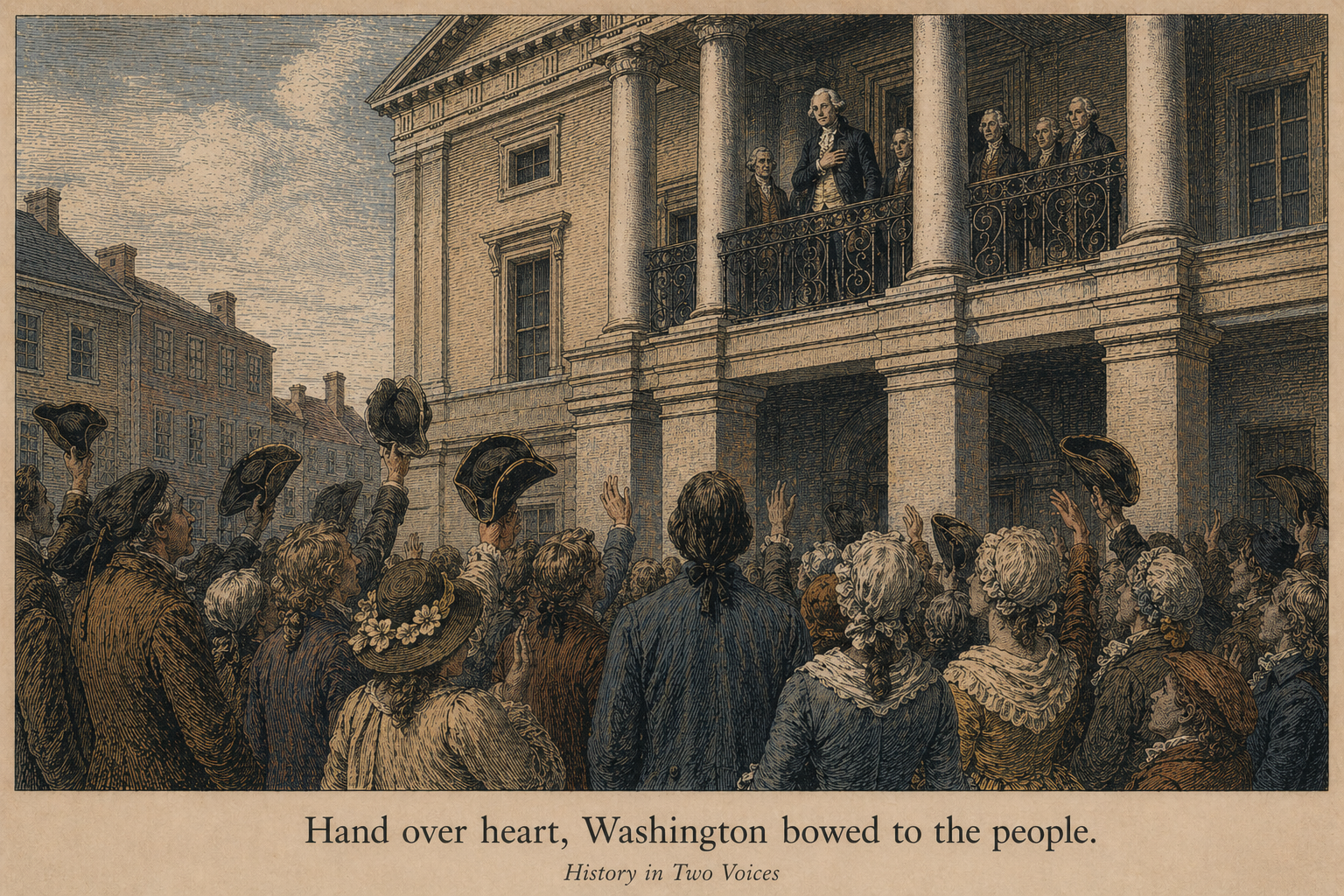
Deeply moved by the solemnity of the moment, he leaned forward, grasped the Bible upon which he had taken the oath, and kissed it. Standing on the balcony of New York City’s Federal Hall, gazing out at the cheering crowd gathered along Wall and Nassau Streets, Washington placed a hand on his heart and bowed several times.
It had been a whirlwind two weeks for the new president. After learning that the Electoral College had unanimously chosen him on February 4, 1789, Washington prepared to leave Mount Vernon. On April 16, he departed by coach, heading north toward New York City. Passing through six states, he was celebrated at nearly every stop—honored at dinners, escorted by military processions, and greeted with the booming of cannons.
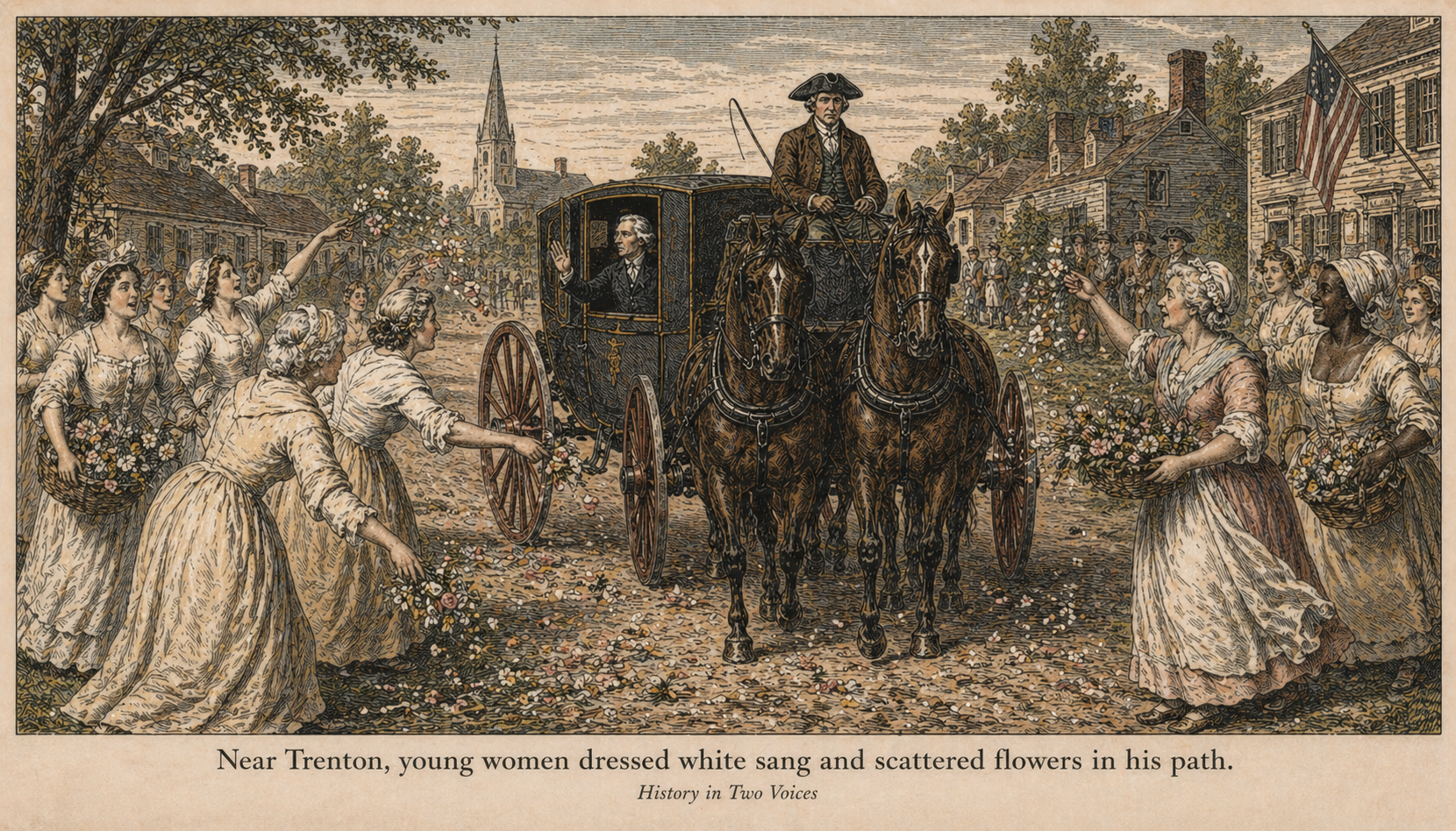
Near Trenton, New Jersey, young women dressed in white sang to him and scattered flowers in his path. Slightly embarrassed by the adulation, Washington eventually mounted a horse, allowing the people a better view during what had become a triumphal journey.
Washington interpreted this enthusiastic reception as a kind of public ratification. Having played a central role in securing adoption of the U.S. Constitution, he now saw the people affirming not only the new government, but his leadership within it. He understood clearly that his presidency would set precedents—serving as a test of legitimacy for himself, his policies, and the constitutional republic he now led.
That test began auspiciously on inauguration day. The French minister to the United States, the Count de Moustier, observed that there had never been a moment when a “sovereign reigned more completely in the hearts of his subjects” than Washington did among his fellow citizens. He possessed, Moustier wrote, “the soul, look, and figure of a hero united in him.”
The United States would need all that Washington brought to bear to ensure the success of the new nation.
Our Perspective
The first inauguration was more than ceremony—it was a moment of national definition.
Nothing about the American presidency was fully established in 1789. There were no traditions, no settled expectations, and no guarantee that the experiment in republican government would endure. Every gesture Washington made—his restraint, his humility, even the way he received public praise—helped shape what the presidency would become.
Just as importantly, the public response to Washington revealed something essential about the early republic: Americans were not simply accepting a new form of government—they were emotionally investing in it. The celebrations, the processions, the almost monarchical admiration did not signal a rejection of republican ideals, but rather a search for stability in an uncertain moment.
Washington stood at the center of that balance. He had to embody authority without becoming a monarch, command loyalty without demanding it, and establish precedent without overreaching. The success of that delicate performance gave the presidency—and the Constitution itself—its first real measure of legitimacy.
In that sense, the first inauguration was not just the beginning of a presidency. It was the beginning of trust in the American system.
If you enjoy our blog content, consider Pre-ordering our forthcoming biography, Presidentess: The Life of First Lady Julia Gardiner Tyler. Use code 24LADYJULIA for 30% off at checkout.
Sources
Stanley Elkins and Eric McKitrick, The Age of Federalism: The Early American Republic, 1788–1800 (Oxford University Press, 1993).
Ron Chernow, Washington: A Life (Penguin, 2010).
Image Citations
Slide 1 – Washington Leaves Mount Vernon
Leahy, Sharon. Image concept and direction. AI-assisted illustration generated using digital tools, 2026.
Slide 2 – Trenton Flower Scene
Leahy, Sharon. Image concept and direction. AI-assisted illustration generated using digital tools, 2026.
Slide 3 – Arrival in New York City / Federal Hall in Distance
Leahy, Sharon. Image concept and direction. AI-assisted illustration generated using digital tools, 2026.
Slide 4 – Oath of Office (Balcony Scene)
Leahy, Sharon. Image concept and direction. AI-assisted illustration generated using digital tools, 2026.
Inspired by historical engravings of Washington’s inauguration, including works in the public domain.
Slide 5 – Balcony Close View (Inspired by Wikimedia Commons Image)
Leahy, Sharon. Image concept and direction. AI-assisted illustration generated using digital tools, 2026.
Based on an original engraving of Washington’s inauguration balcony scene, via Wikimedia Commons (public domain).
Slide 6 – Federal Hall Exterior (Street Perspective / Bowing Scene)
Leahy, Sharon. Image concept and direction. AI-assisted illustration generated using digital tools, 2026.
Inspired by “View of the Federal Edifice in New York,” via Wikimedia Commons (public domain).