The Journey Before the Journey: When Nellie Bly Turned Her Reporter’s Eye to America’s First Ladies
In 1889, a confident young reporter named Elizabeth Cochrane, better known as Nellie Bly, boarded a ship at Hoboken and set out to beat the fictional record in Jules Verne’s Around the World in Eighty Days. She completed her journey in a remarkable 72 days, becoming a global celebrity and redefining the possibilities for women journalists.
But one year earlier, in 1888, Bly undertook a very different kind of trip — one that has been largely forgotten, yet essential to the history of American women in public life. Before she raced around the world, she crisscrossed the United States to interview every living former First Lady, along with the woman who had served as President Chester Arthur’s White House hostess.
Her purpose was bold and ahead of its time:
To document the lives, memories, and political insights of the women who had shaped the Executive Mansion.
At a moment when women’s voices were routinely dismissed, Bly recognized that First Ladies were historical actors whose experiences deserved careful preservation.
The 1888 First Lady Interview Tour
In 1888, Nellie Bly set off on an ambitious journey through Virginia, Tennessee, Maryland, New York, Ohio, and beyond. Her reporting appeared under the headline:
“Ladies Who Have Been the First Ladies of the Land,”
Chicago Tribune, November 4, 1888.
During that year, she interviewed:
Julia Gardiner Tyler in Richmond, Virginia
Sarah Childress Polk in Nashville, Tennessee
Harriet Lane Johnston in Baltimore, Maryland
Julia Dent Grant in New York City
Lucy Webb Hayes in Fremont, Ohio
Lucretia Rudolph Garfield in Mentor, Ohio
Mary Arthur McElroy, Acting First Lady for her brother, in Albany, New York
Not long afterward, she also secured an interview with the sitting First Lady, Frances Folsom Cleveland, the youngest First Lady in American history. Her profile of Mrs. Cleveland — often published under the headline “A Chat with Cleveland’s Bride” — became one of the earliest widely circulated First Lady interviews in the national press.
What is astonishing is not only the access she obtained but the depth and generosity of what these women shared. They spoke to Bly with a candor and clarity that suggest an unusual level of trust in this determined young reporter.
Bly’s articles from 1888 provide historians today with invaluable firsthand recollections:
how these women understood their public roles,
how they managed political upheaval,
how they viewed their husbands’ presidencies,
and how they remembered life inside the Executive Mansion.
She captured details, impressions, and personal reflections that appear nowhere else in the historical record.
Why It Matters
Long before her name became synonymous with global adventure, Nellie Bly was already reshaping the way Americans understood First Ladies. Her 1888 interviews helped shift the press from viewing presidential spouses as ornamental figures to acknowledging them as participants in the nation’s political and social life.
Her work underscores several truths that remain relevant today:
First Ladies are central to the American story, even when the historical record has been uneven in preserving their voices.
Women’s history requires intentional documentation — otherwise, it risks being lost.
Journalism can serve as a form of preservation, especially when traditional historians have not yet taken up the task.
If Bly had not traveled the country in 1888 with her notebook, many of the memories of Julia Tyler, Sarah Polk, Harriet Lane Johnston, or Lucy Hayes — women who carried enormous responsibility — might have vanished.
Her reporting did more than inform. It safeguarded the voices of First Ladies.
To learn more about First Ladies, pre-order our forthcoming biography, Presidentess: The Life of First Lady Julia Gardiner Tyler, (Univ Press of Kansas, Sept 2026). Use code 24LADYJULIA at checkout for 30% off for a limited time.
Image Captions
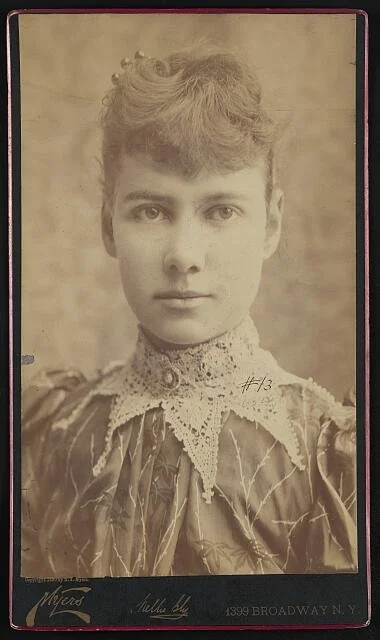
Portrait of Nellie Bly (Elizabeth Cochrane), ca. 1890.
Photographer: H. J. Myers.
Courtesy of the Library of Congress, Prints and Photographs Division, LC-USZ62-15622.
Public Domain.
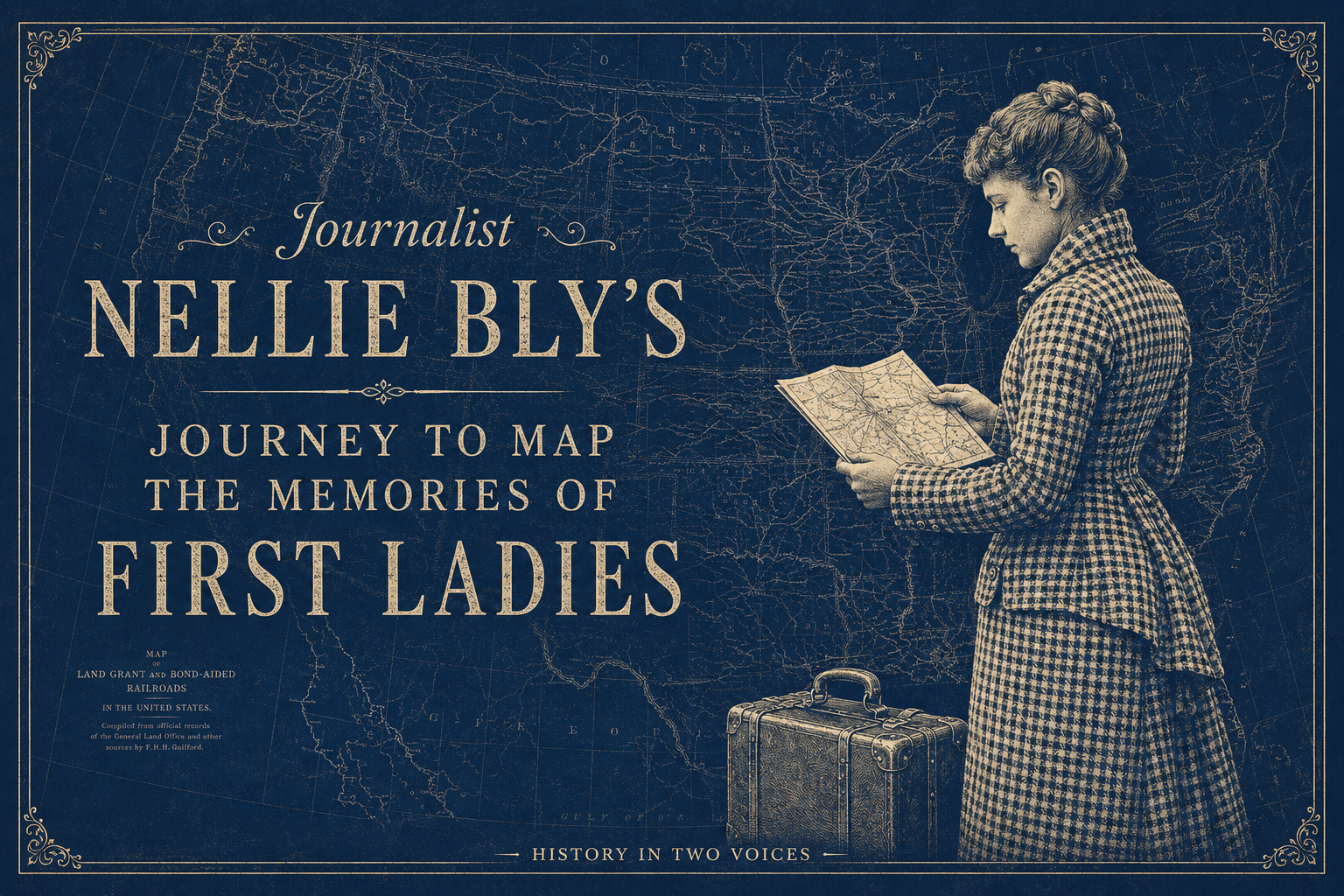
Leahy, Sharon. Image concept and direction. AI-assisted illustration generated using digital tools, 2026. Background map and Nellie Bly portrait adapted from Wikimedia Commons images: Nellie Bly in traveling cloak and Map of land-grant railroads.