A Remarkable Correspondence
Historians have long noted the unceasing political ambition of John Adams. Forgoing leisure, material success, and—at times—the presence of his family, he sought political fame above all else. Not content with playing bit parts on the public stage, Adams worked relentlessly to achieve stature as a Revolutionary, a founding father, and eventually, president of the United States.
As his biographer John Ferling has observed, however, “the public man also had a private side, and sometimes that dimension of a person’s character can disclose as much as one’s external conduct.”
Few of Adams’s contemporaries would have described him as a “hopeless romantic,” or imagined him as a flirtatious and ardent suitor. Abigail Smith knew better.
She met the future second president in the summer of 1759; he was not quite twenty-four, she not quite fifteen. John’s friend Richard Cranch likely introduced him to the Smith family. Abigail’s father, the Reverend William Smith, served for more than half a century as minister of the First Congregational Church in Weymouth, Massachusetts.
At the time, Adams was training for a career in the law and regularly visited the Smiths’ home—initially more for Cranch’s sake than his own. John was, in fact, romantically interested in Abigail’s cousin Hannah, though he ultimately decided not to court her. Impressed by Abigail’s intelligence, he did not at first see her as a potential mate. She was too young, he thought. Besides, she appeared interested in Richard Cranch. Before long, however, the budding lawyer found himself smitten.
Abigail took slightly longer to warm to him, but by the early fall of 1762 their relationship had become serious.
On October 3, 1762, John and Abigail stayed up late talking. The next day, after several hours away from his sweetheart, John wrote the first extant letter of their courtship.
“Miss Adorable,” he addressed her, “By the same Token that the Bearer hereof satt up with you last night I hereby order you to give him, as many Kisses, and as many Hours of your Company after 9 O’Clock as he shall please to Demand and charge them to my Account.”
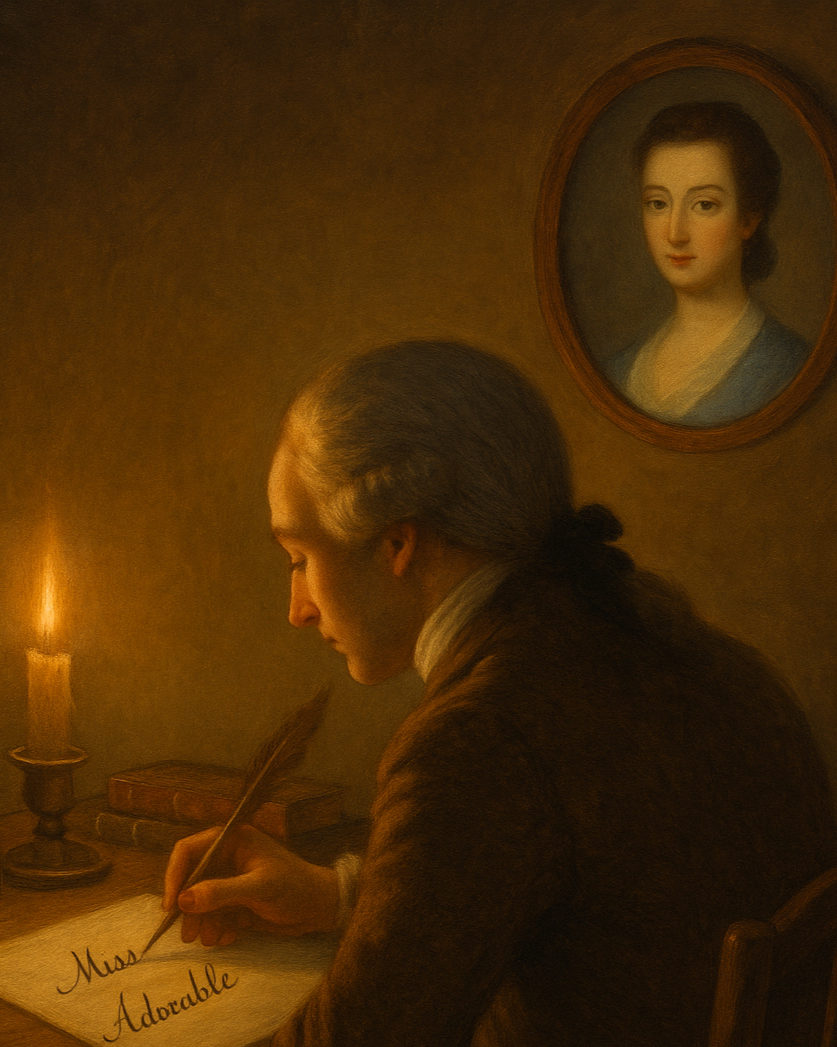
John declared that he had “good Right to draw upon you for the Kisses as I have given two or three Millions at least, when one has been rec’d, and of Consequence the Account between us is immensely in favour of yours.”
His ardor for Abigail was unmistakable.
Their courtship lasted three years. They were frequently apart, as John’s legal business required circuit riding throughout Massachusetts (and what would later become Maine). At the same time, he was beginning to make a name for himself in public affairs. Still, their romance flourished. Abigail even adopted the nickname “Diana” in their correspondence, a practice common among young women of the era.
The couple married on October 25, 1764.
Well before their union, John often addressed Abigail in his letters as “My Friend.” In time, he would address her in many—if not most—of them as “My Dearest Friend.” She later took on another classical nickname and became his “Portia.”
Theirs was a deep, emotionally sustaining marriage. Today, we might be inclined to think that the word friend implies something less than a romantic relationship. For John and Abigail Adams, however, the word nourished their bond and spoke to the multi-layered attachment they shared. For them, friend was romantic.
Why It Matters
As scholars Margaret A. Hogan and C. James Taylor have argued, John and Abigail Adams’s letters “held an importance that transcended the information they contained.” Read carefully, their correspondence allows us to glimpse the heart of one of the most significant marriages of the Founding Era.
The letters reveal personality, insecurity, triumph, tragedy, and ego. They also provide invaluable insight into the period itself—offering perspective on major events as well as details about the emergence of new ideas surrounding parenting, marriage, and family life.
Together, these letters stand as essential primary sources for understanding the political, social, and cultural history of the early American nation.
Sources
John Ferling, John Adams: A Life (New York: Henry Holt and Company, 1992).
Margaret A. Hogan and C. James Taylor, My Dearest Friend: Letters of Abigail and John Adams (Cambridge: Belknap Press of Harvard University Press, 2007).
Edith B. Gelles, Abigail and John: Portrait of a Marriage (New York: William Morrow, 2009).
Image:
“Miss Adorable.” Interpretive illustration of John Adams composing a letter to Abigail Smith, inspired by eighteenth-century portraiture and period correspondence. Created for History in Two Voices, 2025.