Arthur Robinson: Humble Hero of the Mystery Disaster
On a blustery July 10th afternoon in 1887, pleasure turned suddenly to panic on the waters of Jamaica Bay.
The sloop yacht Mystery, owned by members of the Crescent Yacht Club, had carried women and children back from an excursion to Ruffle Bar while the men traveled aboard other vessels. Considered one of the largest and fastest sloops in the bay, the Mystery should have been safe. Instead, she became the scene of one of the region’s deadliest maritime disasters.
Witnesses later testified that the Mystery was racing another vessel in squally winds. Her captain, David Heinrichs, carried too much sail. Her centerboard became fouled in the mud. A sudden gale struck. Within moments, the yacht was on her beam ends, water pouring into the cockpit, recovery impossible.
Women and children were thrown into the bay.
Fourteen people would eventually be rescued. Twenty others drowned.
And seven lives were saved by one man in a small rowboat.
“I Saw That Help Was Needed”
That man was Arthur Robinson, a deckhand and cook working aboard the schooner Reaper out of Barren Island.
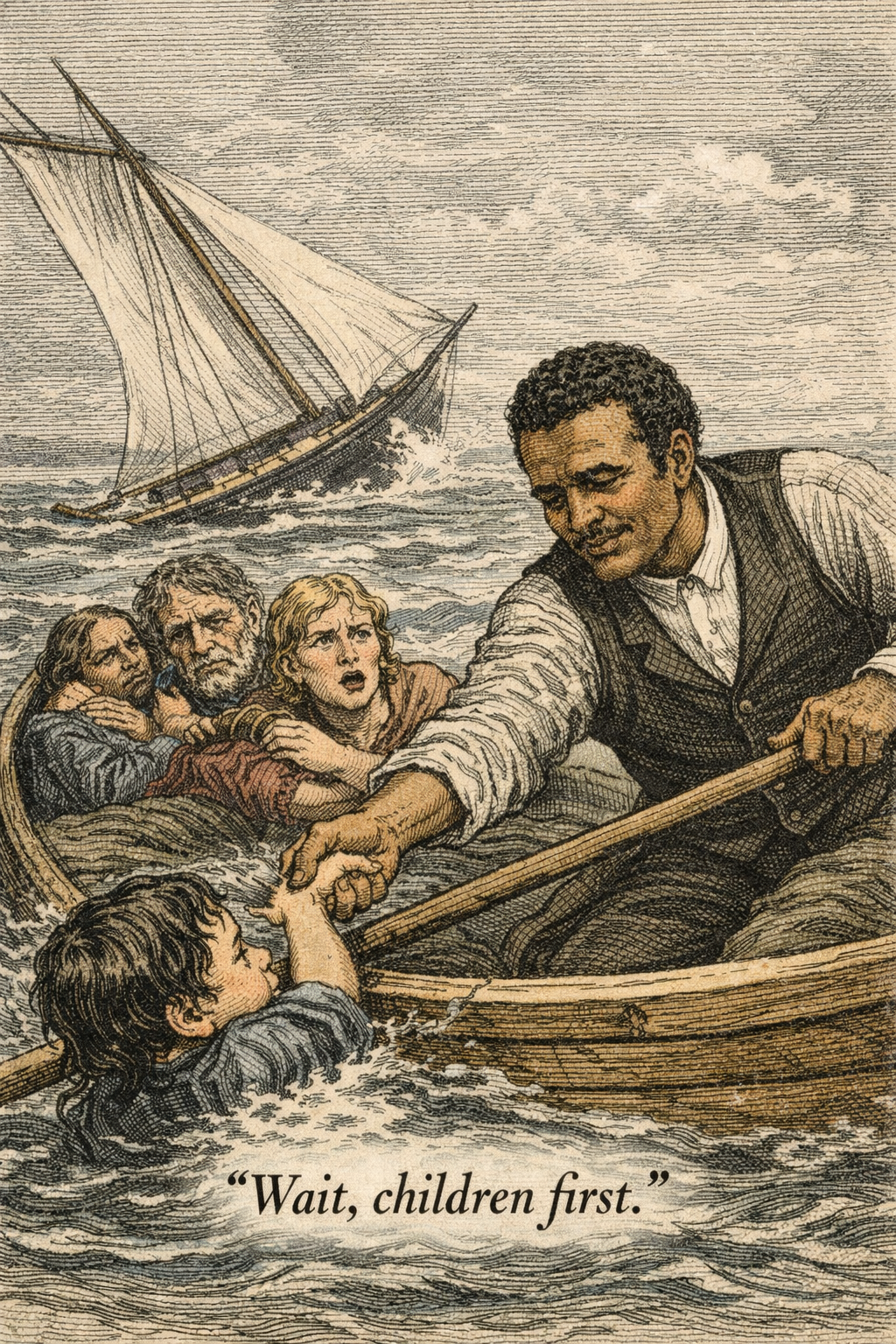
Robinson noticed the Mystery carrying more sail than conditions allowed. As the yacht heeled sharply, he did not wait for orders or assistance, using a small rowboat to help in the rescue efforts.
He rowed for fifteen minutes, straight into the wreckage.
Newspapers across the country marveled at what followed. Robinson dragged those too exhausted to help themselves into his fragile boat. Others he lashed to the gunwales. When the weight of one large woman nearly capsized his vessel, he steadied himself, feet braced firmly on the keel.
“The first person I took up was a little boy,” Robinson later recalled. “Then a man, his wife and child. Then others. I was trying to save all I could.”
Seven were pulled from the water by his hands alone.
A Reluctant Hero
In the days that followed, Robinson’s actions drew national attention — and offers he refused.
Showmen tried to book him for exhibitions. One offered $350 for a week’s engagement; another $75 for a single Sunday. Robinson declined them all. He did not seek notoriety. He returned to his work as a cook.
Instead, recognition came in quieter, more meaningful ways.
The Life Saving Benevolent Association of New York awarded Robinson a silver medal enclosed in a Morocco-leather case, inscribed in recognition of his “humanity and heroism.” He was appointed a lieutenant in the Volunteer Life Saving Corps. Civic organizations presented resolutions praising not only his bravery, but his character.
One medal bore a scene of the capsizing yacht. Another would later be struck in gold, its design suspended from anchor chains, engraved with the words Robinson shouted as passengers scrambled toward safety:
“Wait — children first.”
A Life Shaped by the Sea
Robinson was born in Aquia Creek, Virginia, and believed himself to be about thirty-seven years old at the time of the disaster. He had run away to sea at the age of ten, learning to cook aboard sailing vessels and spending most of his life on the water.
A reporter who met him at Canarsie Landing described a modest man in a cutaway suit and straw hat, weighing no more than 140 pounds — possessed of what the journalist called “a clear head and a lot of latent pluck that appears when face to face with danger.”
Robinson himself explained it more simply:
“I see them strugglin’ and screamin’ in the water; I see myself and knows as all depends on me.”
Aftermath and Accountability
The inquest into the Mystery disaster placed responsibility squarely on unsafe practices: too much sail, insufficient crew, and the absence of small boats. Jurors urged reforms to pleasure sailing in Jamaica Bay, recommending that all such vessels carry trained assistance and proper lifesaving equipment.
Those changes came too late for the twenty who died.
But because of Arthur Robinson, seven lived.
Why It Matters
Arthur Robinson’s story reminds us that heroism does not announce itself. It rows quietly into danger. It refuses spectacle. It chooses duty over reward.
Robinson was celebrated — not as a curiosity, but as a man whose “everyday life” matched his extraordinary courage.
He asked for no fame.
History owes him remembrance.
Image: Interpretive illustration inspired by an 1887 newspaper engraving and contemporary accounts of the Mystery disaster. Created for History in Two Voices.