A Renewed Friendship
“When languishing then under disease, how grateful is the solace of our friends! How are we penetrated with their assiduities and attentions! How much are we supported by their encouragements and kind offices!”
Jefferson’s “Dialogue” of Head and Heart
These lines come from Thomas Jefferson’s famous “Dialogue” between his head and heart that he constructed in a famous letter to his friend Maria Cosway on October 12, 1786. Jefferson was reflecting on the flirtation he had enjoyed in Paris with the younger—and married—woman. The heart steals more words in the 4000-word missive, but the head wins out, as Jefferson indicates their flirtation is over.
His judgment on friendship applies to an even more significant relationship in Jefferson’s life: the one he shared with John Adams.
Linked by the Revolution
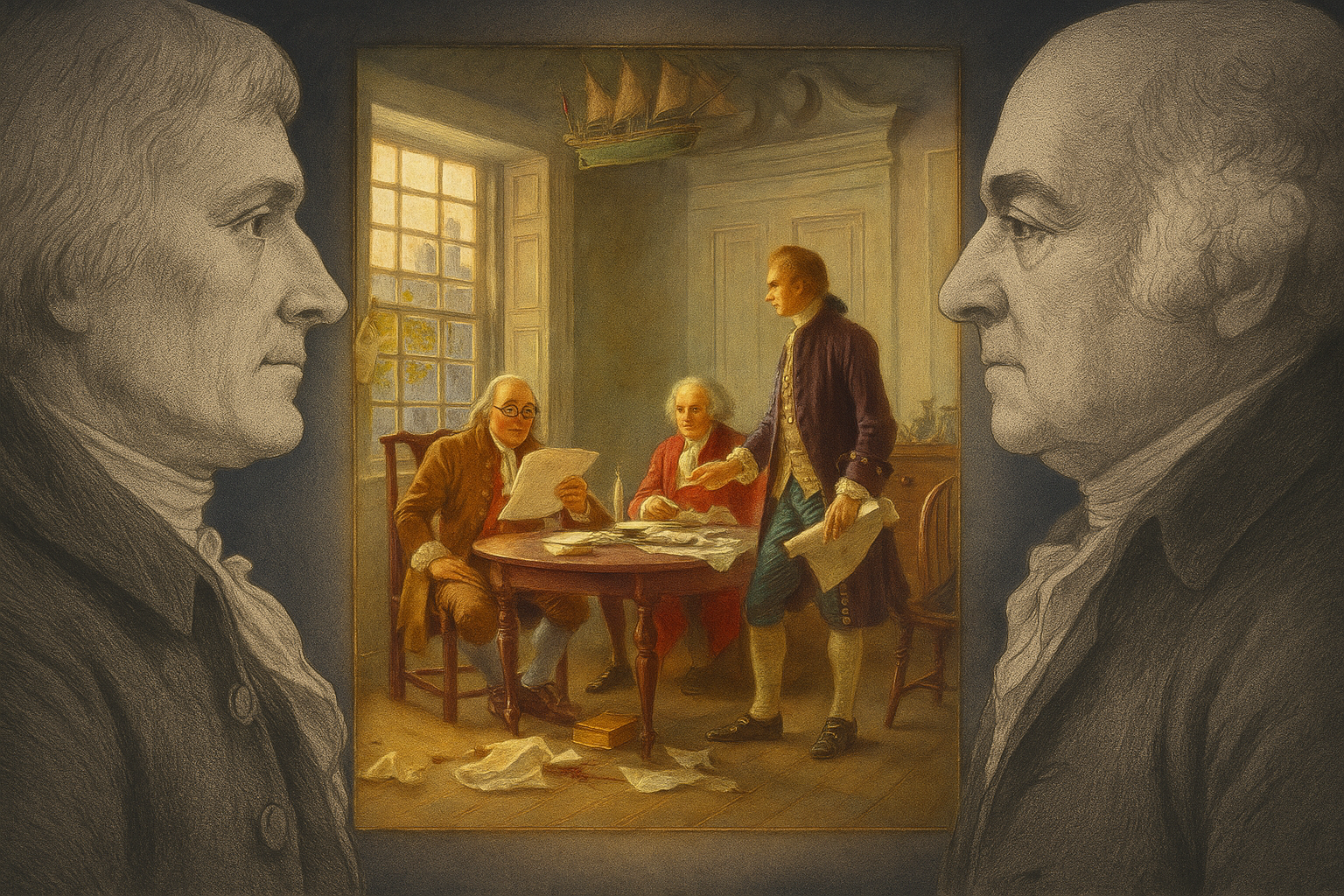
The two men had served together on the Committee of Five that the Second Continental Congress appointed to draft the Declaration of Independence. While Adams and the other members of the Committee deferred to Jefferson’s superior way with words and let him compose what became, as one prominent historian put it, “American Scripture,” the two men became inextricably linked as patriots of the Revolution and founders of the nation.
A Friendship Broken by Politics
In the wake of the bitterly contested presidential election of 1800, which cost the incumbent Adams a second term and placed Jefferson in the Executive Mansion, the two friends had a falling out. Partisan politics destroyed their friendship.
The two men were still not speaking in April 1804, when Jefferson’s younger daughter, Polly, died at the age of twenty-five. Abigail Adams, the former first lady, wrote to Jefferson, unbeknownst to her husband, expressing her condolences. Her letter began an exchange with Jefferson that lasted for much of the summer. Unfortunately, the correspondence did not restore the friendship between the two men.
Dr. Benjamin Rush Steps In
The task of reconciling the two aging patriots fell to their mutual friend and fellow revolutionary, Dr. Benjamin Rush. In 1809, Rush wrote to Adams, relating a dream that forecast a renewal of his relationship with Jefferson. Rush then operated as a broker, dispatching letters to both Adams and Jefferson, doing all he could to bring them together again. It worked—though it took a while. On New Year’s Day 1812, Adams sent Jefferson a letter. With the ice broken, mail traveled regularly between Massachusetts and Virginia. “You and I,” Adams declared in one note, “ought not to die before We have explained ourselves to each other.”
A Remarkable July 4th Farewell
Fittingly, Thomas Jefferson and John Adams both died on July 4, 1826, the fiftieth anniversary of the Declaration of Independence. Legend has it that Adams whispered “Thomas Jefferson survives” shortly before he passed away. He could not have known of course that his once-again friend had beaten him to immortality just six hours earlier.
Over the years since they renewed their correspondence, the two men exemplified the sentiments about friendship that Jefferson expressed in his “Dialogue” letter. Their deaths on the day of the nation’s Golden Jubilee reinforced the providential character many Americans believed—and still believe—animated their Revolution.
Sources
Gordon S. Wood, Friends Divided: John Adams and Thomas Jefferson (New York: Penguin Books, 2017);
Lester J. Cappon, ed., The Adams-Jefferson Letters: The Complete Correspondence between Thomas Jefferson & Abigail & John Adams (Chapel Hill: University of North Carolina Press, 1987).
Images: “Thomas Jefferson, John Adams, and Benjamin Franklin working on the Declaration of Independence.”
Painting by J. L. G. Ferris, c. 1900. Courtesy of Wikimedia Commons.