Bicentennial Logos: National Symbols, Local Meaning (1975–1976)
Participation Over Spectacle
As the American Bicentennial approached, communities across the country embraced a guiding principle: participation mattered more than spectacle.
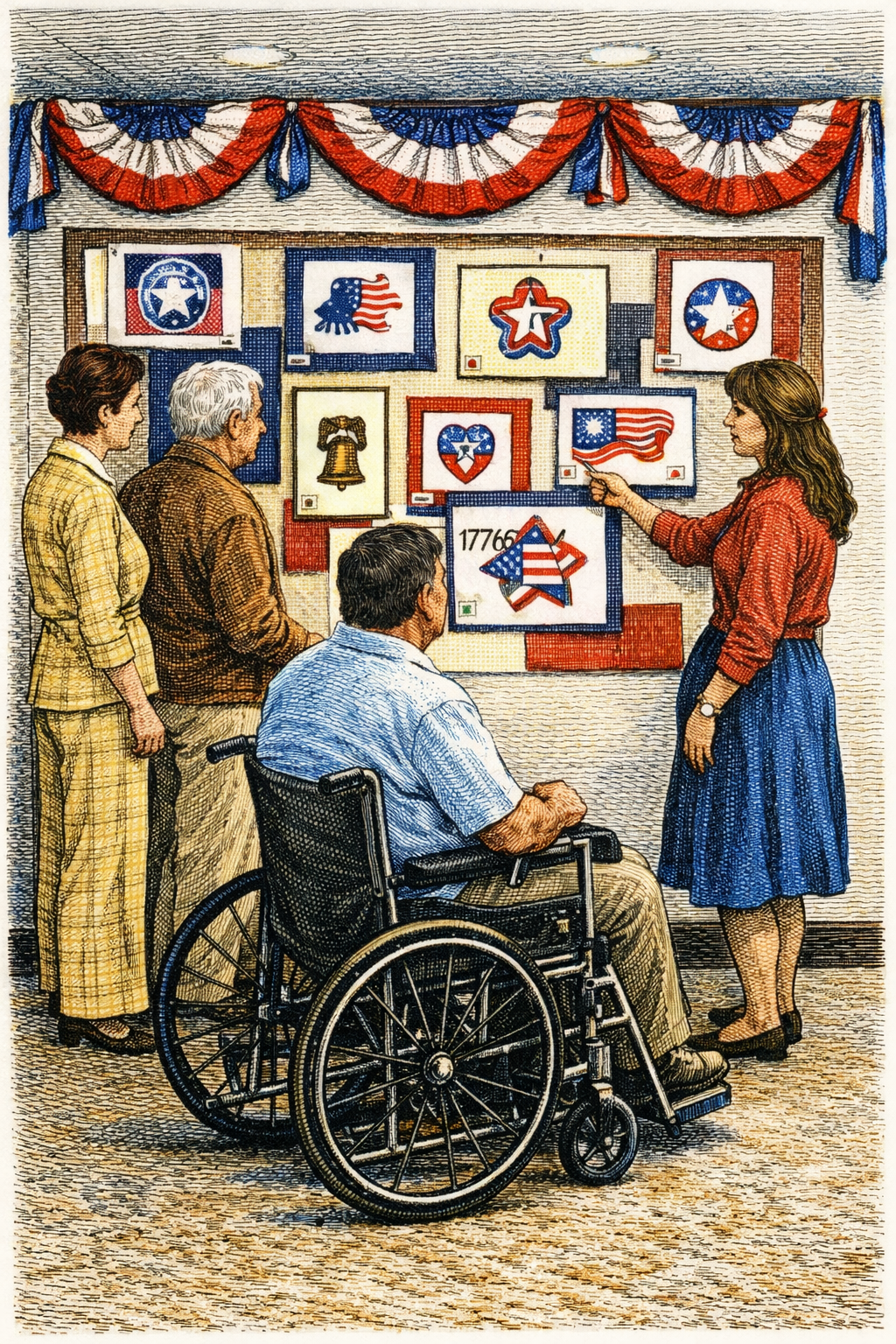
In Washington State, county planners made that goal explicit. As reported by the Daily Sun in Sunnyside (May 15, 1975), Chamber of Commerce leaders emphasized that Bicentennial success would be judged “by the number of participants, not the number of spectators.” One way to achieve that goal was through county-wide logo design contests, inviting residents—especially students—to visually define how their communities would mark the nation’s 200th anniversary.
This local creativity unfolded alongside a carefully regulated national symbol. The official U.S. Bicentennial emblem—developed under the authority of the American Revolution Bicentennial Administration—featured a white five-pointed star encircled by continuous red, white, and blue stripes forming a second star. According to Bicentennial literature cited by the Albuquerque Journal (August 7, 1975), the double star symbolized the two centuries that had passed since the American Revolution.
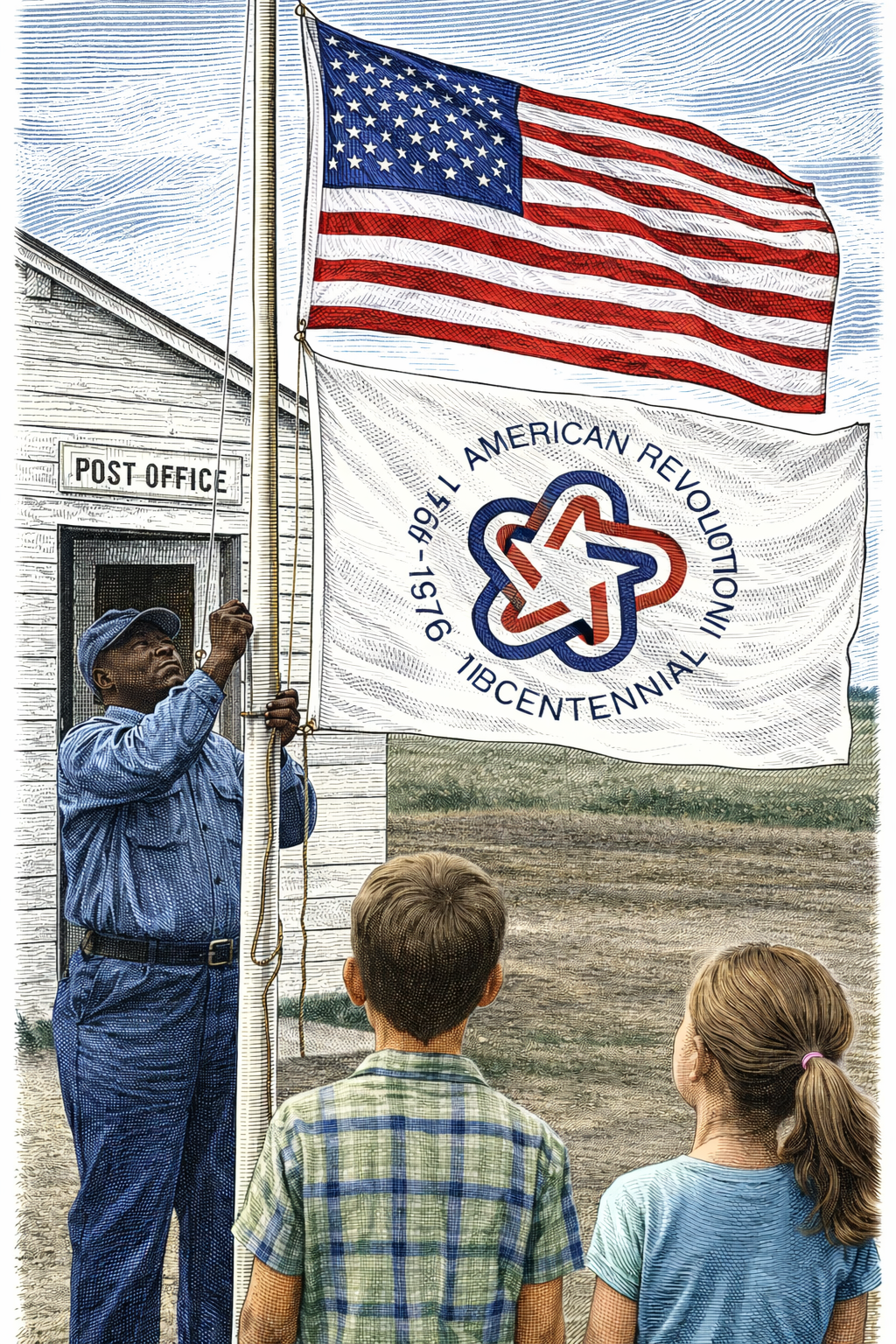
The National Bicentennial Emblem
Use of the emblem was restricted by law, but ARBA permitted licensed items—such as bumper stickers and commemorative license plates—to be sold by states and communities to help offset Bicentennial costs and fund local programming.
State Symbols and Regional Meaning
States often blended national symbolism with regional identity. New Mexico’s Bicentennial logo, for example, combined an American eagle—holding an atom in one talon to represent present knowledge and an open talon to signify the unknown future—with the Zia Sun Symbol, honoring the state’s Native American heritage.
Visibility was key. In Vermont, the Rutland Daily Herald (December 24, 1975) reported that the Vermont Bicentennial Commission worked with the state Department of Highways to install both state and national Bicentennial logos on overhead signs along Interstates 89 and 91. These markers identified “nationally recognized Bicentennial communities” and were intended to remain in place through 1977—turning highways themselves into commemorative spaces.
Young people played a central role. In California’s Las Virgenes area, student-designed Bicentennial logos were displayed publicly at the local high school (News Chronicle, Thousand Oaks, October 27, 1975), reinforcing the idea that the anniversary belonged to a new generation as much as to the past.
Across the country—from Idaho to New Mexico—the same symbolism echoed. As the Times-News of Twin Falls (March 23, 1975) explained, the inner and outer stars of the national logo represented two centuries of American history, while thousands of local interpretations ensured that the Bicentennial was not only remembered—but made—by the people themselves.
Why It Matters
The Bicentennial was never meant to be a performance watched from the sidelines. As communities across the country made clear in 1975 and 1976, the goal was participation, not pageantry.
Logo contests, student exhibitions, and locally designed symbols turned abstract national history into something tangible and personal. By inviting citizens to help design the Bicentennial—literally shaping how it looked—communities encouraged ownership of the past rather than passive consumption of it.
The official national emblem provided a shared visual language, but it was the local adaptations that gave the anniversary depth. State and county logos blended regional identity, heritage, and aspiration, reminding Americans that the nation’s story had always been built from many distinct places and voices.
Even highway signage mattered. Marking “Bicentennial communities” along interstates transformed everyday travel into an encounter with history, reinforcing the idea that the anniversary belonged not just to museums or ceremonies, but to ordinary life.
Seen this way, the Bicentennial logos were more than decorations. They were tools of civic memory—designed to invite Americans of all ages into a shared act of remembrance at a moment when the country was still searching for cohesion after years of division.
Sources
Daily Sun (Sunnyside, Washington), May 15, 1975.
“Bicentennial Logs, National and Local.”Rutland Daily Herald (Rutland, Vermont), December 24, 1975.
Coverage of Vermont Bicentennial Commission and interstate highway signage.Albuquerque Journal (Albuquerque, New Mexico), August 7, 1975.
Description and legal use of the official U.S. Bicentennial emblem and ARBA licensing.News Chronicle (Thousand Oaks, California), October 27, 1975.
Student participation in local Bicentennial logo contests.Times-News (Twin Falls, Idaho), March 23, 1975.
Explanation of the symbolic meaning of the national Bicentennial logo.American Revolution Bicentennial Administration
Official federal body overseeing Bicentennial symbols, licensing, and national coordination.
Image Citation
Illustration inspired by:
Times-News (Twin Falls, Idaho), March 23, 1975.
Coverage explaining the symbolism of the official U.S. Bicentennial logo and its representation of two centuries since the American Revolution.
Artwork:
Digital illustration rendered in a fine-point engraving style with subtle colorization, created for History in Two Voices to interpret how national Bicentennial symbols appeared in everyday community life.