Mapping the First Ladies: Nellie Bly visits Sarah Polk
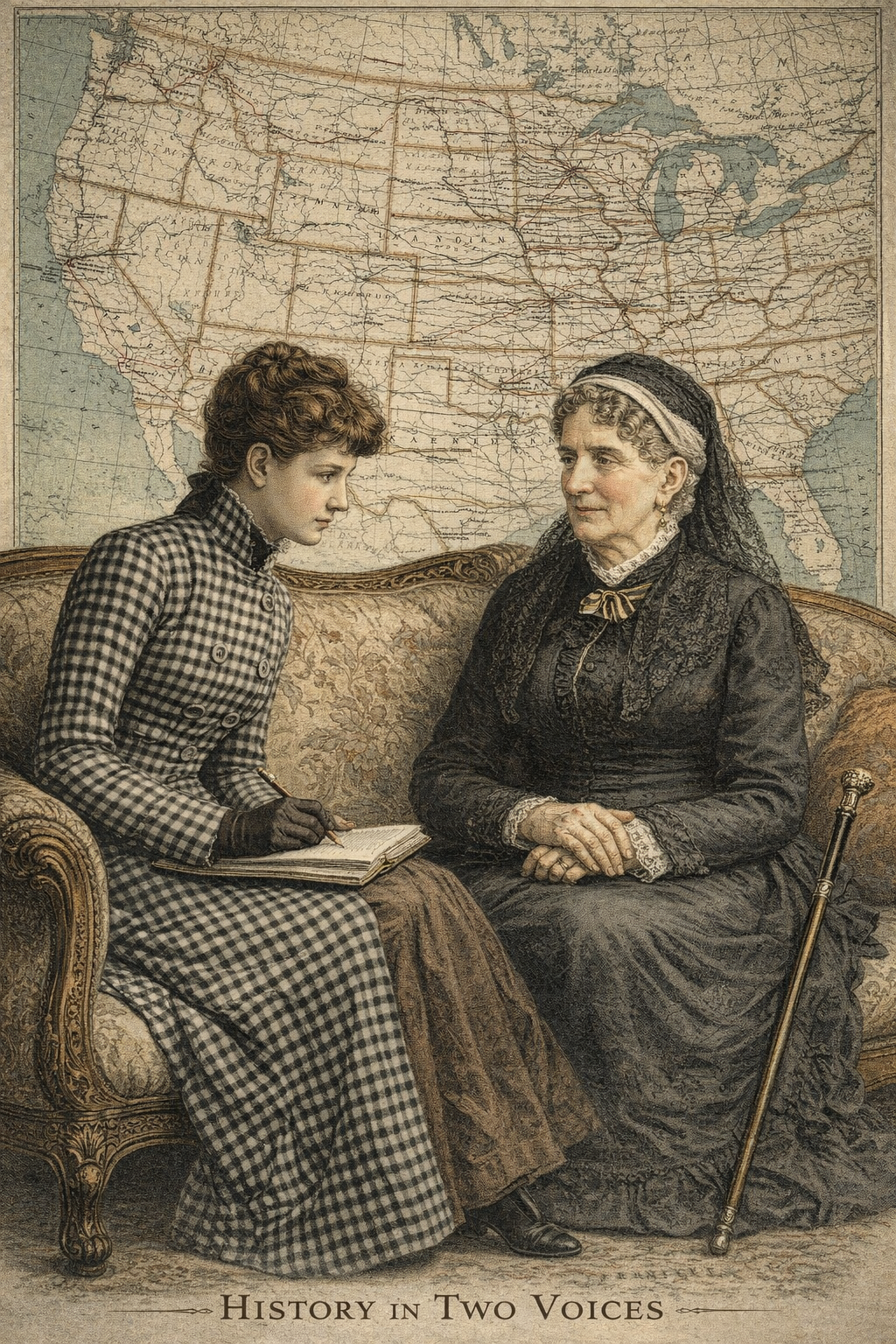
When Nellie Bly arrived in Nashville to interview Mrs. Polk—now about eighty-five years old and long widowed—she waited in the foyer of Polk Place, already aware that the interview itself was something of an exception. Mrs. Polk was not strong. Visitors tired her. Too many interruptions were discouraged.
So when the doorbell rang and two Catholic priests were admitted, Bly privately bristled. She later confessed to feeling ungracious at the interruption, though she politely followed Mrs. Polk’s niece, Mrs. Fall, into the former First Lady’s presence.
“It is a great privilege—indeed—for anyone to see my Aunt Sarah now,” Mrs. Fall explained. Though callers of all importance made their way to Polk Place, Mrs. Polk “does not see any of them.” But Bly’s reputation had preceded her. Despite a slight cold, Mrs. Polk consented to receive the intrepid reporter.
“We heard a soft, slow patter of feet in the hall,” Bly wrote, “and somehow we all rose to our feet and turned toward the door.” Framed in the doorway stood, as Bly described her, “the brilliant mistress of the White House.”
Mrs. Polk extended her hand and said gently, “Miss Bly, I am pleased that I am able to see you. Come here and sit beside me.”
She spoke candidly of her age and her limitations, explaining why she received so few visitors now. Yet there was no bitterness in her reflections. “The evening of my life is happy and peaceful,” she said. “I feel much the kindness of the people to me. I am grateful for it—it makes me happy.”
Though she relied on a cane to walk, Mrs. Polk declared with confidence, “My memory is just as good as it was forty years ago.” She told Bly she had been blessed throughout her life and noted that she was about forty-two years old when James K. Polk assumed the presidency. She still possessed the Bible upon which her husband had taken the presidential oath.
Proud of her husband’s service, Mrs. Polk recited his accomplishments as many wives would have done. The Mexican War had been fought. California, New Mexico, and Texas had been legislatively accepted into the Union. The work, she explained, came at a terrible cost to his health. President Polk died just three months after returning to Nashville from the White House.
Mrs. Polk had lived nearly forty years at Polk Place without him. They never had children.
During her years as First Lady, Bly observed, Sarah Polk was widely considered beautiful, witty, and one of the finest conversationalists—and entertainers—the White House had ever known. Mrs. Polk confirmed she had never returned to Washington and had no wish to do so. To return would require calling upon the present mistress of the White House.
Now, she explained with quiet satisfaction, everybody called on her.
Mr. and Mrs. Hayes had visited. Mr. and Mrs. Cleveland had come as well. “No one of any distinction ever visits Nashville,” Bly concluded, “without calling on Mrs. Polk and feeling honored to see her.”
Our Perspective
Nellie Bly’s visit to Sarah Polk reminds us that First Ladies did not disappear when their White House years ended. Long after James K. Polk’s presidency closed, Sarah Polk remained a living repository of national memory—respected, sought out, and honored not for spectacle, but for steadiness, intellect, and character.
At eighty-five, frail yet mentally sharp, Polk embodied a generation of women whose influence operated through conversation, hospitality, moral authority, and historical witness. Her pride in her husband’s achievements was not boastful but custodial; she preserved the memory of his presidency just as carefully as she preserved the Bible upon which he took the oath of office.
Bly’s account also reveals a shift in power and perspective. Once required to call upon others, Sarah Polk now received them. Presidents and First Ladies traveled to Nashville to pay their respects. In old age, she no longer needed Washington—Washington came to her.
Mapping Sarah Polk allows us to see First Ladyhood not as a temporary role confined to the White House, but as a lifelong identity shaped by memory, loss, and public regard. Her story underscores an essential truth of women’s political history: influence often endured quietly, long after formal power had passed.
If you want more stories on first ladies, pre-order our forthcoming biography, Presidentess: The Life of First Lady Julia Gardiner Tyler (Univ Press of Kansas, Sept 2026)
Sources
Chicago Tribune, November 4, 1888
Images
Composite illustration inspired by historical sources:
Portrait of Sarah Polk, George Dury, 1878.
Map of the United States, late 19th century (Library of Congress).
Photograph of Nellie Bly, c. 1890s (Library of Congress).
Final image: Original illustration created for History in Two Voices, rendered in a fine-point engraved style with subtle colorization. Not a photographic reproduction.