Thomas Gardner: Hero of the St. Joseph Gas Explosion
On August 22, 1946, a routine repair at a butane gas plant in St. Joseph turned suddenly catastrophic.
An excavation roughly four feet deep had been opened to remove a damaged section of pipe. A mixture of butane and propane gas escaped. When it ignited, the pit became a furnace—flames shooting nearly thirty feet into the air and rolling outward beyond the edges of the trench.
Standing nearby was William David Clarke, twenty-eight years old, a World War II veteran recently returned from overseas service with the Army Air Corps. He was supervising the work when the explosion hurled him into the burning excavation.
Thomas Gardner, fifty-two, was working as a pipefitter’s helper. He had served briefly during World War I and had spent his life as a steady laborer in Tensas Parish. Over the years, he carried responsibility quietly—first helping support his mother, and later providing for his wife and her son. He earned little, but duty was a constant in his life.
When the pit erupted in flame, Gardner did not hesitate.
Pulling down the visor of his pipefitter’s mask to shield his face, he jumped into the burning excavation. The heat was unbearable. He reached Clarke but could not move him. Forced back by the flames, Gardner climbed out of the pit, gasping for air.
Then—unbelievably—he turned and went back in.
The second time, Gardner managed to roll Clarke—six feet tall and weighing more than 230 pounds—toward the edge of the excavation. With great difficulty, he dragged him up and out. By the time Gardner emerged, his own clothing was aflame. He collapsed nearby, badly burned and exhausted.
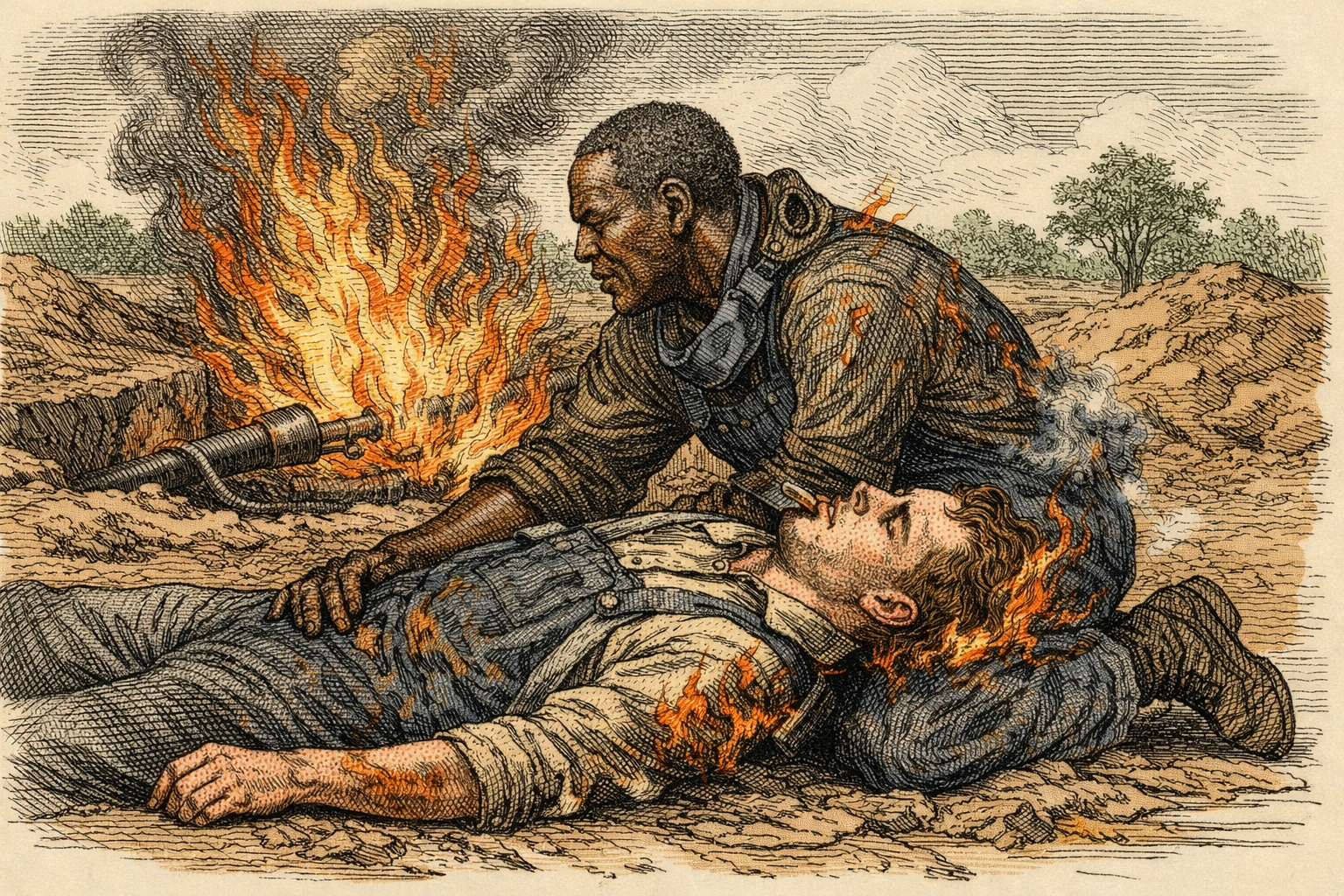
Both men were taken for treatment. Gardner suffered severe burns to his hands, arms, head, legs, and feet, along with a torn shoulder. He remained hospitalized for weeks at Ferriday Hospital.
Clarke, despite the rescue, succumbed to his injuries the following day.
The two men had never served in the same war. They were separated by a generation, by rank, by experience. But they shared something fundamental: both had worn the uniform of their country. In moments like this, such distinctions vanish. Soldiers refuse to leave other soldiers behind.
News of Gardner’s actions spread quickly through the small community. He had risked—and nearly lost—his life trying to save another. In a town where people understood the cost of labor and the value of quiet courage, that mattered.
According to the 1940 census, Gardner’s annual income amounted to roughly $125. When the citizens of St. Joseph raised $1,000 to compensate him for lost wages and suffering, the sum represented not charity, but recognition—nearly eight times his yearly earnings. The money was presented publicly on the courthouse square months later, in the spring of 1947.
Efforts were also made to secure formal recognition for Gardner’s bravery. Those efforts succeeded. The Carnegie Hero Fund awarded him its medal for heroism, affirming what the people of St. Joseph already knew.
After his recovery, Gardner returned to a quiet life. He died in 1957. Like many men of his generation, his name might have faded from memory had it not been for a single moment when character met catastrophe—and he chose to act.
Why It Matters
Acts of heroism do not always come from those with rank, wealth, or public standing. Thomas Gardner was a working man shaped by responsibility and service. In the chaos of an industrial disaster, he responded not with calculation, but with instinct—twice entering a pit of fire to save another veteran.
Understanding this moment as it was lived allows us to see courage not as spectacle, but as action: costly, immediate, and often carried by those who ask for nothing in return.
If you appreciate the work of the Carnegie Hero Fund in recognizing acts of extraordinary civilian bravery, consider supporting their mission at carnegiehero.org.

Sources
Concordia Sentinel (Vidalia, LA), February 22, 1946
Tensas Gazette (St. Joseph, LA), August 9, 1946; August 30, 1946; September 13, 1946
Morning World (Monroe, LA), August 15, 1946
Chicago Defender, September 21, 1946
Vicksburg Post, May 1, 1947
Carnegie Hero Fund Commission, Thomas Gardner case file
1940 United States Census, Tensas Parish, Louisiana
U.S. World War I Draft Registration Cards, 1917–1918
U.S. Headstone Applications for Military Veterans, 1861–1985
Louisiana Statewide Death Index, 1819–1964
Image Citations
Hero Illustration & Carousel Images
All illustrated scenes depicting Thomas Gardner, William David Clarke, the gas explosion, rescue, and courthouse ceremony were original digital illustrations created for History in Two Voices.
These images were produced in a fine-point engraving style with subtle colorization, based on contemporary newspaper accounts and archival descriptions of the August 22, 1946, St. Joseph, Louisiana gas explosion and its aftermath.
Tensas Parish Courthouse (Reference Image)
Tensas Parish Courthouse, St. Joseph, Louisiana
Wikimedia Commons, public domain
Used as architectural reference for original illustration of the 1947 public recognition ceremony.