John Quincy Adams and the First Rail Accident
A Near-Death Experience
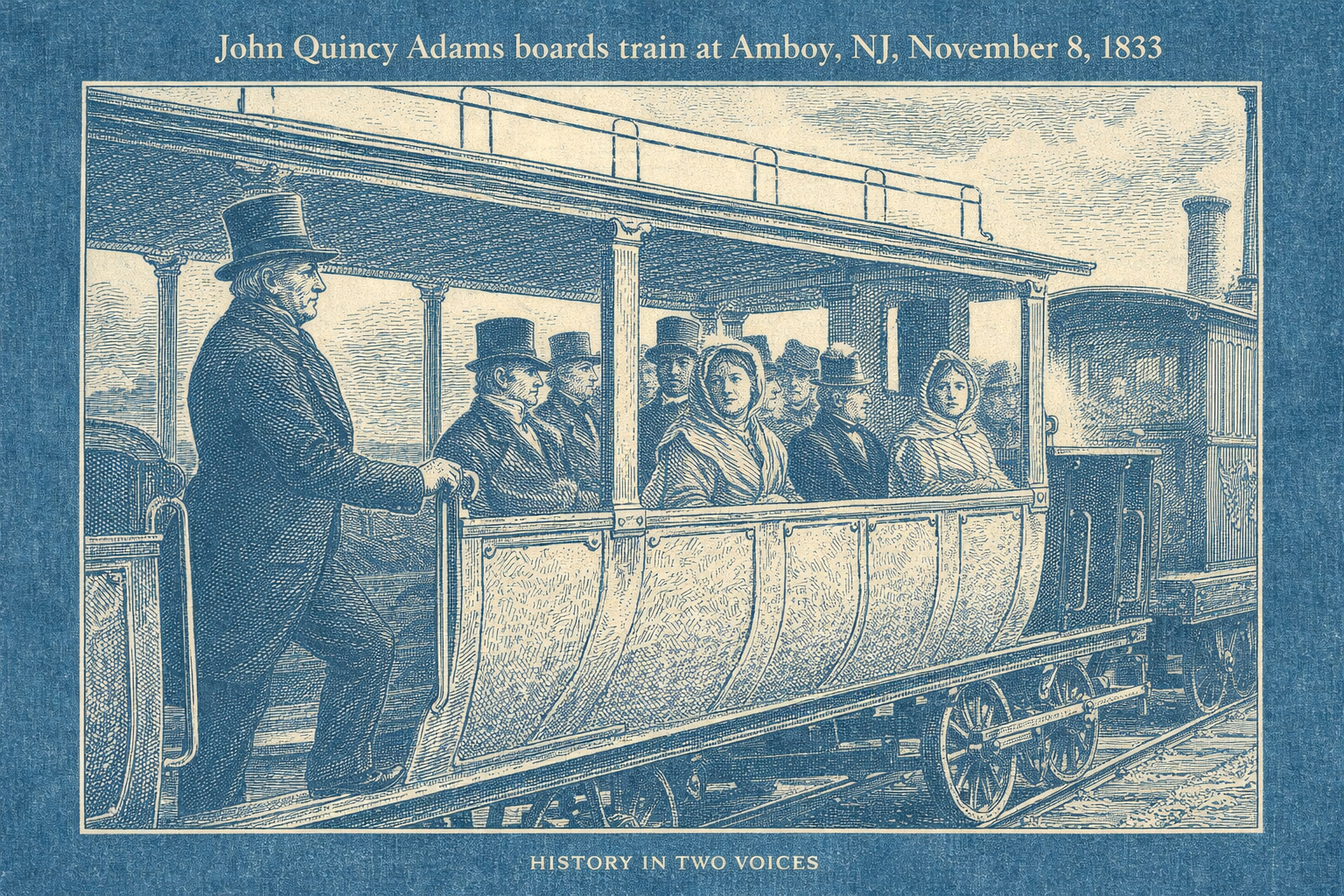
The train left Amboy, New Jersey, shortly after 10:30 a.m. on Friday, November 8, 1833, headed for Philadelphia. Traveling at a top speed of 37.5 miles per hour, the “cars” (as nineteenth-century Americans referred to trains) carried some 200 passengers. Two locomotives—Engines A and B—pulled five cars that were essentially large stagecoaches on wheels.
Roughly fifteen miles into the trip, the front left wheel of Engine B caught fire and slipped off the rail. The car tilted sideways, triggering a chain reaction that propelled the other cars from the tracks. The train lurched forward some 200 feet after the derailment, where it finally—and violently—skidded to a stop. At least one car was completely caved in from the impact.
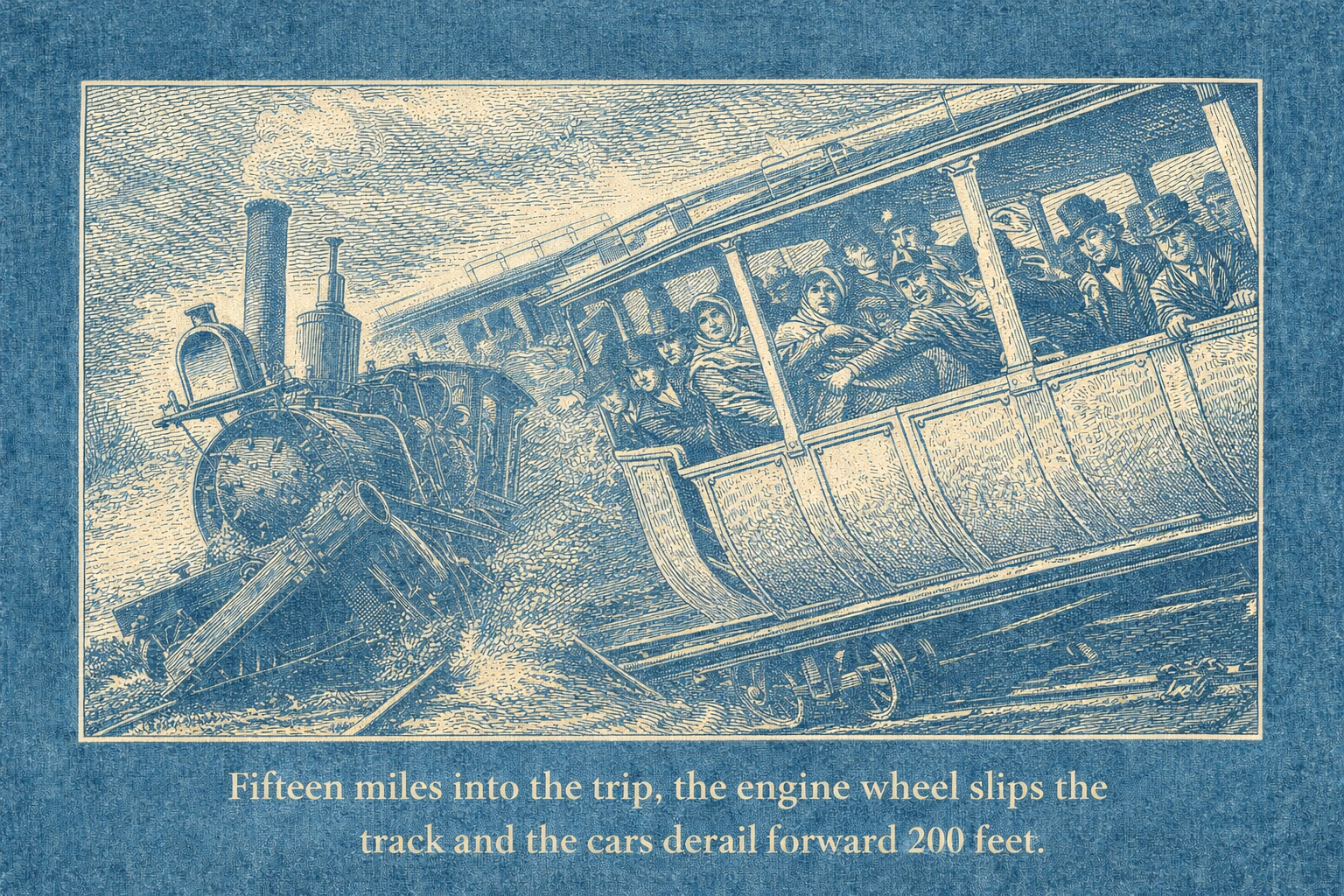
One of the passengers aboard that day was former president-turned Massachusetts congressman John Quincy Adams. Adams was on his way back to Washington, D.C., following his wife and grandchild, who had departed the day before. Stunned but otherwise unhurt, he recounted the aftermath of the accident in his diary that night.
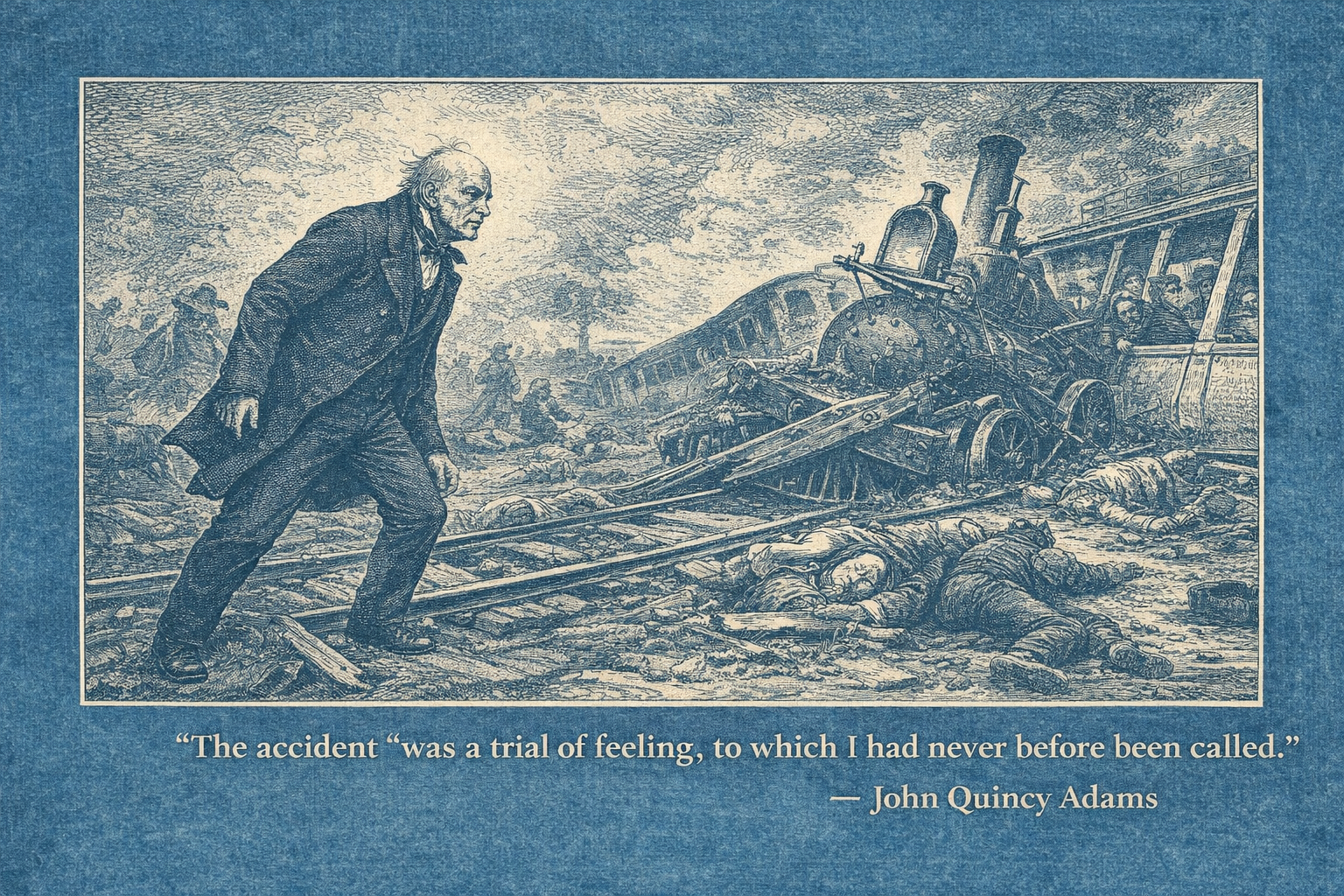
“The Scene of sufferance was excruciating. Men, women, and a child, scattered along the road, bleeding, mangled, groaning, writhing in torture and dying.” One passenger, John C. Stedman of Raleigh, North Carolina, “was so dreadfully mangled, that he died within ten Minutes.” Others, including Cornelius Vanderbilt, had been “dangerously hurt.”
Adams wrote that the accident “was a trial of feeling, to which I had never before been called.” Counting his blessings, he maintained that “when the thought came over me,” he realized “that a few seconds more of pressure on the Car in which I was would in all probability have laid me a prostrate Corpse, like him who was before my eyes, or a cripple for life.” Worse still, his family could have been traveling with him. Would they have survived the crash?
“Merciful God! How can the infirmity of my Nature express or feel the Gratitude that should swell in my bosom, that this torture, a thousand-fold worse than death, has been spared me.”
Two passengers aboard the train died—the first recorded fatalities from a rail accident in the United States. Thankfully, train crashes during the early-to-mid-nineteenth century were rare. Rail travel was generally safer than steamboats, a means of conveyance especially prone to boiler explosions and underwater snags that could capsize a vessel.
Why It Matters
The Amboy rail accident of 1833 reveals how Americans were learning—often abruptly—to live with technological change. Railroads promised speed, progress, and national connection, but they also introduced new risks that few yet understood. For John Quincy Adams, the crash was not simply a physical ordeal; it was a moment of reckoning with mortality, providence, and the fragile boundary between innovation and human vulnerability.
His account reminds us that the age of progress was experienced not as an abstract triumph, but as something deeply personal—felt in broken bodies, shaken faith, and profound gratitude for survival.
Sources
John Quincy Adams, Diary, vol. 39, December 1, 1832 – May 31, 1835, p. 178 (electronic edition).
The Diaries of John Quincy Adams: A Digital Collection. Boston: Massachusetts Historical Society, 2004.
http://www.masshist.org/jqadiaries
Image Citations:
Slide 1: John Quincy Adams Boarding the Train
Source: Based on an engraved portrait of John Quincy Adams from the early 19th century, used for historical reference. Public-domain source material; modern composite design © History in Two Voices.Slide 2: The Train Accident Scene
Source: Based on a vintage-style illustration of an early 19th-century locomotive derailment, adapted to reflect the moment of the accident described in the blog post. Public-domain source material; modern composite design © History in Two Voices.Slide 3: John Quincy Adams in the Aftermath of the Accident
Source: Adapted from historical representations of John Quincy Adams, reflecting his reaction to the 1833 train crash. Public-domain source material; modern composite design © History in Two Voices.Final Slide: Why It Matters Divider
Source: Based on a traditional 19th-century train design, modified for vintage-style graphic use. Public-domain source material; modern composite design © History in Two Voices.