Mamie Anxiously Waits and Wonders
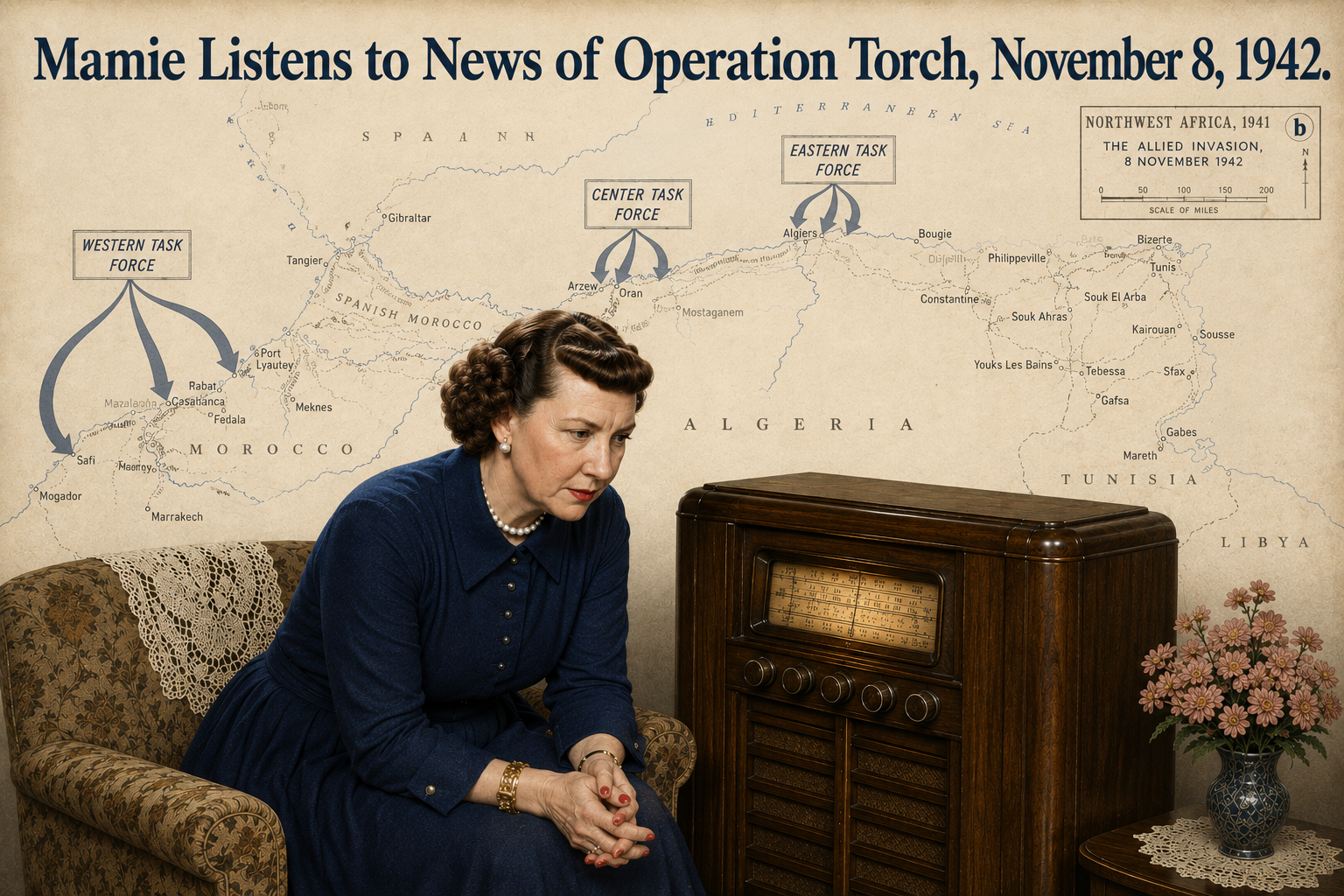
November 8, 1942, was a pivotal day for Mamie Eisenhower. Months into her separation from her husband, she was about to learn—through a radio bulletin—that Lieutenant General Dwight D. Eisenhower was leading a major Allied operation in North Africa.
Eisenhower’s Assignment to London
On June 15, 1942, Major General Eisenhower returned home with news. Mamie could tell from the excitement on her husband’s face that he was about to share something significant—something she suspected she would not welcome. As they sat across from each other at the dinner table, Ike said casually, “I’m going to London again—to stay.”
As usual, Mamie tried to be pleased for her husband despite the personal cost of another separation.
“What post are you going to have?” she asked.
Mamie later recalled that Ike’s voice sounded “almost awe-struck” when he replied, “I’m going to command the whole shebang!” He had been appointed to lead the European Theater during World War II, a role of enormous responsibility and visibility.
Mamie During the Separation
During the weeks and months that followed, Mamie lived at a hotel, then known as the Wardman Park Hotel, in Washington, D.C. With her husband now becoming internationally known, she maintained a quiet routine. She stayed close to home, rarely socialized, and spent much of her time volunteering at servicemen’s canteens.
The Radio Announcement
On November 8, 1942, Ike’s brother Milton and his wife, Helen, invited Mamie to their home in Falls Church, Virginia, for a quiet evening of dinner and cards. Throughout the visit, Milton kept the radio turned up loudly. Distracted by the constant noise, Mamie finally exclaimed, “Please turn that darn thing off.”
Milton refused, and moments later Mamie understood why.
The music suddenly stopped, and an urgent voice broke in:
“We interrupt this program for an important announcement.”
After a series of clicks and buzzing sounds, Mamie heard the words that stunned her:
“American and British troops under the command of Lieutenant General Dwight D. Eisenhower are landing at several points on the coast of North Africa.”
Mamie remained by the radio until two o’clock in the morning. The following day, she was up early again, listening for every new report as Operation Torch unfolded across the airwaves.
Why It Matters
For many Americans, Dwight Eisenhower seemed to emerge suddenly onto the world stage during World War II. But for Mamie Eisenhower, the announcement carried a far more personal meaning. Sitting beside a radio in a Virginia living room, she learned alongside the nation that her husband now commanded one of the largest Allied operations of the war.
The moment also reveals the emotional reality faced by military families during wartime. Despite being married to one of America’s highest-ranking officers, Mamie often received news the same way ordinary citizens did—through radio broadcasts, newspaper headlines, and fragments of public information. The uncertainty, waiting, and quiet endurance of separation became part of her wartime experience.
Long before she entered the White House, Mamie Eisenhower was already navigating the burdens that accompanied public leadership. While Ike directed global military strategy overseas, Mamie carried the emotional strain of war from the home front, listening and waiting like millions of other American wives and mothers.
Discover more about Mamie Eisenhower’s hidden influence and cultural power in Sharon Williams Leahy’s First Ladies Association for Research & Education journal article:
Sources
Alden Hatch, Red Carpet for Mamie. New York: Henry Holt and Company, 1954, 186-187.
Times Herald (Washington, D.C.), November 9, 1942.
Tampa Bay Times (St. Petersburg, Florida), November 10, 1942.
Images
Based on “Mrs. Eisenhower Hears Army Broadcast,”Times Herald (Washington, D.C.), November 9, 1942; Map of Operation Torch, Wikimedia Commons.
Leahy, Sharon. Image concept and direction. AI-assisted illustration generated using digital tools, 2026.