Presidential Gifts of the Untameable Variety
When the White House Became a Menagerie
By the 1920s, the White House was no stranger to unusual presidential pets. But under President Calvin Coolidge and First Lady Grace Coolidge, the executive mansion briefly resembled something closer to a small zoological park.
According to the Salt Lake Telegram on December 23, 1923, President Coolidge had already accepted six pets as gifts during his time in office: “two kittens, one canary, two dogs, one peacock, one grizzly bear.” The grizzly bear, however, proved just a little too energetic for White House life and was ultimately sent to the zoo.
Both the President and First Lady genuinely loved animals. Newspapers of the period frequently commented on the warm relationship between President Coolidge and his white collie, Rob Roy. One reporter observed the pair’s “perfect understanding” of one another.
Rebecca Raccoon and Other Unexpected Residents
Not all presidential pets were traditional household companions.
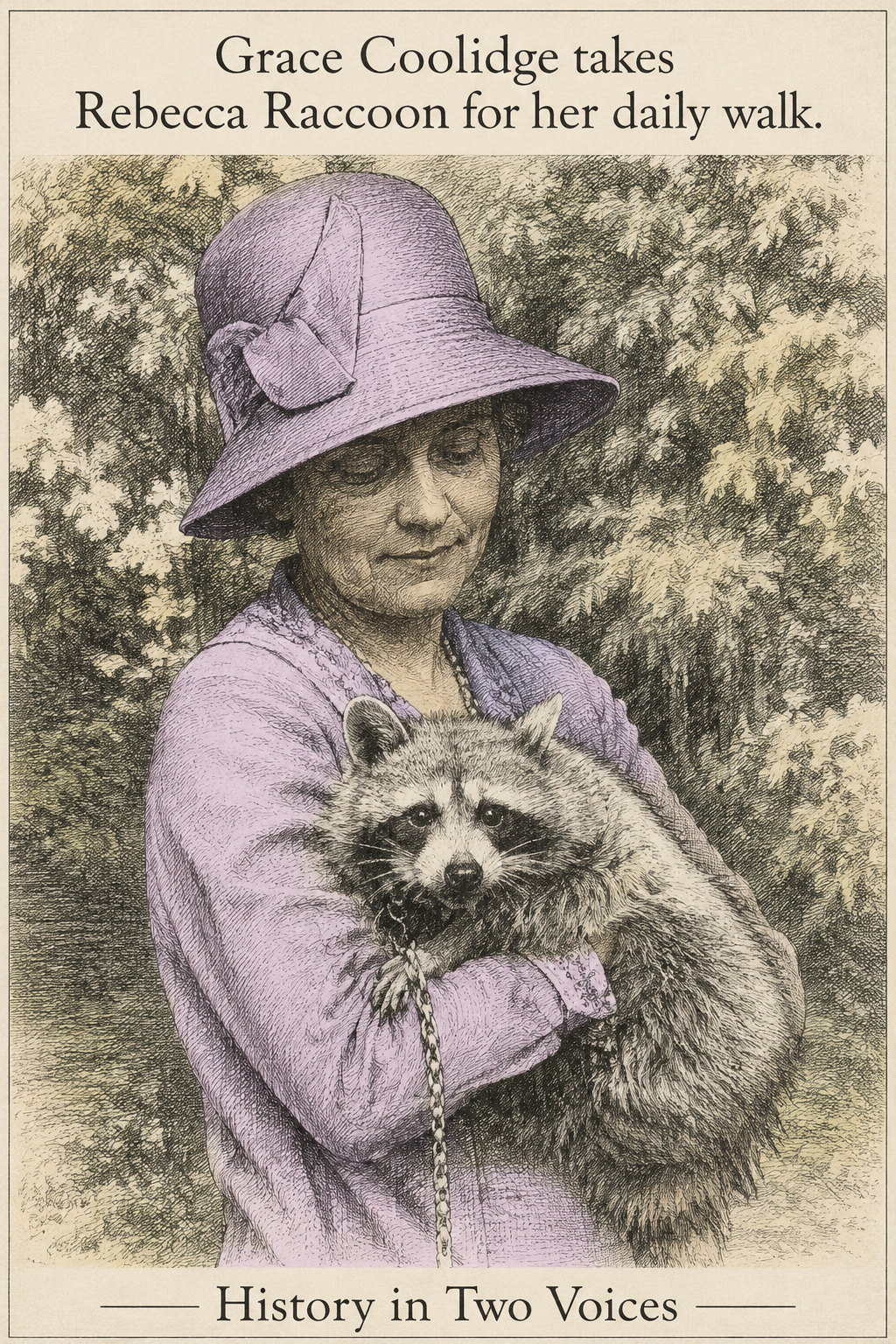
One of the most famous was Rebecca Raccoon, who arrived from Michigan. Rebecca quickly became a favorite at the White House. She was fed and petted so often that she reportedly sat comfortably on the President’s knee and allowed Mrs. Coolidge to walk her on a leash across the White House grounds.
The animal gifts continued to grow more exotic.
The Coolidges received:
A wallaby from Australia
Two lion cubs from the mayor of Johannesburg, South Africa
A pygmy hippopotamus presented by tire magnate Harvey Firestone
“Smokey Robert,” a bobcat sent from Tennessee
By October 1927, the Daily Sketch of London was reporting on the extraordinary collection of presidential animals.
President Coolidge remained personally attached to many of them, even after several had been relocated to the zoo. During one visit, according to the Rapid City Journal on October 22, 1927, Coolidge reportedly told the zoo superintendent:
“I came to see my lions and the rest of my animals.”
A White House Bathroom Full of Ducks
In the eighth installment of her memoir series, My Life in the White House, published in the San Francisco Examiner on February 23, 1930, Grace Coolidge reflected humorously on the practical difficulties of housing such unusual gifts.
“From time to time,” she wrote, “animals were sent to us, for whose comfort and safety it was impossible to make provision at the White House.”
Those animals, she explained sensibly, “found a home at the zoo.”
One group of visitors, however, stayed temporarily inside the Executive Mansion itself. A baker’s dozen of Pekin ducks initially took up residence in one of the White House bathrooms before eventually being moved to what Mrs. Coolidge described as a more “commodious” home at the zoo.
Our Perspective
The Coolidge White House reminds us that presidential life in the early twentieth century often blended formality with surprising moments of humor, warmth, and unpredictability.
These animals were more than amusing curiosities. Many arrived as diplomatic gifts or tokens of admiration from citizens around the world, reflecting how Americans and foreign visitors alike sought personal connections with the presidency. The unusual menagerie also revealed the growing celebrity culture surrounding the White House during the 1920s, when newspaper readers eagerly followed even the smallest details of presidential domestic life.
At the same time, Grace Coolidge’s practical observations highlight an important reality: the White House was both a symbolic national home and a functioning residence struggling to accommodate increasingly public expectations. A grizzly bear, lion cubs, raccoons, ducks, and a pygmy hippopotamus might delight newspaper readers, but they also posed very real logistical challenges for the First Family.
In many ways, the Coolidges’ “untameable” gifts revealed a presidency becoming more personal, visible, and human to the American public.
To hear more about First Ladies pre-order our forthcoming biography, Presidentess: The Life of First Lady Julia Gardiner Tyler (Univ Press of Kansas, Sept 2026). Use code 24LADYJULIA at checkout to receive 30% off at checkout for a limited time.
Sources
Salt Lake Telegram (Salt Lake City, Utah), December 23, 1923.
Daily Sketch (London, England), October 25, 1927.
Rapid City Journal (Rapid City, South Dakota), October 22, 1927.
My Life in the White House, installment published in the San Francisco Examiner, February 23, 1930.
Image Citations
Slide 1 — Grace Coolidge Takes Rebecca Raccoon for Her Daily Walk
Leahy, Sharon. Grace Coolidge takes Rebecca Raccoon for her daily walk. Image concept and direction. AI-assisted illustration generated using digital tools, 2026. Source inspiration: Rapid City Journal (Rapid City, South Dakota), October 22, 1927.
Slide 2 — “I Came to See My Lions and the Rest of My Animals.”
Leahy, Sharon. “I came to see my lions and the rest of my animals.” Image concept and direction. AI-assisted illustration generated using digital tools, 2026. Source inspiration: Rapid City Journal (Rapid City, South Dakota), October 27, 1927.
Slide 3 — President and Mrs. Coolidge Loved Animals
Leahy, Sharon. President and Mrs. Coolidge loved animals. Image concept and direction. AI-assisted illustration generated using digital tools, 2026. Historical sources referenced: Salt Lake Telegram (Salt Lake City, Utah), December 23, 1923; Daily Sketch (London, England), October 25, 1927; Grace Coolidge, “My Life in the White House,” San Francisco Examiner, February 23, 1930.