Mapping the First Ladies: Nellie Bly Visits Harriet Lane Johnston
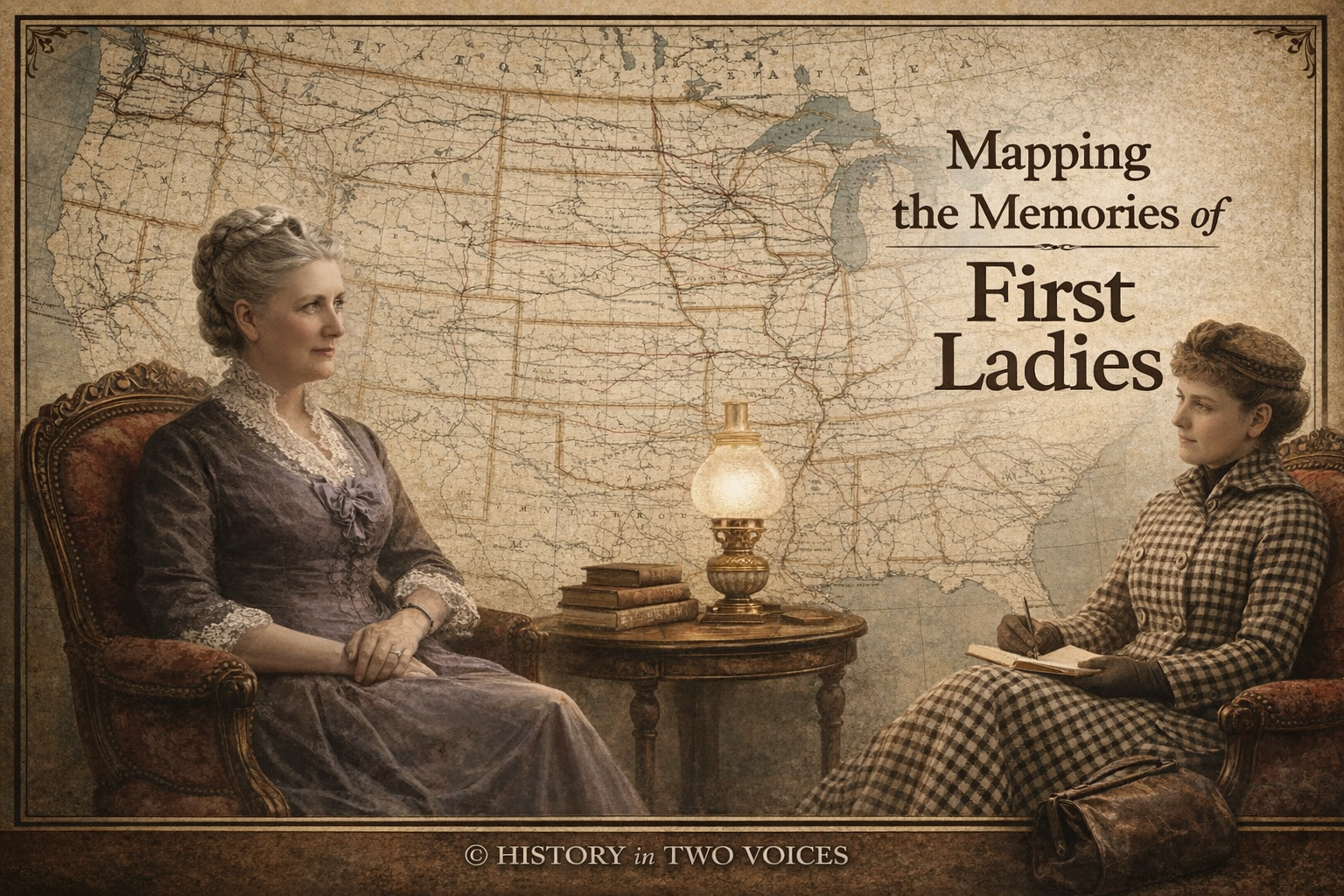
When Nellie Bly arrived at 518 Park Avenue in Baltimore, she entered what she described as the “saddened” home of Mrs. Harriet Lane Johnston—a woman once celebrated on both sides of the Atlantic, now living in profound quiet.
Harriet Lane traced her earliest memories to Mercersburg, Pennsylvania, before leaving home at age twelve to continue her education in Charlestown, Virginia (today West Virginia). She later attended Georgetown Convent in Washington, D.C., where her refinement and intellect continued to develop. Georgetown Convent would quietly shape the lives of more than one woman connected to the White House—among them a future First Lady and her daughter, whose own spiritual journey would later unfold within its walls.
Bly noted that Harriet’s personal appearance had long been admired. She possessed a “commanding figure” and striking “deep violet eyes.” Musically gifted, she was also known for her sharp wit and exceptional “conversational powers,” qualities that led many to regard her as a brilliant woman.
Those gifts served her well abroad. Harriet accompanied her uncle, James Buchanan, during his service as United States Minister to Great Britain, where she was “greatly admired” by Queen Victoria and the royal family. When Buchanan assumed the presidency in 1857, Harriet became the White House’s executive hostess—effectively serving as First Lady during his administration.
Following her uncle’s counsel to be cautious in choosing a husband, Harriet married later than most women of her era. In 1866, at the age of thirty-six, she wed Baltimore banker Henry Elliott Johnston. The couple had two sons.
Tragedy soon followed. In 1881, their eldest son, James Buchanan Johnston, died at just fourteen years old. In the years that followed, Harriet lost both her husband and her remaining child. By the time of Bly’s visit in 1888, the former First Lady was entirely alone.
Bly observed that Harriet had retained her beauty, though it now bore the unmistakable marks of sorrow. Her once-vivid violet eyes reflected deep sadness, her golden hair had turned silver-white, and she was “always clad in somber black.” The house itself, Bly wrote, was “as quiet as the grave.”
It was a sobering portrait—one that illustrated how lives once marked by admiration, influence, and celebration were never immune to grief, loss, and solitude.
*** If you are interested in learning more about first ladies, pre-order our forthcoming biography, Presidentess: The Life of First Lady Julia Gardiner Tyler (Univ Press of Kansas, Sept 2026). Use code 24LADYJULIA at checkout for 30% for limited time.
Sources
Chicago Tribune, “Ladies Who Have Been the First Ladies of the Land,” November 4, 1888.
Harriet Lane Johnston, biographical information compiled from contemporary accounts and later historical summaries.
James Buchanan, diplomatic and presidential context.
Nellie Bly, reporting career and 1888 interview tour of former First Ladies.
Image Citation
Composite illustration created for History in Two Voices, inspired by:
Period portrait of Harriet Lane Johnston (19th century).
Late-19th-century photographs and illustrations of Nellie Bly in traveling attire.
Antique United States railroad and land-grant maps, c. late 19th century.
Artwork digitally composed and colorized to evoke the historical setting and emotional tone of Nellie Bly’s 1888 visit.
© History in Two Voices. All rights reserved.