Tom Lee: A River Rescue Remembered
Memphis, Tennessee | May 8, 1925
The Story
On the afternoon of May 8, 1925, the stern-wheel steamboat U.S.S. M. E. Norman overturned in the swirling current of the Mississippi River, roughly twenty-five miles south of Memphis.
The vessel capsized and sank in less than thirty seconds.
There was no time to lower lifeboats. Few passengers were able to reach life preservers. Men and women were quickly swept downstream in the muddy current.
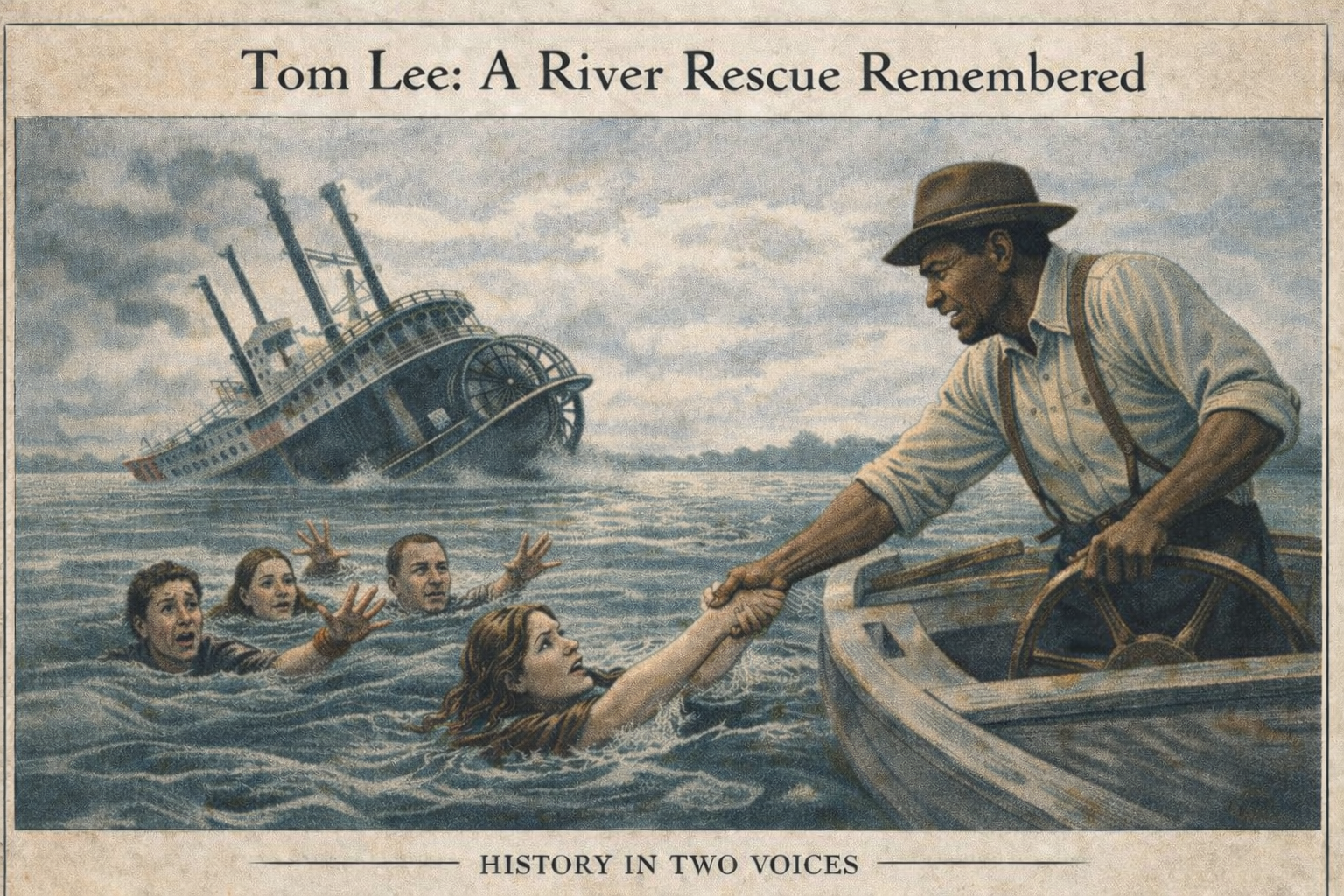
Passing nearby in a small motorboat was Tom Lee, a levee worker with two decades of river experience. Seeing the Norman list, Lee turned his boat without hesitation and headed straight toward the wreck. He pulled women from the water first, then men—guiding his boat with one hand while hauling survivors aboard with the other. When exhaustion overtook those struggling to stay afloat, Lee looped ropes around their hands and pulled them to safety.
Trip after trip, Lee ferried survivors to a sandbar, where he lit fires using dry matches he carried. Alone, he returned to the river again and again—until no one remained to be rescued.
Thirty-two people lived because Tom Lee was there.
Remembered in Gratitude
News of Lee’s actions spread quickly. A hero fund formed across multiple states. Survivors sent money and handwritten notes of thanks. Engineers—many of them connected to the ill-fated excursion—raised enough to purchase Lee a home and establish a fund to maintain it.
Later that month, Lee was received at the White House by President Calvin Coolidge, who publicly praised his courage.
By 1936, the Engineers Club had made it a tradition to open its annual Christmas gathering by honoring Tom Lee, a ritual that kept his 1925 rescue at the center of their remembrance.
Decades later, in 1998, when a 1936 time capsule was rediscovered at the former Corps of Engineers yard in Memphis, artifacts from the Norman—including a torn, oil-stained flag—recalled the disaster and the man whose actions defined it.
Update: A Living Memorial
After Lee’s death in 1952, Memphis renamed Astor Park in his honor. Two years later, the city dedicated a thirty-foot granite obelisk overlooking the Mississippi River at the foot of Beale Street, marking the place where Tom Lee’s courage had become part of the city’s memory.
In 2003, the monument was damaged during Hurricane Elvis and ultimately removed. Three years later, in 2006, Memphis installed a new memorial in Tom Lee Park: a bronze sculpture depicting Lee in his small boat, reaching into the river to save those struggling in the water.
The form of the memorial changed—but the act it remembers did not.
Why It Matters
Tom Lee did not act for recognition, reward, or applause. He acted because someone needed help—and he knew the river.
His story reminds us that history is often shaped not by rank or title, but by ordinary people who meet extraordinary moments with calm resolve. Some rescues last minutes. Their memory lasts generations.
Sources
Commercial Appeal (Memphis, TN), May 9–15, 1925; December 22 & 27, 1936; July 9, 1954
Nashville Banner (Nashville, TN), May 9 & 12, 1925
Johnson City Chronicle (Johnson City, TN), May 10, 1925
Washington Post (Washington, DC), May 29, 1925
Commercial Appeal, August 7, 1998
Image Citations
Rescue Illustration (Artistic Interpretation)
Artistic rendering inspired by contemporary newspaper accounts of the M.E. Norman disaster, including survivor testimony published in the Commercial Appeal (Memphis, TN), May 9–15, 1925, and the Nashville Banner, May 9–12, 1925.
Illustration created for History in Two Voices.
President Calvin Coolidge and Tom Lee, 1925
President Calvin Coolidge greeting Tom Lee at the White House, 1925.
Library of Congress, Prints and Photographs Division.
(Originally published in the Washington Post, May 29, 1925.)
Tom Lee Memorial, Memphis, Tennessee (2006)
Bronze sculpture memorializing Tom Lee’s 1925 river rescue, dedicated in 2006 at Tom Lee Park, Memphis, Tennessee.
Photograph via Wikimedia Commons.
Artist: David Alan Clark.
(Note: Astor Park was renamed Tom Lee Park in 1953; memorials to Lee have stood at the site since 1954.)