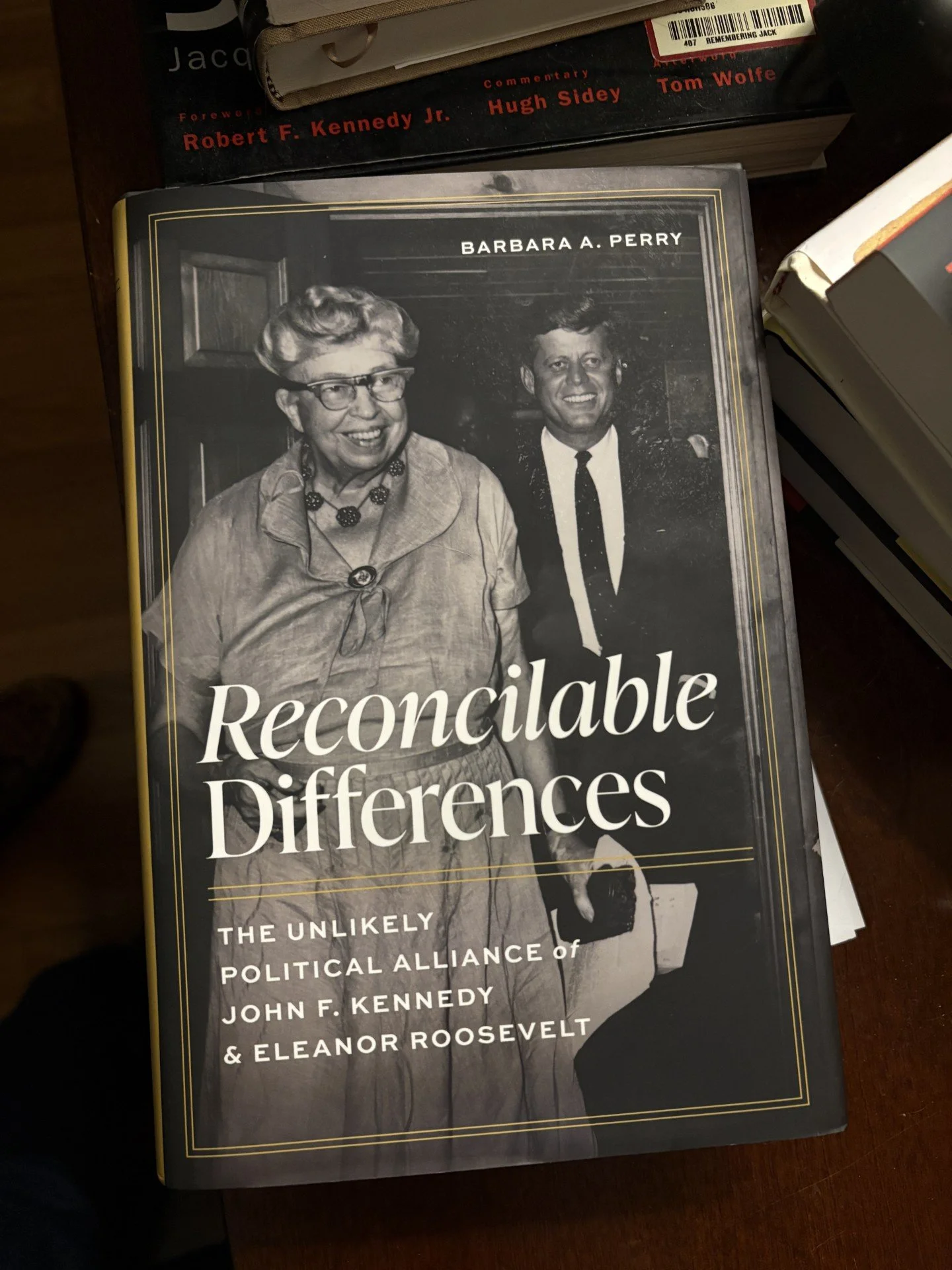
Barbara A. Perry, Reconcilable Differences: The Unlikely Political Alliance of John F. Kennedy & Eleanor Roosevelt (University of Virginia Press, 2026).
This is a book that I have felt for a while needed to be written. And Barbara A. Perry is just the scholar to write it. Her previous work on the Kennedys, the presidency, and first ladies, as well as her position as the J. Wilson Newman Professor of Governance and Co-Chair of the Presidential Oral History Program at the University of Virginia’s Miller Center, uniquely situates her to tell this important story.
Eleanor Roosevelt was conditioned to be wary of the young, well-heeled, and ambitious Senator from Massachusetts when he was laying the groundwork for a presidential run in 1960. She knew JFK’s father and had listened to her husband, FDR, gripe about Joseph P. Kennedy’s isolationist views and appeasement while he served as American Ambassador to Great Britain in the run-up to World War II. Guilt by association characterized her early impression of the younger Kennedy.
She also didn’t believe he was liberal enough. Indeed, her beau ideal of a liberal Democrat was Illinois Governor Adlai Stevenson, the man Dwight D. Eisenhower defeated twice—in 1952 and again four years later—and whom she hoped would throw his hat into the ring one last time in 1960.
Forced to the realization that JFK would win the Democratic nomination for president in 1960, especially after his victory in the now-mythic West Virginia primary, Eleanor wanted to personally size up the candidate and secure promises from him.
She invited him to lunch at Val-Kill, her small cottage in Hyde Park, New York, on August 14, 1960, the anniversary of the passage of the 1935 Social Security Act.
The two reached a rapprochement that both ultimately found satisfying. Eleanor gave the forty-three-year-old nominee (whom she had referred to condescendingly as “My dear boy” in at least one letter) her blessing, which linked the Roosevelt and Kennedy dynasties together and bridged the generational gap in the Democratic Party. JFK gave a promise to work hard to attract Stevenson voters in New York and California to the ticket and organized a foreign affairs advisory committee that Stevenson chaired.
Eleanor was not shy about sending letters and other messages to President Kennedy on matters she believed were important. The ever-gracious JFK genuinely appreciated what the former first lady had to say.
Kennedy appointed Eleanor Roosevelt to chair the President’s Commission on the Status of Women (PCSW), the first time the U.S. federal government had undertaken systematic study of the nation’s gender differences and the role of women in the workplace and elsewhere. The commission’s recommendations for expanding opportunities for women in the federal workforce and the armed forces particularly pleased the president.
Perry skillfully covers a lot of ground in this book. She does so with prose that never seems to waste a word, and she provides details that allow the reader to grasp the significance of the political alliance she analyzes. Both Eleanor Roosevelt and JFK emerge in the book as complicated people, but people who were reasonable and who had the best interests of the nation at heart.
As a college instructor, I found Perry’s discussion of the work of the PCSW informative and significant, enough to warrant adapting it to my classes when we cover JFK and the 1960s. In sum, I learned a great deal by reading this excellent book.