The Petticoat Affair: When Manners Shook a Presidency
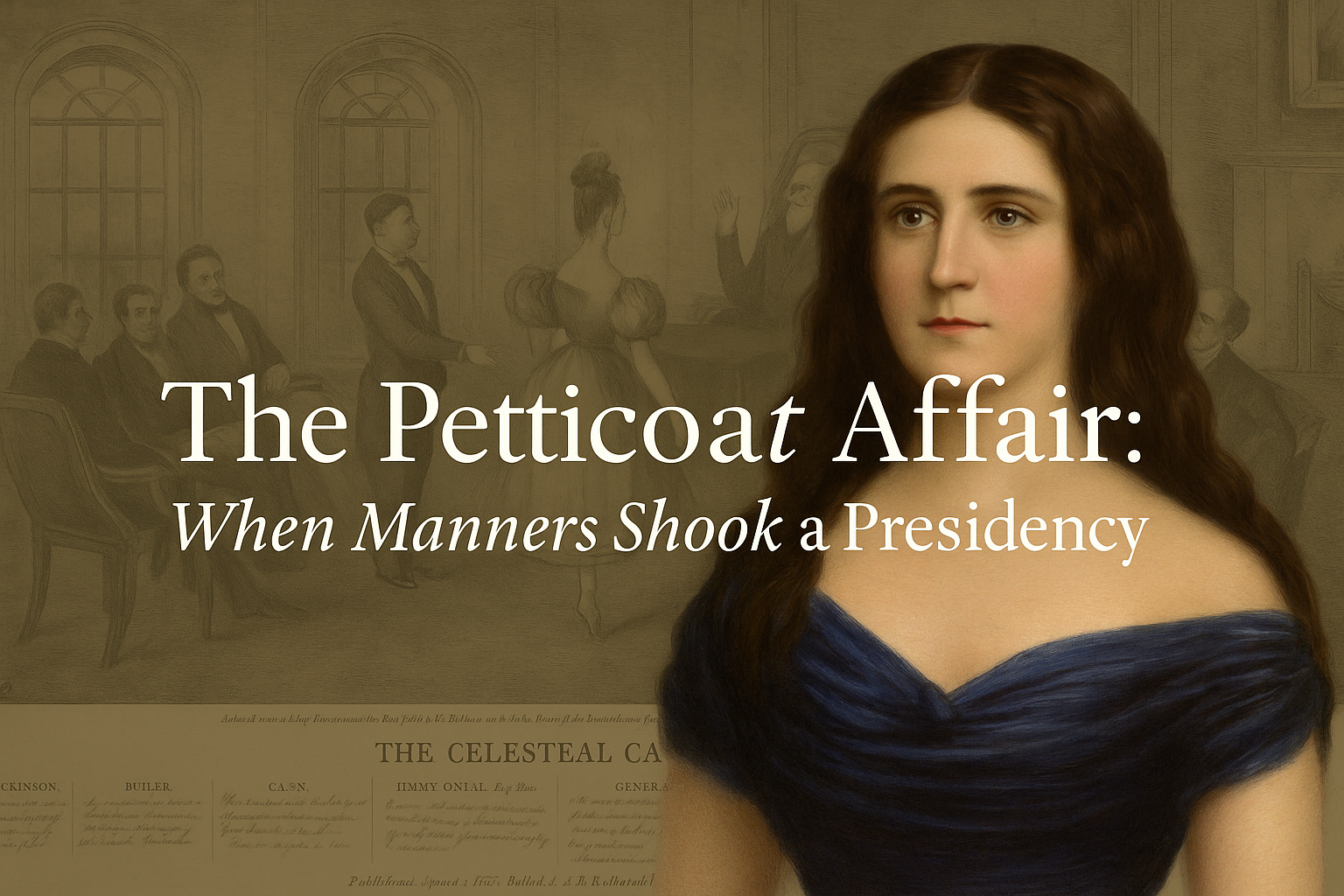
Margaret “Peggy” Eaton, daughter of a Washington innkeeper, could “charm males with her looks no less than with her conversation.” Andrew Jackson, who had boarded with her family years earlier, delighted in her company. But when Peggy married Jackson’s Secretary of War, John Eaton, only nine months after her first husband’s death, Washington society erupted.
Led by Floride Calhoun—the vice president’s wife—the wives of Jackson’s Cabinet refused to socialize with Mrs. Eaton. The scandal, fueled by gossip and rigid expectations of “womanly propriety,” led nearly the entire Cabinet to resign. Jackson refused to bow to the petticoat cabal.
Historian John F. Marszalek writes that the controversy revealed “the struggle of women in all periods of history… to escape from societal perceptions of the limited ideas that society considered proper for them.”
Nineteenth-century historian James Parton captured the intrigue with characteristic wit:
“The political history of the United States, for the last 30 years, dates from the moment when the soft hand of Martin Van Buren touched Mrs. Eaton’s knocker.”
Why It Matters
Peggy Eaton’s ordeal was more than a scandal—it was a battle over who defined virtue in the early republic. Her treatment exposed the double standards that governed women’s reputations and men’s power. In standing by her, Jackson believed he was defending honor and loyalty; in ostracizing her, Washington society believed it was upholding morality. The resulting fallout reshaped his Cabinet and altered the course of American politics.
Citation:
John F. Marszalek, The Petticoat Affair: Manners, Mutiny, and Sex in Andrew Jackson’s White House (Baton Rouge: Louisiana State University Press, 1997).
Image captions:
Margaret O’Neale Eaton, c. 1830s (public domain, Wikimedia Commons).
The Washington social world of the Jackson administration, where rumor and etiquette collided (Library of Congress).
** This educational post is part of the History in Two Voices project and is not intended as a political statement or endorsement. Learn more at www.historyintwovoices.com.