Letitia Tyler’s Personal Story: A First Lady’s Experience (1841-1842)
John Tyler’s Political Rise
John Tyler’s political ascent began in December 1816 when he was elected to the U.S. House of Representatives from Virginia's Charles City district. His tenure in Congress lasted until 1821, when he resigned to return home and focus on family. However, the allure of national politics proved irresistible. In December 1823, Tyler resumed his political career in the Virginia House of Delegates, a chamber he had entered in 1811 at just 21 years old. He went on to serve as governor of Virginia in 1825 and was later elected to the U.S. Senate in 1827.
A Strained Family Life
Tyler’s political responsibilities required him to spend half of each year in Washington, creating a strain on his family life. His wife, Letitia, was already frail in health, having borne eight children over the course of their marriage. Her condition, exacerbated by Tyler’s absences, grew worse as she suffered frequent, debilitating migraines that often confined her to bed. According to Christopher J. Leahy in President Without a Party: The Life of John Tyler (Baton Rouge: Louisiana State University Press, 2020), when Tyler prepared to leave for Washington, Letitia's physical distress was often attributed to "hysteria"—a term commonly used in the 19th century to describe unexplained physical ailments, which were later understood as symptoms of depression (p. 96).
Psychosomatic Struggles
Letitia’s struggles were psychosomatic in nature. She could not cope with her husband’s long separations, and it became clear that his national political career held greater importance to him than their emotional bond or her well-being. In addition to his neglect of their relationship, Tyler was largely absent from the lives of their children, leaving Letitia to shoulder the responsibility of raising them.
Our Perspective
Letitia Tyler’s experience serves as a poignant reminder that the personal costs of public life extended beyond the political figures themselves. Behind every ambitious statesman stood a woman who, in silence, endured isolation, illness, and the weight of societal expectations. Letitia’s quiet endurance set a pattern for the emotional burdens that countless First Ladies would bear in the years to come.
***To explore the life and legacy of another remarkable First Lady, be sure to check out Presidentess: The Life of First Lady Julia Gardiner Tyler—available for pre-order now!
Citation
Christopher J. Leahy, President Without a Party: The Life of John Tyler (Baton Rouge: Louisiana State University Press, 2020), p. 96.
Image:
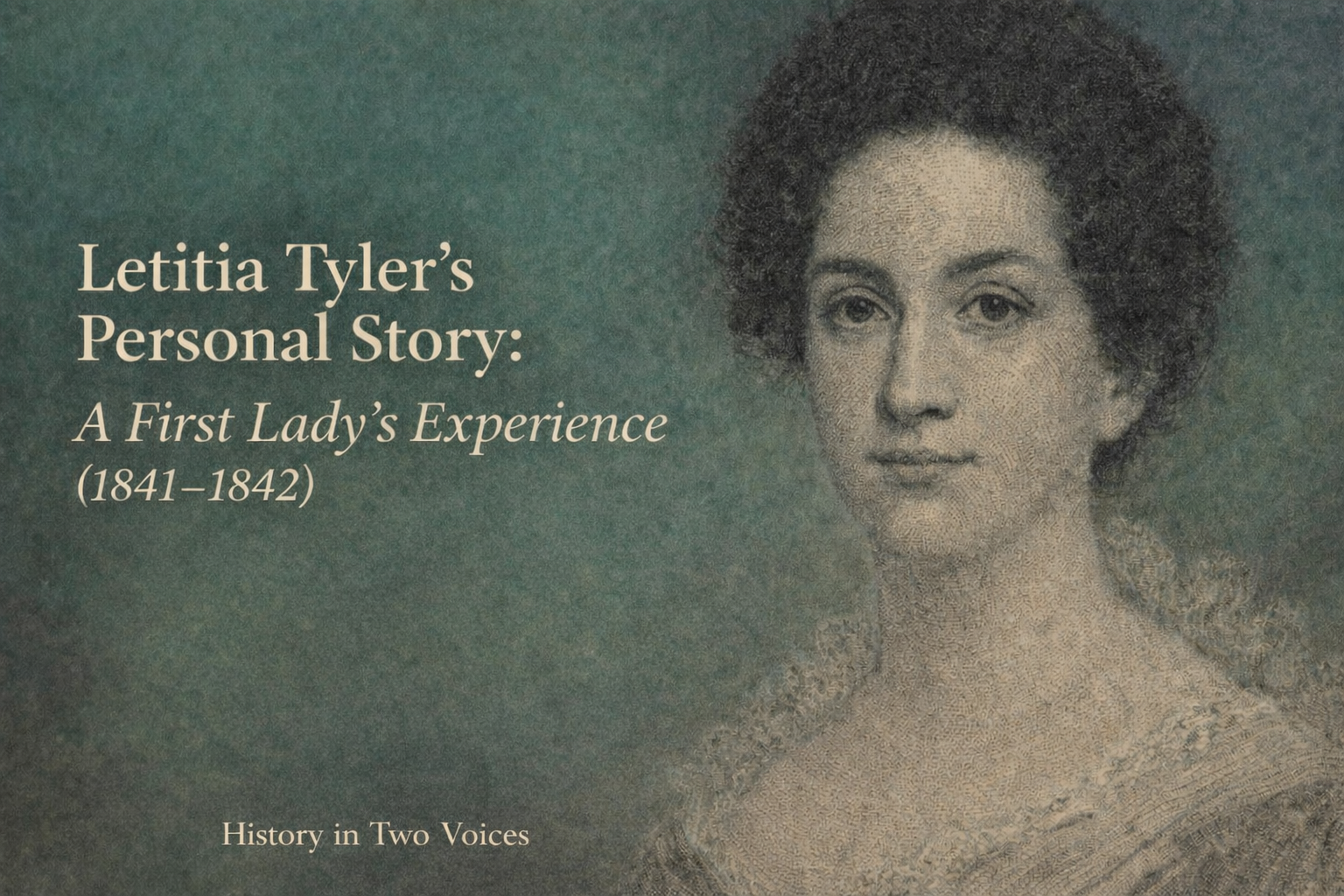
Letitia Christian Tyler, First Lady of the United States (ca. 1830s). Artist unknown. Oil on canvas. Public domain via Wikimedia Commons. Source: https://commons.wikimedia.org/wiki/File:Letitia_Tyler.jpg
*** History in Two Voices is a nonpartisan, educational platform. Our posts explore historical events and figures for the purpose of public history and scholarship — not to advance any political viewpoint or agenda.
Categories: First Ladies, John Tyler, Early Republic, Women’s History, Mental Health in History
Tags: Letitia Tyler, John Tyler, First Lady History, 19th Century Women, White House History, History in Two Voices