Confessions of a Late-Blooming History Buff, Part II: “You Want Me to Write WHAT?”
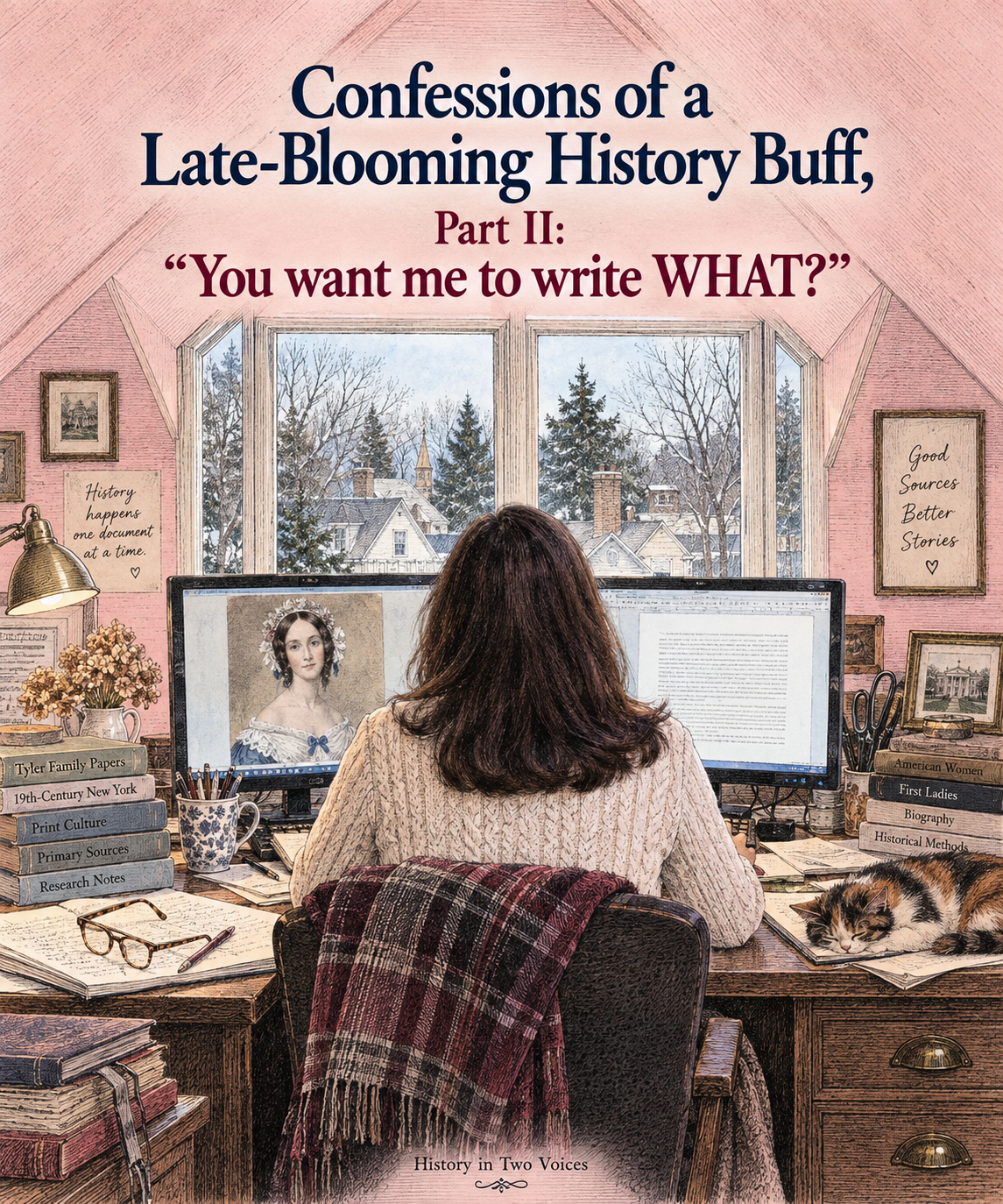
Once I learned how to decipher Julia Gardiner Tyler’s handwriting, something rather dangerous happened. I started doing my own research.
It began innocently enough. While Chris was working on his biography of President John Tyler, President Without a Party, I had been helping transcribe Julia’s letters. But the more I read, the more interested I became in Julia herself, and eventually I began following questions of my own.
One of them involved a strange little lithograph called The Rose of Long Island.
For decades, the story had been repeated that in 1839, nineteen-year-old Julia secretly agreed to pose for an advertisement for a New York City dry-goods store without her parents’ permission. The stunt supposedly created such a scandal that her mortified family whisked her off to Europe.
It was a great story, but there was just one problem. The evidence didn’t support it.
Following the Evidence
The more I dug, the more pieces of the traditional story began to fall apart. The lithograph itself was dated 1840, not 1839. The dry-goods store supposedly being advertised did not appear in the New York City directory for 1839–40. And Julia’s own correspondence revealed something even more intriguing.
She didn't call the image an advertisement. She called it “my caricature.” That sent me in an entirely different direction. I began researching the world of lithographs and caricatures in 1840s New York City, and particularly the man whose name appeared on The Rose of Long Island: lithographer Alfred E. Baker.
And that's when things got really interesting.
Only weeks after Julia's caricature appeared, Baker was arrested and indicted on seven counts of libel involving caricatures featuring daughters of prominent New York City families that he had produced that spring. He eventually pleaded guilty to just four counts. The court fined him, sentenced him to thirty days in jail, and ordered the offending prints destroyed and the lithographic stones destroyed so that no more copies could be made.
Suddenly, The Rose of Long Island looked very different. Rather than a publicity-seeking young woman secretly posing for an advertisement, the evidence pointed toward Julia being the target of a caricature produced in the rough-and-tumble print culture of antebellum New York.
The story that had followed her for generations had it backwards.
“You Want Me to Write WHAT?”
By this point, I had accumulated quite a pile of evidence. My history-professor husband noticed. Chris looked at what I had found and suggested that I write an academic article about it. My reaction was immediate:
“You’re kidding, right?” Me? Write an academic journal article?
The last research paper I had written was in college. Ha! But Chris wasn't kidding. He told me I had done the research. I had the primary sources. I had an argument. Now I needed to write it. So I did.
I sat down and attempted something I had never imagined myself doing: I wrote an academic history article. Then came an even more terrifying step. I submitted it.
The journal was New York History.
And lo and behold! They accepted it.
There Was My Name
In the Summer/Fall 2018 issue of New York History, the article appeared: “Not a Model: First Lady Julia Gardiner Tyler and New York City’s Print Culture.” And directly underneath the title were the words: Sharon Williams Leahy, Independent Scholar.
That was quite a moment for someone who hadn't considered herself a historian and whose initial reaction to writing an academic article had been, You've got to be kidding. But something had changed. I had discovered that historical research wasn't about already knowing all the answers. It was about asking questions. Following evidence. Reading the footnotes. Going back to the original documents. And sometimes asking whether a story that had been repeated for decades was actually true.
Most of all, I discovered something about myself: I could do the work. And once the article was published, I was hooked.
Eight years later, Chris and I would become co-authors of Presidentess: The Life of First Lady Julia Gardiner Tyler, the first full biography of the woman whose nearly indecipherable handwriting had started this whole adventure.
Apparently, that first academic article created a monster. 😂
Pre-order Presidentess: The Life of First Lady Julia Gardiner Tyler from the University Press of Kansas. Use 24LADYJULIA at check out to save 30% for a limited time.