He Escaped the Wreck—Then Went Back Inside: Pullman Porter J. A. Taylor and the Little Falls Train Disaster, 1940

The Derailment
As the New York–Chicago Lake Shore Limited traveled west through the historic Mohawk Valley, it rounded a curve near the village of Little Falls, New York. A few minutes before midnight, the train suddenly derailed.
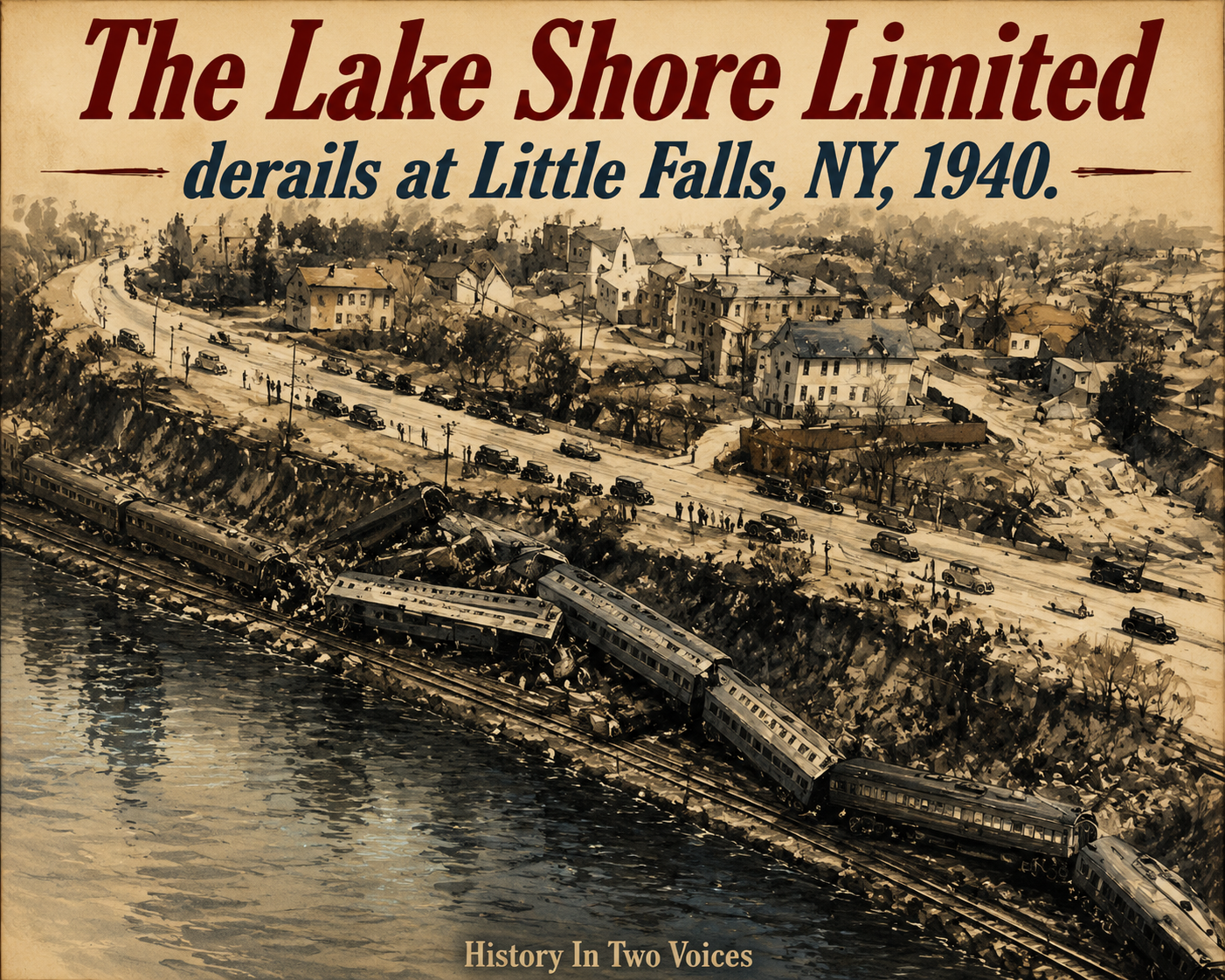
Most of the approximately 300 passengers were asleep when nine of the 16 cars of the New York Central train left the tracks, becoming what news reports described as a “mass of twisted steel” along a half-mile stretch beside an east-west highway and the Albany-Buffalo barge canal.
Reports at the time said there had not been a train disaster of this kind in thirteen years. Investigators noted that the train had been traveling 59 miles per hour on a curve where regulations limited speed to 45 miles per hour. The engineer and fireman were both killed in the crash, and twenty-five people lost their lives that night.
Conditions After the Crash
The night was bitterly cold. Many survivors huddled together under blankets taken from the Pullman berths as they waited for help. One passenger, Hyman Blitz, 48, of Toledo, Ohio, told reporters that he “was in bed when all of a sudden we heard a tremendous crash” before his car toppled over. He later helped a friend who had been badly injured in the wreckage.
J. A. Taylor’s Rescue Effort
According to the Daily Worker of Chicago, Illinois, on April 24, 1940, one of the survivors was 44-year-old train porter J. A. Taylor. A husband and father of two, Taylor had worked as a porter since 1921.
Taylor was dozing when the derailment threw him from his berth. “It was like a tremendous crack of thunder,” he recalled. Once the car came to a stop, he grabbed his shoes and “groped his way through the blocked aisle to the rear door of the Pullman.”
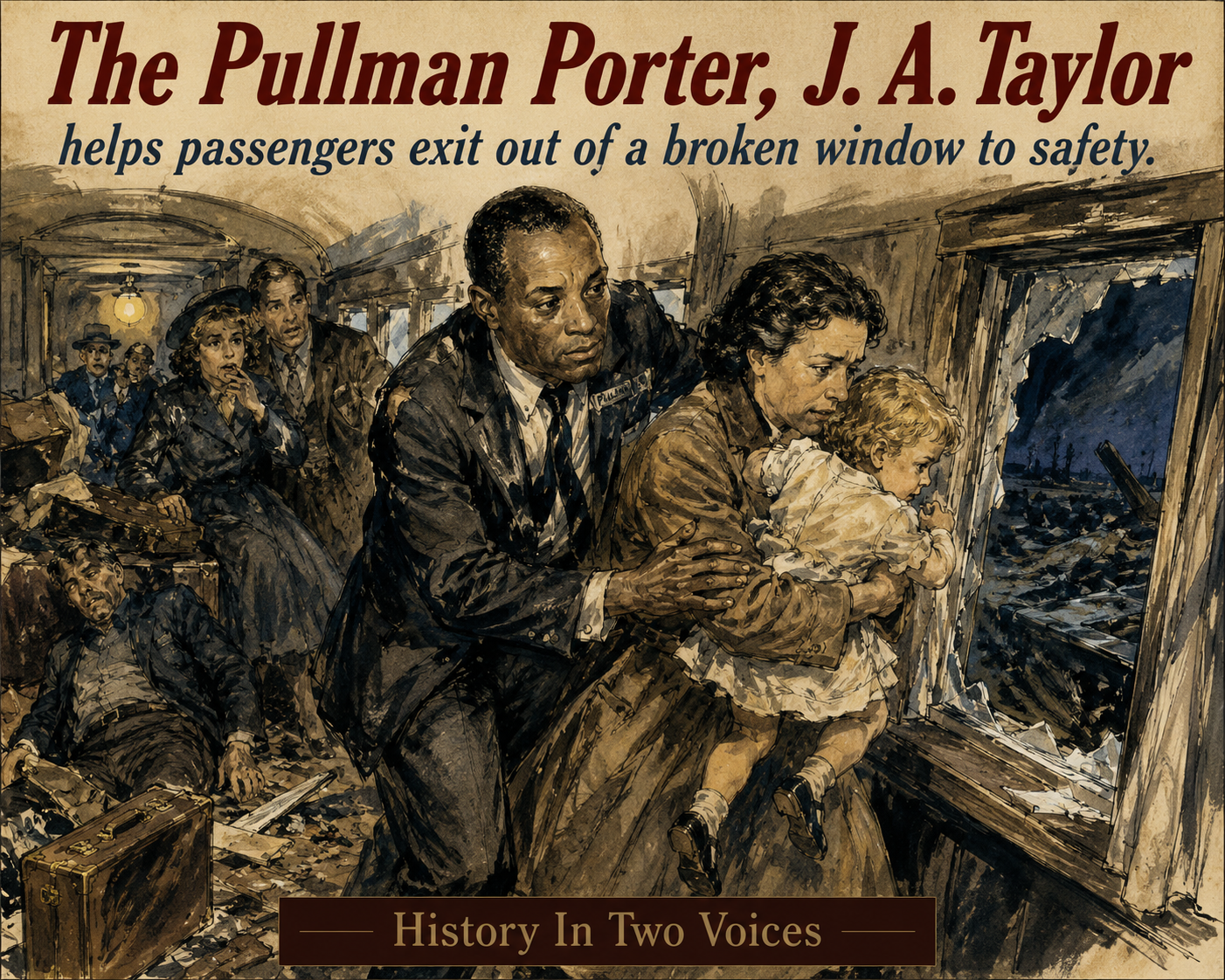
When he found the exit blocked, Taylor smashed a window and lowered every passenger in his car to safety—thirteen adults and three children. He then returned to retrieve luggage and even brought out bedding and blankets for the children.
Reflecting afterward, Taylor said, “You don’t think about anything at a time like that; you just do what has to be done. You think of yourself last.” His actions were credited with saving sixteen passengers.
Why It Matters
The Little Falls train catastrophe of 1940 was one of the deadliest rail disasters in New York State during the golden age of American rail travel. The wreck shocked the nation, not only because of the loss of life, but because so many passengers had gone to sleep expecting an ordinary overnight journey aboard one of the country’s premier trains.
Amid the twisted steel, freezing temperatures, and confusion of the crash, acts of courage emerged. Pullman porter J. A. Taylor repeatedly placed the safety of others before his own, guiding frightened passengers through a shattered window to safety before returning into the wreckage for blankets and belongings. His calm determination helped save sixteen lives.
Taylor’s story also highlights the often-overlooked role of Pullman porters in American history. Pullman porters were expected to provide service, comfort, and professionalism under demanding conditions, yet their contributions were frequently underappreciated in their own time. During one of the worst rail disasters of the era, Taylor became far more than a porter—he became a lifeline for passengers trapped in darkness and fear.
Stories like this remind us that history is not only shaped by presidents and generals, but also by ordinary individuals who acted with extraordinary courage when others needed them most.
Sources
“Train Wreck Dead to 25”, Kansas City Star, Kansas City, MO, April 20, 1940.
“Train Porter Saves 16 in Wreck,” Daily Worker (Chicago, Illinois), April 24, 1940.
Image Citations
Slide 1 – The Lake Shore Limited travels through the Mohawk Valley, April 20, 1940
Inspired by advertisement imagery published in the Omaha World-Herald (Omaha, Nebraska), April 24, 1936.
Slide 2 – Passengers enjoyed air-conditioning and fine dining
Inspired by illustration published in the Daily News (New York City, New York), May 29, 1935.
Slide 3 – The Pullman Porter, J. A. Taylor helps passengers exit out of a broken window to safety
Inspired by photograph published in the Afro-American (Baltimore, Maryland), April 27, 1940.
Slide 4 – The Lake Shore Limited derails at Little Falls, NY, 1940
Inspired by aerial wreck photograph published in the Kansas City Star (Kansas City, Missouri), April 20, 1940.
Slide 5 – Location of the 1940 Lake Shore Limited Train Catastrophe
Inspired by map published in the Kansas City Star (Kansas City, Missouri), April 20, 1940.
Slide 6 – The Aftermath at Little Falls, NY
Composite historical illustration inspired by contemporary newspaper coverage and photographs of the Little Falls train disaster published in April 1940 newspapers.
Leahy, Sharon. Image concepts and direction. AI-assisted illustrations generated using digital tools, 2026.