Louisa Catherine Adams's Incredible 2,000-Mile Journey to Paris

A Journey That Defied Modern Comprehension
Her feat still defies modern comprehension.
Despite modestly claiming that the undertakings which appear very difficult and arduous to women in general, “are by no means so trying as imagination forever depicts them,” Louisa Catherine Adams needed every bit of fortitude and every ounce of courage she could muster for her long journey from St. Petersburg, Russia to Paris, France during the winter of 1815.

A New Diplomatic Life in Russia
President James Madison had appointed Louisa’s husband, John Quincy Adams, U.S. Minister to Russia on July 4, 1809. Disappointed by his political career up to this point, and welcoming the post abroad, the future president arranged for the couple’s two older boys, George, eight, and John, six, to stay with relatives, with his mother, Abigail, overseeing their care.
The youngest child, Charles Francis, almost two, would travel abroad with his parents. Louisa had no choice in the matter.
After an eighty-day ocean voyage, the Adamses arrived at Kronstadt, the nearest port to St. Petersburg, on October 22. Taking temporary lodgings, they awoke the next morning to news that the ship they had crossed the Atlantic on had drifted out to sea overnight, with all the family’s belongings on board—a most inauspicious beginning to their time in Russia.
The Challenges of a Minister’s Wife
Louisa would endure numerous challenges as the U.S. Minister’s wife. As historian Margery M. Heffron notes, however, the future first lady “demonstrated a resilience and mental toughness she didn’t know she had.”
Separated from her children, forced to adhere to a stifling diplomatic protocol, enduring often brutally cold weather, and constantly subjected to the mood swings of her husband, Louisa made the best of a difficult situation.
The Loss That Never Left Her
Emotionally, the most difficult challenge of all was the death of her daughter. Little Louisa Catherine, born on August 12, 1811, died shortly after her first birthday. Louisa was bereft and never really recovered from the tragedy.
Eventually, she would be forced to leave her daughter’s gravesite behind forever.
A Husband’s Assignment and an Impossible Journey
President Madison ordered John Quincy Adams to Ghent, Belgium, to negotiate an end to the War of 1812. Adams departed St. Petersburg on April 28, 1814, leaving Louisa and Charles behind.
By Christmas 1814, Adams could report that the representatives of the American and British governments had reached agreement on a treaty ending the war. At the same time, Adams informed Louisa that he would not be returning to Russia.
Instead, he wanted her to bring seven-year-old Charles and meet him in Paris.

Crossing Europe in Winter
She would be forced to travel nearly 2,000 miles in midwinter aboard a berline (four-wheel) carriage pulled by six horses that brought her through a countryside devastated by the armies of the Napoleonic Wars.
Accompanied by her young son, she left St. Petersburg at 5:00 PM on February 12, 1815, and arrived in Paris on March 23.
Courage on the Road
Along the way, she encountered people willing to help. Armed only with a letter from the Russian Minister of the Interior that ensured priority treatment—including, when necessary, fresh horses and private rooms in which to stay overnight—she nevertheless faced harrowing circumstances.
A drunken mob surrounded the coach. Blinding snow hampered travel. The landscape remained scarred by years of war.
Yet Louisa continued. Fortified by character and determination, she made it to Paris.

The Strength She Discovered
In her narrative account of the journey, Louisa maintained that “I was carried through my trials by the mercy of a protecting Providence; and by the conviction that weakness of either body, or mind, would only render my difficulties greater and make matters worse.”
The lesson she gleaned was simple: if woman practices “persevering discretion, they may from their very weakness be secured from danger, and find friends and protectors: and that under all circumstances, we must never desert ourselves.”
A Triumph of Independence
The successful completion of her journey no doubt owed something to the absence of her husband. She made all the decisions—without the second-guessing she had grown accustomed to throughout her marriage.
For his part, John Quincy Adams never doubted that his wife would arrive in Paris unscathed. Whether through blind faith or a startling indifference to what she would have to endure, he confided to his diary that the months he spent in Paris awaiting Louisa and Charles were “in many respects the most agreeable interlude of my life.”
Always his wife’s harshest critic, he revealed more than even he probably realized when he failed to mention their safe arrival in his diary.
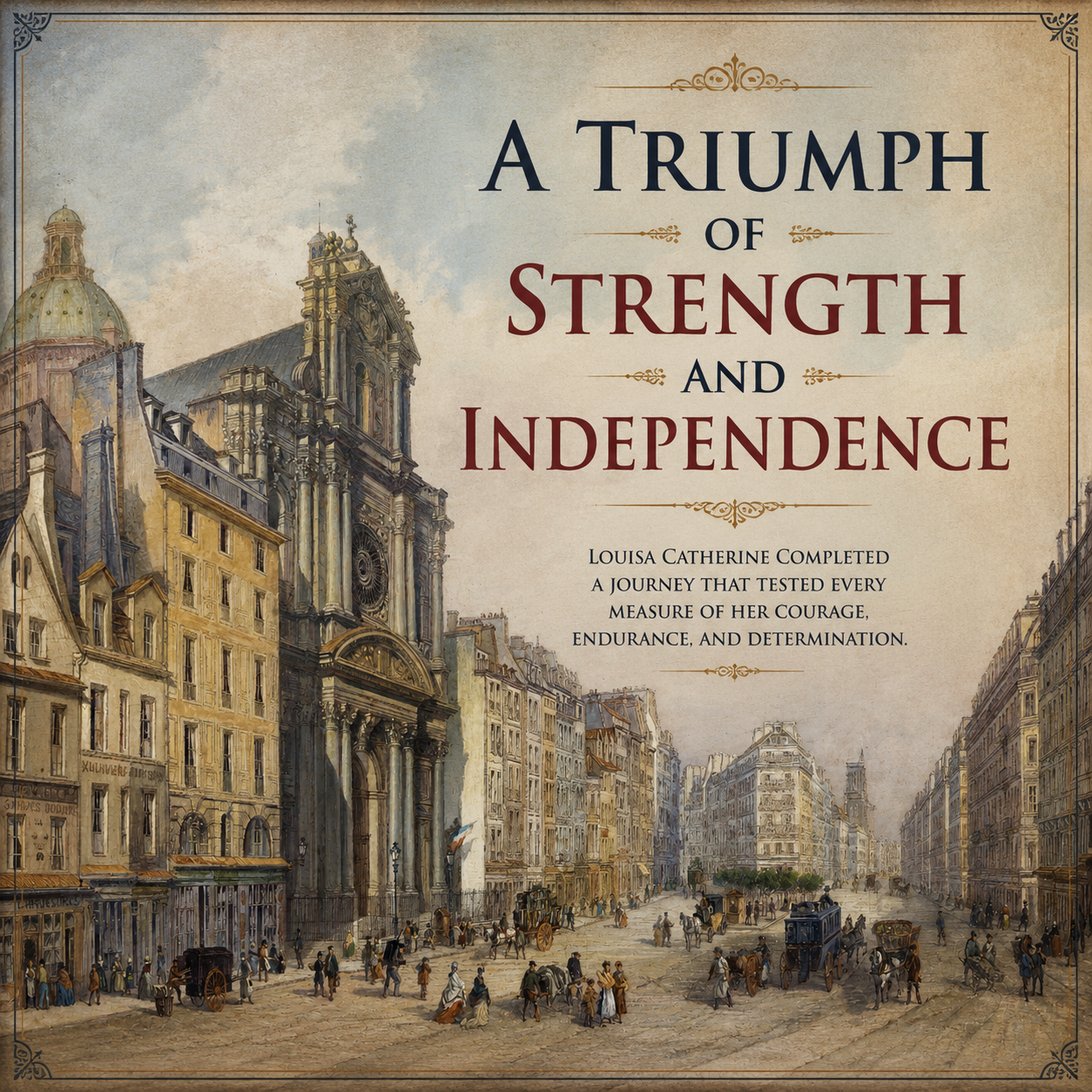
Louisa, however, understood her accomplishment and was proud of it. She had completed a journey that tested every measure of her courage, endurance, and determination.
Her winter journey from St. Petersburg to Paris remains one of the most extraordinary journeys undertaken by a First Lady before she ever entered the White House.
Source
Margery M. Heffron, Louisa Catherine: The Other Mrs. Adams (New Haven: Yale University Press, 2014).
Image Credits
Slide 1 — Louisa Catherine Adams portrait, Image: Portrait of Louisa Catherine Adams; Slide 2 — Louisa Catherine Adams silhouette, Image: Silhouette portrait of Louisa Catherine Adams, 1809; Slide 3 — Winter harbor scene / Russia, Image: [Winter scene/harbor painting]; All Wikimedia Commons. Slide 4 — Journey Route map
Created by History in Two Voices using historical geographic references based on Louisa Catherine Adams’s 1815 journey as described in Margery M. Heffron, Louisa Catherine: The Other Mrs. Adams (Yale University Press, 2014). Slide 5 — Paris arrival scene, Image: Paris street scene; Slide 6 — Final portrait with harp
Image: Portrait of Louisa Catherine Adams with harp, both from Source: Wikimedia Commons