The “Holy Alliance” vs the New York Herald, 1840
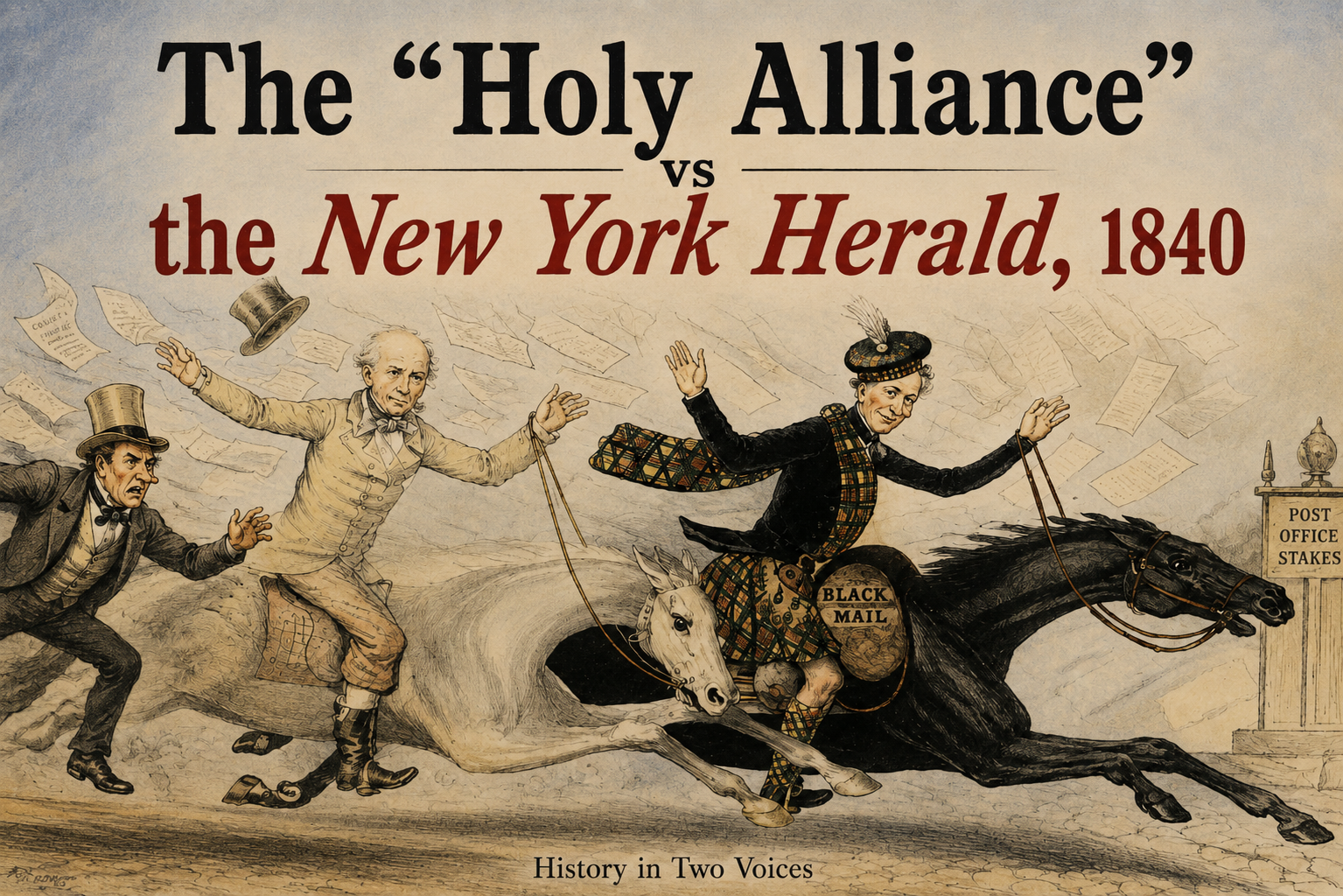
The Initial Controversy
On January 9, 1840, the Buffalo Daily Republican expressed surprise that the three major Wall Street papers—the Courier and Enquirer, the Star, and the Express—had united against the relatively new New York Herald. It treated the dispute as proof of the Herald’s disruptive influence, asking whether “so small an insect” could unsettle such established papers.
At the same time, the Republican did not excuse James Gordon Bennett. It acknowledged that he had “certainly been guilty of introducing immoral allusions in his editorials,” conduct it said deserved public condemnation.
Bennett’s Counterattack
Bennett’s response helps explain both his notoriety and his appeal. Instead of defending himself, he mocked his critics with theatrical humor. In the New York Daily Herald on June 2, 1840, he called the campaign against him “the very amusing and interesting grand war of the Holy Allies of the Wall Street press against the atrocious Herald and the infamous Bennett.” He said his rivals had proposed “suits, assaults, murder—everything,” but were for now confined to “lies, falsehood, folly, passion, stupidity, and bad grammar.” His punchline—“As yet they only murder English”—made the exchange a display of wit.
The Evening Star’s Critique
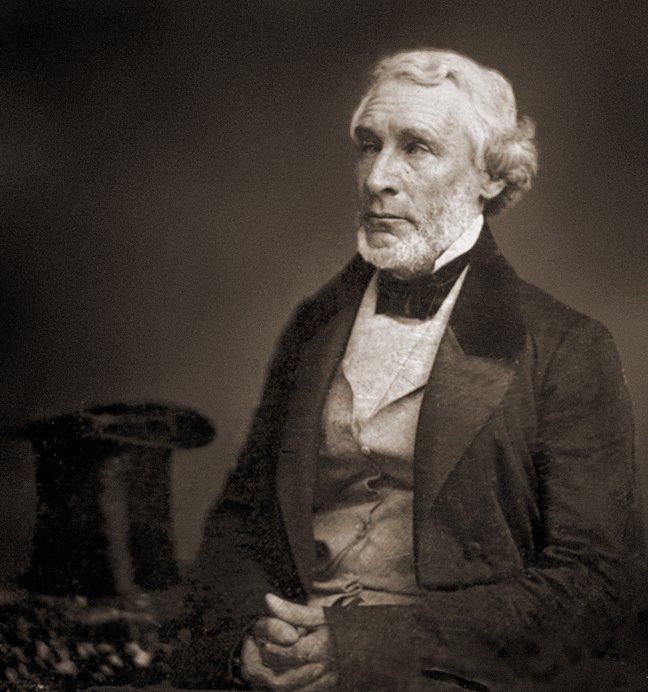
On June 19, 1840, the New York Evening Star offered a sharply different view. It argued that Bennett exploited his own community and deflected criticism by accusing rival editors of envying his success and genius. The Star rejected that defense, insisting that newspapers were a “mighty engine for good or for evil” meant to uphold liberty, law, morality, and justice.
From that perspective, Bennett represented a corruption of journalism. The Star likened him to a highwayman demanding “your money or your life,” accusing him of character assassination, shielding vice, and profiting from scandal. In its view, his paper was indecent and immoral, and respectable editors had a duty to protect the public—especially women and children—from his influence.
The Charge of Blackmail and Sensationalism
The Star also claimed that Bennett, a Scottish immigrant who had raised enough money to found his own paper, had created what Londoners called a “flash journal.” Such a paper, it argued, thrived on ridicule, irreverence, scandal, and attacks on decency and religion. Bennett supposedly sent reporters in search of gossip and private misfortune, producing a paper for readers drawn to sensation and exposure.
The charge went beyond sensationalism to near extortion. The Star alleged that Bennett collected information about respectable families through servants and other informal sources, then used private troubles for profit. Families fearing exposure in the Herald might pay for silence, while social hosts might do the same to secure favorable—or at least harmless—coverage.
The Star called this hush money, or “Black Mail,” Bennett’s “great and despicable source of revenue.”
Our Perspective
The conflict between James Gordon Bennett’s New York Herald and New York’s established papers marked a turning point in American journalism. By 1840, editors were becoming not just political commentators and commercial reporters, but also celebrities, cultural combatants, and shapers of mass opinion.
To Bennett’s critics, the Herald embodied the dangerous commercialization of the press. They accused him of profiting from scandal, undermining morality, and turning private suffering into public entertainment. They feared sensational journalism would erode the dignity and civic purpose newspapers were meant to uphold.
Yet the Herald’s esuccess also showed that readers increasingly wanted immediacy, personality, humor, gossip, and confrontation. Bennett’s style helped turn newspapers from elite political organs into mass-market products for broad urban audiences. The attacks on him only underscored how much journalism was changing.
The controversy also highlights the intensely personal nature of nineteenth-century newspaper culture. Editors insulted one another openly, accused rivals of corruption, and carried on public feuds that readers followed almost as entertainment. In that environment, the press became part of the story itself.
The conflict mattered beyond journalism. The sensational press culture that elevated Bennett soon shaped public views of politicians, reformers, entertainers, and prominent women, including Julia Gardiner Tyler. Long before radio, film, or social media, newspapers were already laying the foundations of modern celebrity culture and public spectacle.
—-The sensational press culture that exploded in the 1840s would soon help shape the public image of First Lady Julia Gardiner Tyler herself. To learn more about Julia’s world of politics, publicity, and celebrity, pre-order Presidentess: The Life of First Lady Julia Gardiner Tyler today:
Sources
“Another Newspaper Alliance,” Buffalo Daily Republican, January 9, 1840.
“The Holy Alliance of the Wall Street Press,” New York Daily Herald, June 2, 1840.
“The Herald and Bennett,” New York Evening Star, June 19, 1840.
Crouthamel, James L. Bennett’s New York Herald and the Rise of the Popular Press. Syracuse: Syracuse University Press, 1989.
Huntzicker, William E. The Popular Press, 1833–1865. Westport, CT: Greenwood Press, 1999.
Mott, Frank Luther. American Journalism: A History of Newspapers in the United States Through 250 Years, 1690–1940. New York: Macmillan, 1941.
Images
Leahy, Sharon. Image concept and direction inspired by Edward Williams Clay’s Race between Bennett and Greely for the Post Office Stakes (1843). AI-assisted illustration generated using digital tools, 2026. James Gordon Bennett, Sr.; Wikimedia Commons open source.