Was This Newark, New York’s First Automobile? The Alexander Winton Mystery of 1899
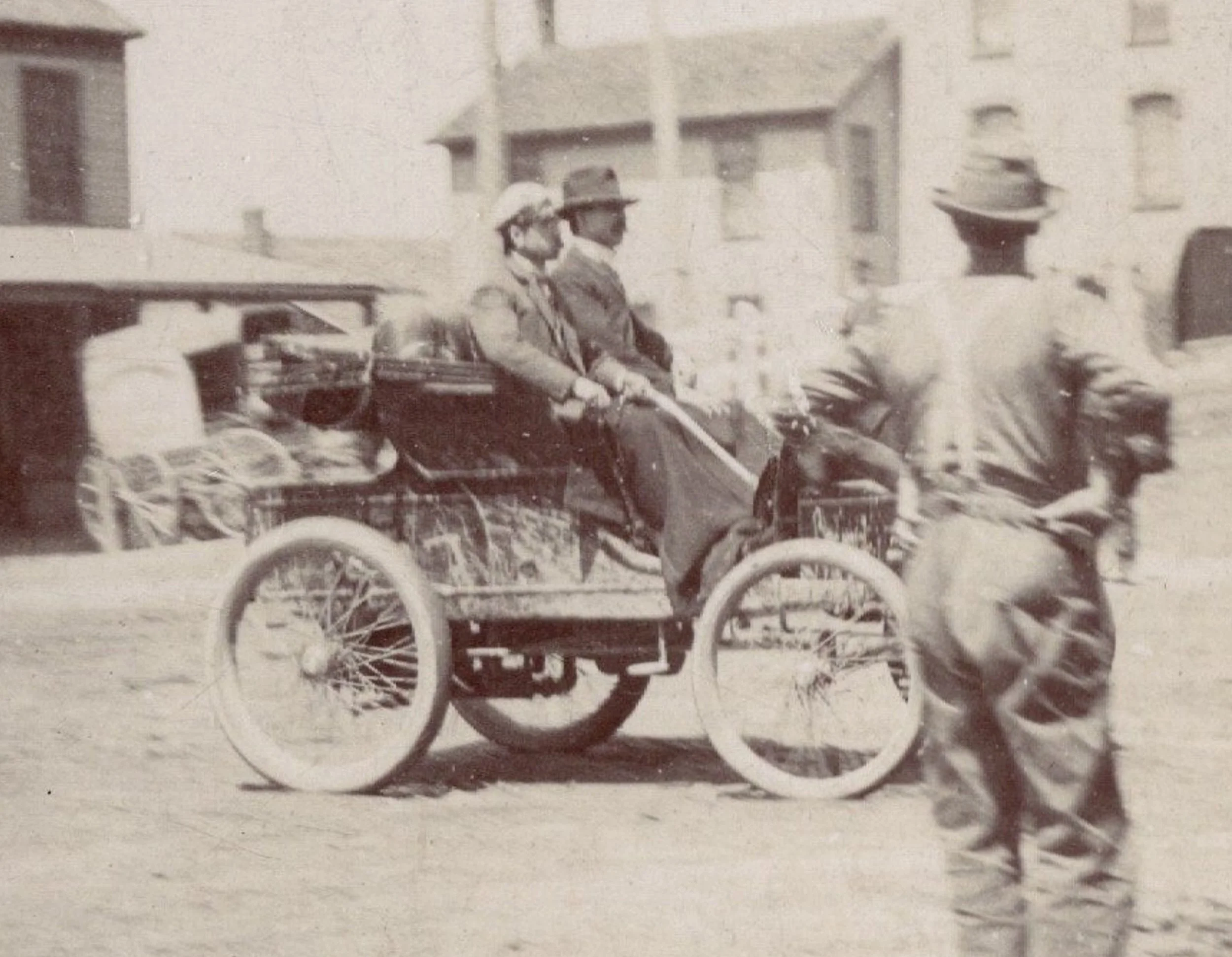
“First Horseless Carriage to Pass Through Newark,” Newark, New York, date unknown. Could this be the Winton automobile driven through Newark by Alexander Winton during his 1899 Cleveland-to-New York City journey? Photograph courtesy of the Newark-Arcadia Historical Society.
Imagine standing along a village street in Newark, New York, in the Finger Lakes region, in May 1899.
You hear something approaching, but not the familiar sound of horses and wagon wheels. Instead, there is the unfamiliar chug and rattle of a gasoline engine. Coming down the road is a strange open carriage perched on four spindly wheels. There are no horses.
For many of the people watching it pass, this may have been one of the first automobiles they had ever seen. More than a century later, a photograph preserved by the Newark-Arcadia Historical Society in Newark, New York, bears an intriguing description:
“First Horseless Carriage to Pass Through Newark.”
But who was driving it? A little historical detective work raises a tantalizing possibility.
Could the automobile in that photograph have belonged to Alexander Winton, one of America’s earliest automobile manufacturers, as he made a celebrated journey from Cleveland to New York City in May 1899?
Selling the Horseless Carriage
Alexander Winton was already convinced that the automobile represented the future. The harder task was convincing everybody else.
Born in Scotland in 1860, Winton immigrated to the United States and eventually settled in Cleveland, where he moved from manufacturing bicycles to experimenting with gasoline-powered automobiles. In 1897, he established the Winton Motor Carriage Company.
At the time, an automobile was still an exotic, and frequently unreliable, piece of machinery. There were few suitable roads, no network of filling stations and certainly no roadside assistance waiting for a stranded motorist.
If Winton wanted Americans to buy automobiles, he needed to demonstrate that they could do something more impressive than circle a city street. The machine had to go somewhere. Winton had already driven from Cleveland to New York in 1897, but in 1899 he decided to do it again—and this time make sure America noticed.
On May 22, 1899, Winton left Cleveland in one of his automobiles accompanied by Charles B. Shanks, a reporter for the Cleveland Plain Dealer. The newspaper sponsored the journey, and Shanks sent reports from the road that helped turn the trip into a rolling publicity campaign.
The two men also carried a letter from Cleveland mayor John H. Farley to New York City mayor Robert Van Wyck. The letter described the venture as the first long-distance automobile trip of its kind on the continent. Cleveland and New York had already been connected by water and railroad.
Now Winton intended to connect them by his “horseless carriage.”
Cleveland to Buffalo—in a Day
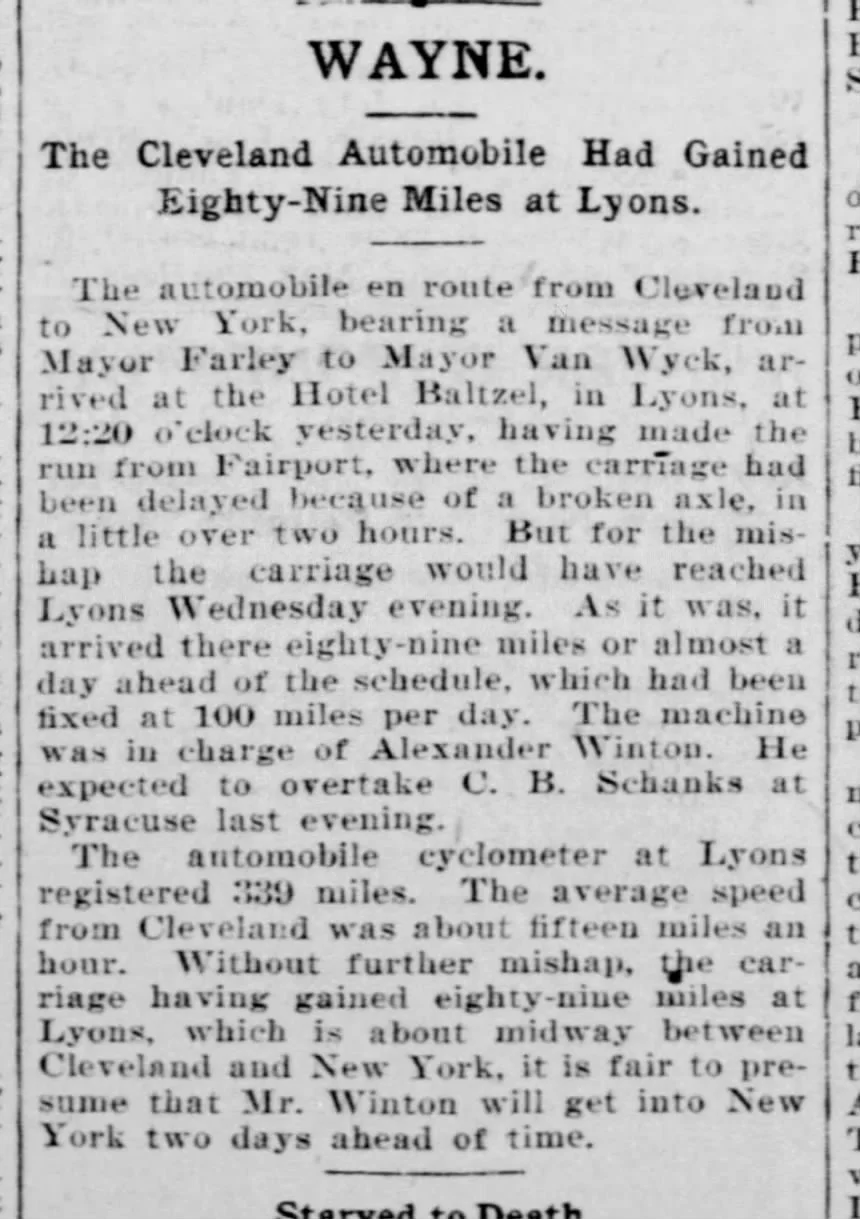
Democrat & Chronicle, Rochester, NY., May 25, 1899
Winton left Cleveland on the morning of May 22. By 9:15 that evening, the automobile had reached Buffalo, NY. That accomplishment is easier to appreciate if we forget everything we know about modern road travel.
Roads varied enormously in quality, and many were designed for horses, wagons and carriages rather than motor vehicles. Mud, ruts, stones and steep grades could turn an automobile journey into an endurance test for both machine and driver. Yet Winton continued east across New York State.
When he reached Rochester, his automobile was enough of a novelty to draw spectators. Winton stopped at the Powers Hotel, where people gathered to inspect the unusual machine. The automobile also presented a distinctly nineteenth-century traffic problem: horses could be terrified by it.
A horse-drawn carriage reportedly traveled ahead of Winton as he left Rochester, NY, helping clear the way and warning other drivers of the strange machine approaching behind them.
Then Winton headed east toward Fairport, NY. And that’s where things went badly.
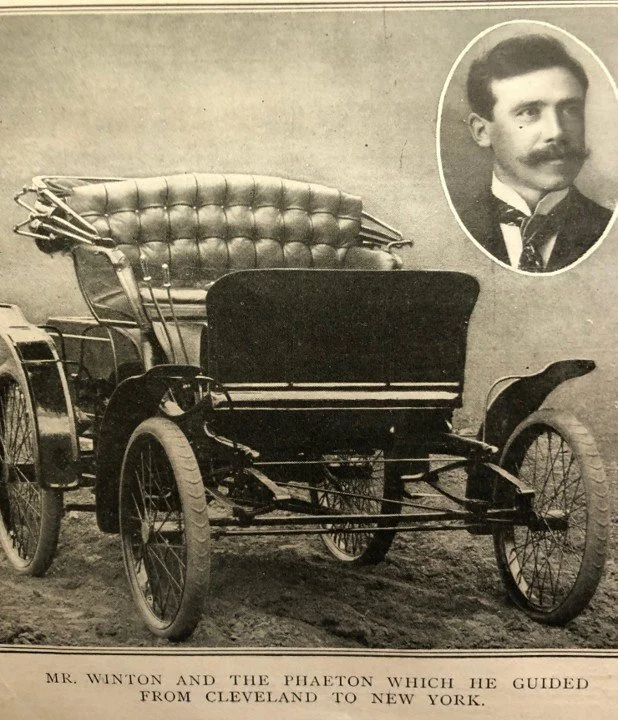
Alexander Winton and “the phaeton which he guided from Cleveland to New York.” Harper’s Weekly, vol. 43, p. 730.
A Crash Near Fairport
Near Fairport, Winton’s automobile suffered a broken axle. Accounts of the journey describe the machine leaving the road and Winton being thrown from it. Fortunately, he escaped serious injury. The automobile was another matter.
In 1899, there was no automobile repair shop conveniently waiting nearby with the correct Winton replacement part. A new axle had to be obtained from Cleveland before the journey could continue. The delay appears in contemporary newspaper coverage. The Rochester Democrat & Chronicle reported that the automobile had arrived at Lyons after coming from Fairport, “where the carriage had been delayed because of a broken axle.”
Once repaired, Winton resumed his journey east. And directly along the route from Fairport to Lyons was Newark, New York.
Winton Comes Through Newark, New York
According to the Democrat & Chronicle, Winton reached Lyons at 12:20 p.m. after leaving Fairport. To get there, his automobile passed through Newark, NY.
The newspaper reported that by the time Winton reached Lyons, NY, his automobile had gained eighty-nine miles (or nearly a full day) on the schedule originally established for the trip.
This is where the documented journey intersects with a fascinating piece of Newark history. The Newark-Arcadia Historical Society preserves an old photograph showing an extremely early automobile on a village street. Its identification describes the vehicle as the:
“First Horseless Carriage to Pass Through Newark.”
At first glance, it is simply a wonderful artifact of local history. But compare it with surviving photographs of Alexander Winton’s automobile. The resemblance is striking.
Both vehicles have large bicycle-style wire wheels, a high carriage body, an open seating arrangement and a similar exposed chassis and overall profile. A surviving photograph of Winton with reporter Charles B. Shanks shows a machine remarkably similar to the automobile photographed in Newark. That does not prove the Newark photograph shows Alexander Winton or his automobile.
Early automobiles borrowed heavily from carriage and bicycle construction, and visual similarity alone is not sufficient to establish an identification. But the circumstantial evidence is intriguing:
Alexander Winton made a highly publicized automobile journey from Cleveland to New York City in May 1899.
He traveled east from Rochester through Fairport.
He experienced a broken axle delayed him near Fairport.
Contemporary newspaper coverage next places him in Lyons.
And geographically, Newark, New York lies directly between Fairport and Lyons along his eastward route.
Meanwhile, Newark’s historical collection contains a photograph identified as the first horseless carriage to pass through the village. Could these two pieces of history describe the same event?
For now, the answer has to remain: Possibly. But it is a possibility worth investigating.
On to New York City
Winton continued east across New York State and eventually reached New York City on May 26. The journey covered approximately 707 miles. More important than the mileage, however, was what the trip demonstrated. An automobile had traveled hundreds of miles between two major American cities. It had broken down, encountered terrible roads, frightened horses, required repairs. And it had still made it.
For Winton, that was precisely the point. The journey was not simply an adventure. It was a demonstration of what the automobile might become—and a remarkably clever advertisement for the Winton Motor Carriage Company.
With a Plain Dealer reporter riding alongside him and newspaper reports following their progress, Winton was introducing Americans to a technology many had never seen in person. He was not merely selling an automobile. He was selling the idea that Americans might someday travel by automobile.
“What You Want Is Good Roads”
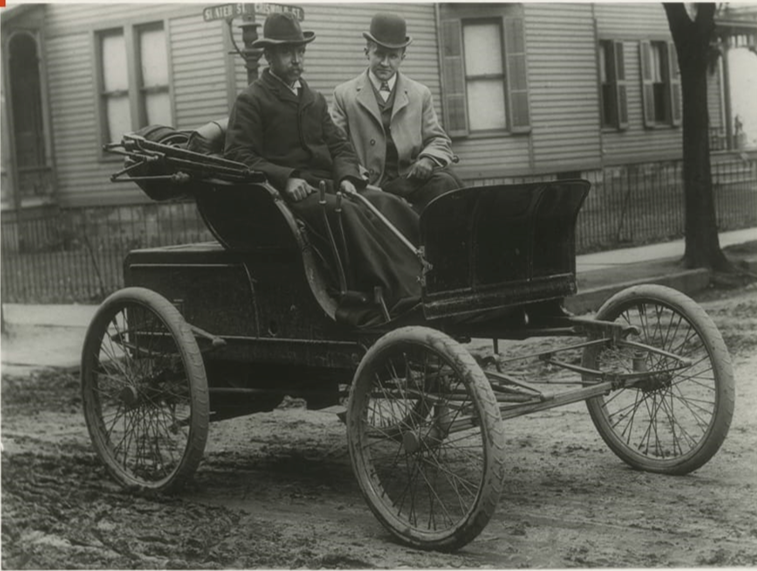
“Alexander Winton and Mr. Shanks in an 1898 Winton Roadster.” The Henry Ford's Henry Austin Clark Jr. Photograph Collection, object P.1774.X.152.
After crossing New York, Winton offered an observation that sounds remarkably modern. The roads between Cleveland and Buffalo, he said, had been fair. Some of the roads between Buffalo and Albany were considerably worse. His conclusion was wonderfully simple: “What you want is good roads.” America eventually agreed.
The automobile would transform where Americans lived, how they traveled, how cities developed and even how the country thought about distance. But automobiles alone could not create that transformation. They needed infrastructure.
Winton’s journey belonged to a moment when Americans were beginning to discover that the success of the automobile would depend not only upon inventors and manufacturers building better cars, but upon communities and governments building better roads.
Our Perspective
There is something wonderful about discovering a national story hiding inside a local photograph.
Alexander Winton’s 1899 journey was part publicity stunt, part endurance test and part demonstration of a technology that was about to reshape American life. But the people standing along the road in Newark, New York, could not have known what was coming. They simply watched a strange machine roll through their village. Perhaps someone grabbed a Kodak “Brownie” camera. Perhaps a small crowd gathered around it. And perhaps the resulting photograph survived for more than a century, eventually acquiring the simple description:
“First Horseless Carriage to Pass Through Newark.”
If the automobile in that photograph really was Alexander Winton’s, then the image captures more than a curious moment in Newark history. It captures the future driving through town. And even if we never prove the identification conclusively, the photograph reminds us why local archives matter.
Sometimes evidence of a much larger American story has been sitting in a box close to home all along.
Sources & Further Reading
Democrat & Chronicle (Rochester, New York), May 25, 1899. Contemporary account of Winton’s journey through Fairport and Lyons and the delay caused by the broken axle.
Newark-Arcadia Historical Society, Newark, New York. Photograph identified as “First Horseless Carriage to Pass Through Newark.”
Encyclopedia of Cleveland History, Case Western Reserve University, “Cleveland-New York Drive.” History of Alexander Winton’s 1897 and 1899 Cleveland-to-New York automobile journeys.
Rochester Historical Society, Rochester History, Vol. XII (1950). Account of Winton’s arrival in Rochester, his stop at the Powers Hotel and the challenges automobiles presented to horse-drawn traffic.
Town of Perinton Historian, “Horse versus Horseless Carriage on West Avenue.” Local history of Winton’s 1899 passage through Fairport and early automobile travel in Perinton.
Larz Anderson Auto Museum, 1899 Winton Phaeton. Historical and technical information on surviving early Winton automobiles.